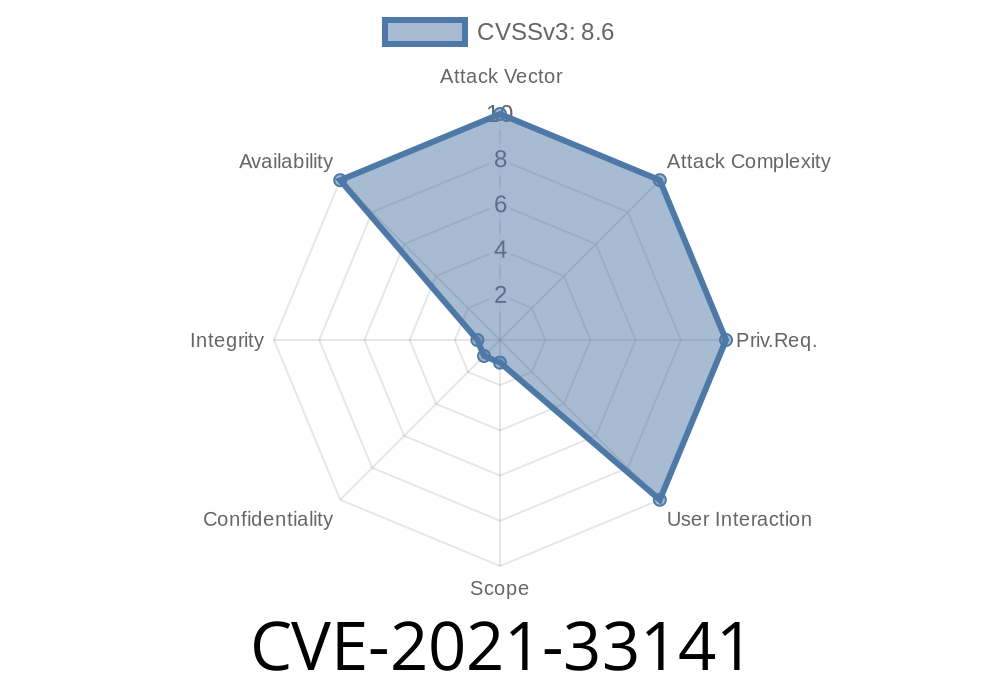
Intel products are widely used for networking infrastructure, supporting data centers, workstations, and enterprise environments. While these products are generally reliable, some vulnerabilities can have a significant impact. In this article, we will break down CVE-2021-33141—a security flaw affecting manageability firmware in some Intel(R) Ethernet Adapters and Intel(R) Ethernet Controller I225. We will explain this vulnerability in a simple way, provide code snippets, reference official sources, and show how an attacker might exploit this bug for denial of service (DoS).
What is CVE-2021-33141?
CVE-2021-33141 is a vulnerability caused by improper input validation in Intel Ethernet Adapter manageability firmware, including the firmware on the popular Intel Ethernet Controller I225. This flaw lets an unauthenticated network attacker potentially cause a denial of service (DoS) without needing valid credentials.
In everyday language: Some Intel-branded network adapters and controllers have management features. Unfortunately, they don’t check some network messages closely enough. This lets anyone on the network send special packets that can crash the management functions or make the whole adapter stop responding.
Intel(R) Ethernet Controller I225
> According to Intel’s advisory, the vulnerability could allow a remote attacker to disrupt network operations, affecting servers, endpoints, or IoT devices that rely on these chips.
Vulnerable Feature: Manageability Firmware
Many Intel network devices come with special firmware for manageability—think remote reboot, diagnostics, and inventory from across the network. This feature listens for certain types of commands sent over the network.
The vulnerability lies in improper input validation in this firmware: it does not correctly check or sanitize specific incoming network packets. If a malicious user crafts such a packet, it could cause the manageability stack to behave incorrectly, freeze, or crash.
How CVE-2021-33141 Can Be Exploited
Scenario:
A company’s server uses a vulnerable Intel Ethernet Adapter for remote management (the kind used for out-of-band admin access, like AMT or vPro). An attacker on the same network segment sends a specially formed network packet to the server’s management interface. Because of the flaw, the server’s network adapter gets overloaded or enters an error state, making it unresponsive to legit remote management commands.
Example Exploit
*Note: Details are simplified for educational purposes.*
Let’s consider a case where the vulnerable firmware expects management packets in a certain format and does not check field limits (like message length or data type).
A simple pseudo-code to craft such a disruptive packet (using Python and Scapy)
from scapy.all import *

# Target manageability IP address and port (replace as needed)
TARGET_IP = "192.168.1.100"
TARGET_PORT = 623  # Example port for RMCP/ASF management

# Build a malformed packet
# For example, a payload with invalid length or unexpected values
# (Actual values may depend on the protocol specifics, which Intel does not publically disclose)
malformed_payload = b"\x00" * 500  # Exaggerated length

packet = IP(dst=TARGET_IP)/UDP(dport=TARGET_PORT)/Raw(load=malformed_payload)

# Send the malformed packet
send(packet, count=3)
Sends an over-sized, junk-filled UDP packet to the management port on the target Intel adapter.
- The vulnerable firmware, unable to validate the packet properly, might crash or freeze, leading to a denial of service on management functions.
Mitigations:
- Update firmware to the latest available from Intel or your motherboard/OEM vendor.
Intel Recommendations
Intel’s Security Advisory (INTEL-SA-00459) urges all users of affected adapters to update to firmware versions at or after:
Ethernet Controller I225-LM: version 1.45 or later
- Other impacted products: Refer to Intel’s official list
Check the Intel download center or your system maker’s website for firmware files.
References
- Intel Security Advisory INTEL-SA-00459
- National Vulnerability Database - CVE-2021-33141
- Intel Firmware Downloads
- Scapy (Packet crafting tool)
Conclusion
CVE-2021-33141 shows how even “small” issues in firmware—like not checking incoming data correctly—can have big effects, such as denial of service in important networking hardware. If you manage servers or network devices with Intel adapters, check your firmware version and update if needed. Always keep management interfaces on private networks and use access controls.
Stay safe, patch often, and don’t let a single network message shut down your business!
Timeline
Published on: 02/23/2024 21:15:09 UTC
Last modified on: 05/16/2024 21:15:47 UTC