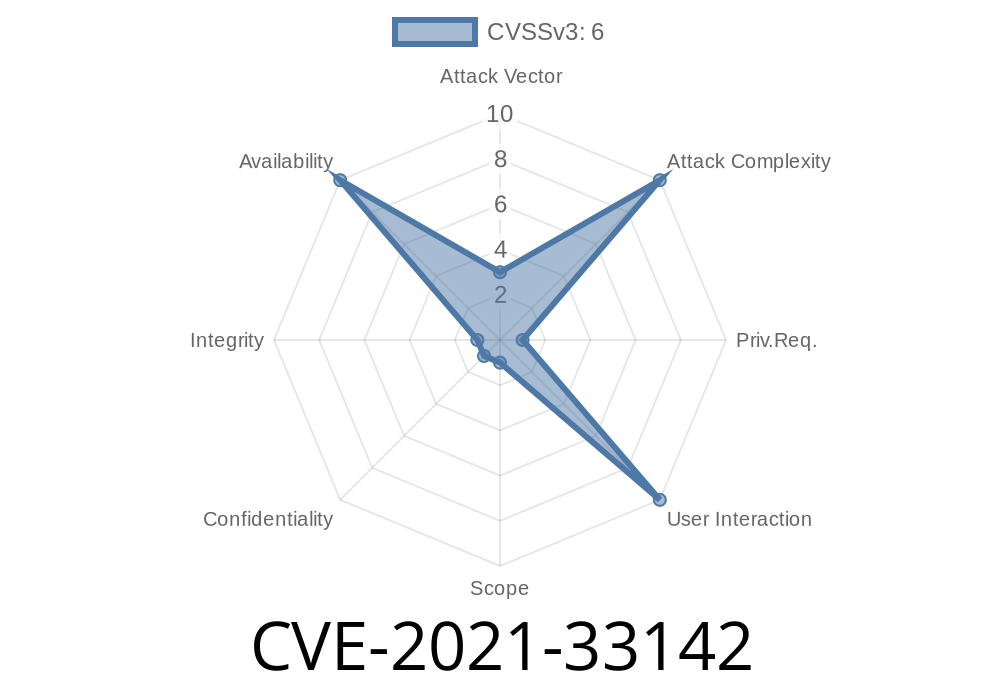
Intro
Security in network hardware is easy to overlook. Yet, every so often, vulnerabilities in firmware remind us how even trusted brands like Intel can have weak spots. In this post, we take a deep dive into CVE-2021-33142, an input validation vulnerability in some Intel® Ethernet Adapters and Intel® Ethernet Controller I225 Manageability firmware. We’ll break it down so anyone can understand, show you code snippets illustrating the risk, and point you to reliable references.
What Is CVE-2021-33142?
CVE-2021-33142 is an input validation vulnerability. That means the firmware didn’t properly check if input coming from a user (even a local, authenticated one) was safe. This particular vulnerability could let someone with elevated privileges cause a denial of service (DoS) locally—that means your system’s network functions might freeze or become useless until you reboot, all because of a maliciously crafted request sent to the Ethernet controller's manageability functions.
> In Simple Terms:
> If you have the right privileges and access, you could intentionally crash the system’s networking—potentially shutting down server communications or desktop internet access until someone restarts the machine.
Intel® Ethernet Controller I225 with manageability features enabled
If you’re running enterprise hardware, check if your model is listed in Intel’s official advisory.
How Does the Exploit Work?
Here’s the core issue: certain firmware routines for the affected manageability functions don’t check incoming data properly. If bad data is handed off, it can crash the firmware or hang it.
Send a specially crafted command or data buffer which triggers the faulty firmware code.
3. The firmware receives bad input and either crashes, hangs, or stops responding until rebooted—networking for that adapter is down.
While the original firmware code isn’t public, we can illustrate the syndrome with a safe, simplified C-style pseudocode snippet:
int handle_manageability_input(char *input, int len) {
    char buffer[64]; // fixed-size buffer in firmware

    // IMPROPER CHECK: len not validated!
    memcpy(buffer, input, len); // BAD: if len > 64, buffer overflow!

    // ...process input...
    return ;
}
In this pseudocode, there’s no proper check for input length, so bad or oversized data can overwrite memory, perhaps crashing the firmware.
Proof-of-Concept & Attack Steps
Because this vulnerability requires privileged access, a proof-of-concept will only work for users who already have SYSTEM or administrator privileges. Here’s an abstract example (don’t run with real interface IDs):
Demo Script (Python, pseudocode)
# Pseudocode, not actual exploit!
import os

def send_malicious_command(interface_id):
    # This would use OS and driver tools to send a bad command
    # Example with ethtool/netsh/IPMItool for actual hardware
    cmd = f"echo DEADBEEF > /dev/{interface_id}/manageability"
    os.system(cmd)

# Needs root/admin permissions!
if __name__ == "__main__":
    send_malicious_command('eth')
> *Note: Actual manageability access methods are hardware- and OS-specific. Only run test code in a safe lab environment.*
Mitigation and Patch
Intel’s fix: Update your adapter’s firmware!
Intel and many motherboard/system OEMs have released patched firmware that validates input correctly.
- Check for updates: Visit Intel’s firmware download center or your server/model vendor’s support page.
Consider limiting local admin access and monitoring suspicious activity.
Intel’s Security Advisory:
CVE-2021-33142 official page
This vulnerability *cannot* be exploited remotely—local admin or script access is required.
- The real risk is for datacenters and shared machines, where malicious users could intentionally knock a server/network offline.
More Reading
- Intel Security Advisory (INTEL-SA-00598)
- National Vulnerability Database: CVE-2021-33142
- Firmware Update Guide - Intel
Summary:
CVE-2021-33142 reminds us that sometimes it isn’t the software, but the firmware, that introduces network risk. If you’re running Intel network gear—especially in a datacenter or business—check your firmware releases, update quickly, and limit local privilege wherever you can.
Timeline
Published on: 02/23/2024 21:15:09 UTC
Last modified on: 05/16/2024 21:15:48 UTC