Intel hardware is the backbone of much of the Internet and many business networks. As such, when a flaw emerges in their network adapters—or even in the firmware underneath—it’s a big deal for both defenders and attackers. Today, we’ll take a deep dive into CVE-2021-33145: how uncaught exceptions in certain firmware versions could let a local, privileged user elevate their permissions even further.
Let’s break down exactly what this vulnerability is, which devices are affected, what a potential attack could look like, and how to respond.
What Is CVE-2021-33145?
In May 2021, Intel released Security Advisory INTEL-SA-00522 describing a newly discovered bug (CVE-2021-33145) in the manageability firmware used in some Intel(R) Ethernet Adapters and Intel(R) Ethernet Controller I225 chips. The advisory describes the issue as:
> "Uncaught exception in some Intel® Ethernet Adapters and Intel® Ethernet Controller I225 Manageability firmware may allow a privileged user to potentially enable escalation of privilege via local access."
Put simply: if an attacker already has privileged, local access on a system with one of these vulnerable adapters, they might get system-level privileges by triggering an error Intel’s firmware isn’t set up to catch safely.
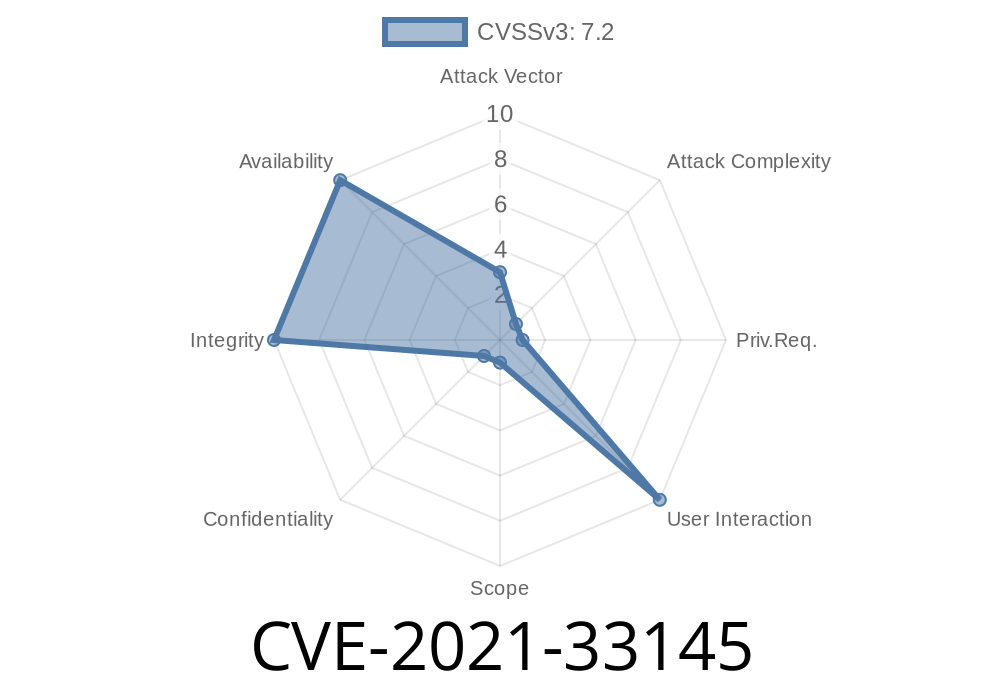
The Common Vulnerability Scoring System (CVSS) rates this vulnerability as CVSS 7.5 (High). In some environments, like shared servers, this goes from “high” to “critical.”
Certain Intel(R) Ethernet Adapters running vulnerable manageability firmware
Consult this Intel security advisory table for the full list of products and fixed firmware versions.
Check your adapter:
# Linux example to check your network chip
lspci | grep Ethernet
The Technical Details
The bug exists in the manageability firmware, a specialized low-level program that runs on the Ethernet adapter itself. Certain operations, if corrupted or interrupted in just the right way, throw an exception—or an error—that this firmware isn’t set up to handle properly. Instead of safely stopping or logging the event, the firmware does... basically nothing useful, which can leave the chip and the system in an unstable state.
A local attacker with elevated permissions (for example, a compromised administrator account, or malicious driver code) could exploit this poor error handling to run code as SYSTEM/root, bypassing normal operating system protections.
Attacker gains privileged access.
This could be via a phishing attack, malware, or exploiting another vulnerability to get admin or SYSTEM on a Windows or root/sudo on Linux.
Attacker loads a custom driver or tool.
They interact directly with the vulnerable Intel Ethernet adapter, performing an operation the firmware can’t handle—like sending a malformed packet or using a buggy manageability command.
Firmware throws an uncaught exception.
Instead of killing just the offending process, the buggy firmware leaves resources exposed, maybe allowing a corrupted pointer or a privileged context to “leak” to the attacker.
Attacker escapes into SYSTEM context.
Now, code can be executed at the highest privilege, potentially bypassing kernel or hypervisor boundaries.
Simple C pseudocode snippet (for illustration)
// A vulnerable call to the manageability firmware
int result = intel_eth_manage_cmd(user_supplied_data);

if (result != ) {
    // The function should log and safely handle the error, but doesn't
    // So attacker can trigger this path and gain control
}
In a real exploit: Attackers would use custom drivers or direct hardware access tools to manipulate the firmware, similar to PCILeech style techniques but aimed at manageability commands.
Exploit Tools and Public Code
As of writing, no easy “copy-paste” public exploit for CVE-2021-33145 exists, but the nature of the vulnerability means anyone with physical (or remote desktop) access and suitable privileges could craft a simple program to poke at the firmware.
For similar research, see
- PCILeech — Direct Memory Access Attack Toolkit
- Intel’s own driver documentation
Many exploit proofs-of-concept for device firmware vulnerabilities use C or C++ with direct Windows driver calls or Linux /dev/mem access.
How To Fix CVE-2021-33145
Update your firmware!
Intel has released new firmware versions that fix the buggy exception handling. Visit:
- Intel Ethernet Drivers and Software Download Center
Ensure the device manager (Windows) or lspci -v (Linux) shows the new firmware version
Mitigation:
If you cannot update immediately
- Restrict all shell/desktop access to local admins
- Limit PCI/driver install rights
Links & References
- Intel Security Advisory INTEL-SA-00522 (CVE-2021-33145)
- National Vulnerability Database entry
- Download updated Intel Ethernet firmware
- PCILeech — Direct Hardware Access
Conclusion: Why This Matters
CVE-2021-33145 is a great reminder that firmware and hardware security are just as important as your OS patches. As hardware gets more powerful and firmware gets more complex, uncaught exceptions (the old “oops, forgot to check for errors” bug) can create massive opportunities for attackers—especially if they’ve already got admin. If you run servers, desktop farms, or anything with Intel Ethernet controllers, update your firmware now and keep an eye on the next wave of hardware bugs.
*Stay safe, stay patched, and don’t ignore those driver updates—hardware bugs are real threats, too!*
Timeline
Published on: 02/23/2024 21:15:09 UTC
Last modified on: 05/16/2024 21:15:48 UTC