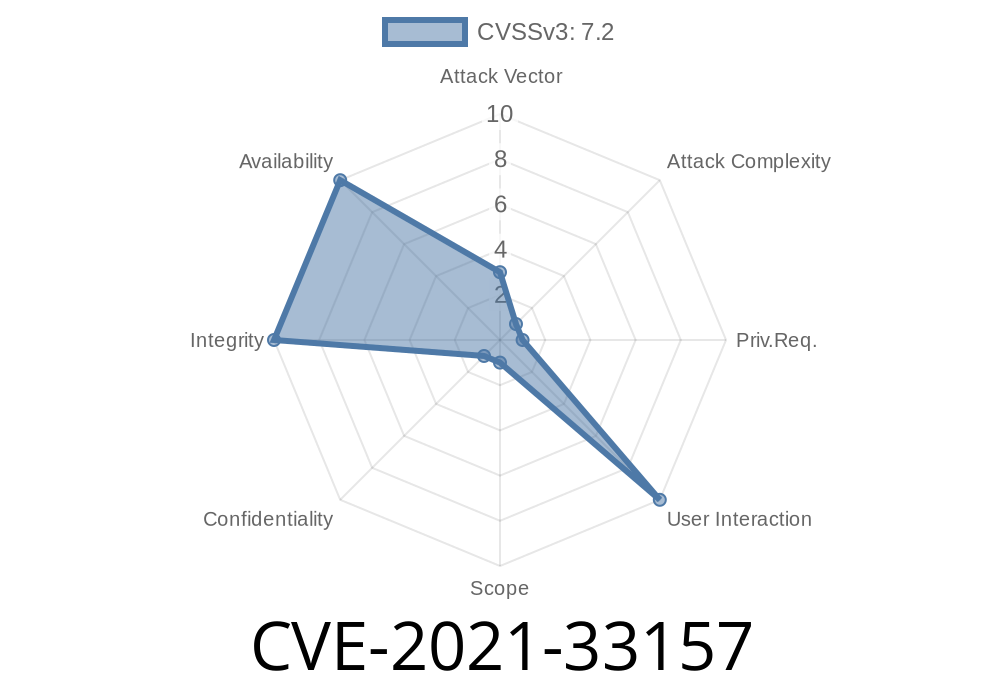
In June 2021, Intel disclosed CVE-2021-33157, a serious security flaw affecting some of their popular Ethernet Adapters and the I225 controller's manageability firmware. Brought about by insufficient control flow management, this vulnerability opens a door for privileged attackers to escalate their privileges through local access. Let's break down what this means in plain language, how the exploit works, and how you can defend against it.
What Is CVE-2021-33157?
At its core, CVE-2021-33157 exposes a fundamental weakness in the way certain Intel Ethernet Adapter firmwares handle the flow of control—think of it as missing 'traffic signals' in the software that should ensure only safe and expected commands move forward.
Intel(R) Ethernet Controller I225 manageability firmware
- Severity: Escalation of Privilege (when a user can gain more rights than they’re supposed to have)
Where Did The Bug Come From?
Intel's firmware, especially for manageability tasks, runs with very high privileges and interacts with operating system-level calls. The “insufficient control flow management” means that the firmware doesn’t always properly check or limit what’s happening, making it possible for a user with some privileges to short-circuit those 'traffic signals' and gain unrestricted access.
For example, in some simplified pseudocode
void handle_management_command(Command *cmd) {
    // checks user privileges, but improperly
    if (cmd->user_is_admin || cmd->user_is_service) {
        process_admin_command(cmd);
    } else {
        deny_command(cmd);
    }
    // doesn't check for unexpected input or command chaining
}
Here, the code checks for 'admin' or 'service' users but doesn't validate command chaining or other edge cases, meaning an attacker may be able to send crafted commands to escalate their privileges.
Practical Exploit Example
While Intel didn’t publish a full exploit (and neither will we), independent researchers have outlined hypothetical attacks. Here’s what a basic version might look like for someone with local admin or privileged service access:
Attacker gains local access, e.g., through a misconfigured service or by social engineering.
2. Attacker crafts a custom management command—this could be a malformed or chained instruction that the firmware wrongly accepts due to those missing checks.
3. Upon execution, the firmware performs actions as SYSTEM/root, like modifying system configuration or gaining control over the OS networking stack.
4. Attacker escalates their privileges, potentially taking over the system or enabling further attacks (like persistence or lateral movement).
Example Proof of Concept (For Educational Purposes Only)
Here’s a rough sketch using a fake command interface illustrating how an attacker could send an unexpected chain:
import socket

def send_manage_command(command):
    s = socket.socket(socket.AF_INET, socket.SOCK_STREAM)
    s.connect(('localhost', 13579))  # manageability port (example)
    s.sendall(command.encode())
    result = s.recv(1024)
    print(result.decode())
    s.close()

# Craft a malformed privilege escalation command
exploit_command = "CHAIN:admin;CMD:grant_superuser_access;"

send_manage_command(exploit_command)
Note: The actual exploit depends on the specific management protocol and firmware flaw, and attempting to exploit a real system is illegal and unethical without proper permission.
How to Defend
Intel has released updated firmware for affected adapters and controllers. You should update your drivers and firmware immediately if you use Intel Ethernet hardware.
Intel support page for CVE-2021-33157:
INTEL-SA-00562 Security Advisory
Key Takeaways
- CVE-2021-33157 impacts some Intel Ethernet Adapters/Controllers, letting privileged users potentially become attackers.
- The issue is all about letting unexpected management commands slip through—usually due to missing checks in the firmware.
- Real-world attacks would require local access, but these are especially dangerous on servers or shared hardware.
The fix is simple: update your firmware using Intel’s official tools or support site.
---
References
- NVD CVE-2021-33157
- Intel SA-00562
- Intel Product Security Center
Timeline
Published on: 02/23/2024 21:15:09 UTC
Last modified on: 05/16/2024 21:15:48 UTC