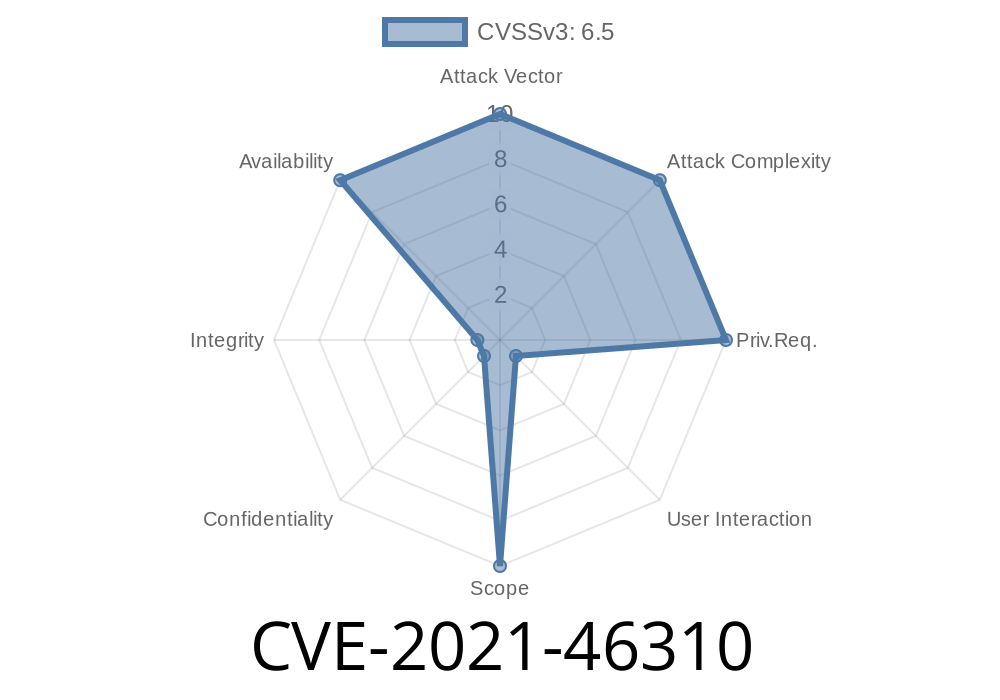
DjVuLibre is a popular open-source library and suite of tools used for handling DjVu documents—a digital document format often leveraged for scanned documents due to its efficient compression. In early 2022, a vulnerability surfaced in DjVuLibre version 3.5.28 that could let an attacker crash applications using this library by crafting a malicious file that triggers a divide-by-zero error in the IW44Image.cpp code. This security flaw is listed as CVE-2021-46310.
In this deep dive, you’ll learn how this bug works, how it can be exploited, and see code snippets demonstrating the issue so you can understand it even if you're not a security pro.
What Exactly is CVE-2021-46310?
This vulnerability is a Denial of Service (DoS) bug. By feeding a specially crafted DjVu file to an application that uses the DjVuLibre library, an attacker can make the program crash. The root cause is a division by zero in the file IW44Image.cpp. This occurs when the library parses image data and, due to lacking input checks, sometimes tries to divide by a value that ends up being zero—a classic crash scenario in C/C++ code.
Where Is the Bug?
The main problem lies in how the code processes certain image sizes and tile counts while parsing a DjVu file. Specifically, the code doesn’t verify that some image width or tile size variables aren’t zero before using them as divisors.
Here’s the vulnerable function excerpt from IW44Image.cpp (see lines around 220+):
int IW44Image::read_bg44(const GURL &url, IW44Image &image)
{
    ...
    int ntilecols = (width + tile_width - 1) / tile_width;
    int ntilerows = (height + tile_height - 1) / tile_height;
    ...
}
If tile_width or tile_height is zero—maybe because the file’s metadata is intentionally malformed—then the calculation results in a crash.
Create a Malicious DjVu File
- An attacker uses a hex editor, script, or custom tool to make a DjVu file with header values that set tile_width or tile_height to zero (or similar malformed data).
Send the File to the Target
- The malicious file is sent to a service, user, or automation that consumes DjVu files with DjVuLibre (e.g., document viewers, PDF exporters, or image converters). If the file is opened or processed, it triggers the bug.
Crash the Service or App
- DjVuLibre tries to parse the file, encounters a zero divisor, and crashes, causing a denial of service.
Proof-of-Concept Example
Here's a simplified C code snippet showing how an attacker can induce the crash by setting bad image parameters:
#include <stdio.h>
#include <stdlib.h>

int main() {
    int width = 100;
    int tile_width = ; // Crafted value from malicious DjVu file
    int ntilecols;

    // This division will cause a runtime error (divide by zero)
    ntilecols = (width + tile_width - 1) / tile_width;
    printf("ntilecols: %d\n", ntilecols);

    return ;
}
If you compile and run this, the program crashes with a "Floating point exception (core dumped)" error, just like what would happen in DjVuLibre’s IW44Image.cpp.
Real-World Impact
Although this vulnerability only lets attackers crash programs, not run arbitrary code, it's still dangerous for public services that automatically process DjVu files. Imagine a file-uploading web service, document converter, or indexing bot that uses DjVuLibre and could be knocked offline by a simple crafted file.
How to Fix It
The best defense is input sanitization—adding proper checks to make sure divisors aren’t zero. The DjVuLibre team eventually fixed the bug by verifying these variables before the division.
A patched version might add
if (tile_width ==  || tile_height == ) {
    // Handle error, reject file...
}
Upgrade: Update to the latest DjVuLibre release, available on SourceForge.
References
- CVE-2021-46310 at NVD
- Original bug report
- Full DjVuLibre source code
- Mitre CVE entry
Summary
CVE-2021-46310 is a reminder that even small oversights—like missing a zero check before dividing—can make systems vulnerable. If you use DjVuLibre, patch it promptly and audit any code that handles untrusted files for trivial logic bugs.
Timeline
Published on: 08/22/2023 19:16:00 UTC
Last modified on: 08/28/2023 17:46:00 UTC