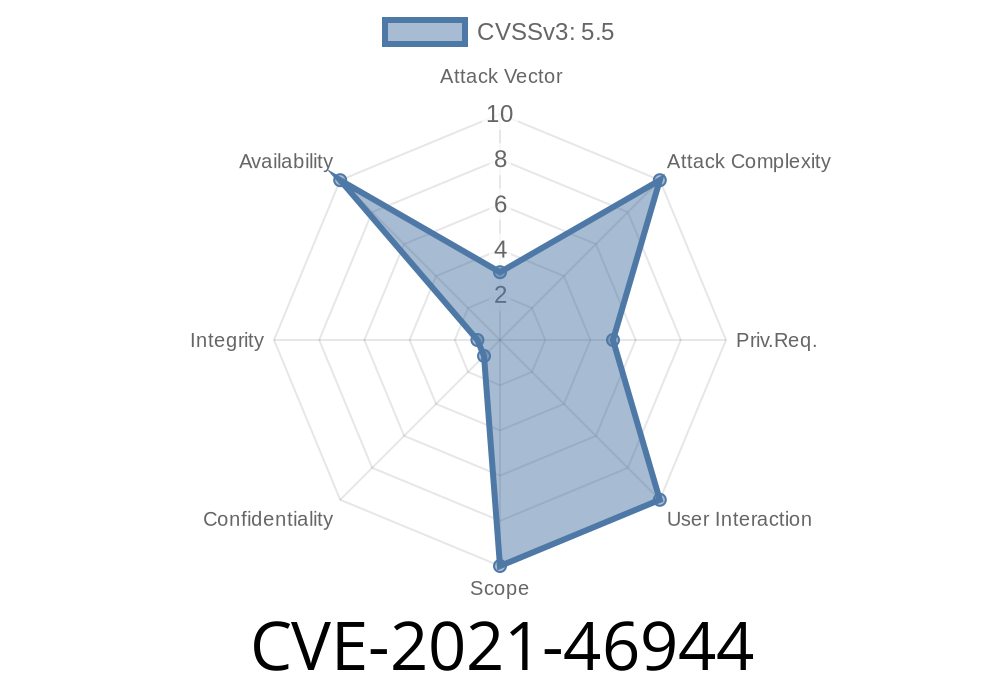
The Linux kernel powers billions of devices, and its reliability is crucial. Sometimes, even a small bug can expose systems to vulnerabilities. One such issue, identified as CVE-2021-46944, involved a memory leak in the Intel IPU3 media driver. This post will explain what happened, how it was fixed, and how you can review or patch your systems. If you’re a Linux or driver developer, or just curious about kernel security, read on.
What Was CVE-2021-46944?
CVE-2021-46944 was a vulnerability found in the intel-ipu3 driver, which is part of the Linux kernel under the "staging" media drivers. Specifically, a function handling image formats (imu_fmt) was leaking memory because of an incorrect code sequence. Vulnerabilities like memory leaks can eventually slow down or destabilize the system, or worse, pave the way to more severe security bugs.
Affected area:
- File: drivers/staging/media/ipu3/ipu3-cio2-async.c
What Was the Problem?
When the kernel processed supported image formats, the driver would allocate memory, but if a check failed, it would forget to release that allocation before returning. Over time (or in a quick loop), this would keep leaking memory.
Code Snippet: The Bug
Let's look at a simplified version of the bug. This is not the exact kernel code, but enough to understand the issue:
struct imu_fmt *fmt = kzalloc(sizeof(*fmt), GFP_KERNEL);

if (!try_supported_format(fmt)) {
    // PROBLEM: The memory for 'fmt' is LOST if this fails!
    return ERR_PTR(-EINVAL);
}

add_supported_format(fmt);
return fmt;
Here, if try_supported_format(fmt) fails, the function just returns, and the pointer to the allocated memory is lost. The kernel never frees that chunk.
How Was It Fixed?
The fix was straightforward: only allocate new memory *after* passing the try_supported_format check, or make sure to free the memory if the check fails.
Here's what the corrected logic looks like
struct imu_fmt *fmt = kzalloc(sizeof(*fmt), GFP_KERNEL);

if (!fmt)
    return ERR_PTR(-ENOMEM);

if (!try_supported_format(fmt)) {
    kfree(fmt);  // <-- FIX: Free the memory before returning!
    return ERR_PTR(-EINVAL);
}

add_supported_format(fmt);
return fmt;
By calling kfree(fmt); before returning on error, the code makes sure there is no leak.
What Could an Attacker Do?
While this bug does not enable code execution or privilege escalation directly, a user or process able to trigger format handling repeatedly could consume system memory — leading to denial of service (DoS) or instability (kernel OOM situations). In environments where hardware uses this driver a lot, the impact could be more severe.
How To Test Vulnerability (For Researchers)
You can write a simple userspace tool that interacts with video devices using the IPU3 driver and submits repeated invalid format change requests. If the kernel leaks memory every time, you'll eventually see system memory usage climb abnormally.
Example (pseudo-code)
for (int i = ; i < 10000; ++i) {
    request_invalid_format();
    // Monitor /proc/meminfo or similar to observe memory usage!
}
*(For real-world testing, you’d use the appropriate ioctl on the device node.)*
Patch commit:
media: staging/intel-ipu3: Fix memory leak in imu_fmt
Kernel mailing list discussion:
https://lore.kernel.org/all/20220424170143.GA599881@kili/
CVE Entry:
Linux Kernel Source:
https://git.kernel.org/pub/scm/linux/kernel/git/torvalds/linux.git/
What Should You Do?
- Check your kernel version! If your system uses the IPU3 driver (common on Intel Core platforms with integrated webcams), and your kernel is from before the patch (April 2022), you are at risk.
Update your kernel to a version that includes the fix.
- Monitor system memory if you suspect you’re affected, especially in multi-user systems or public environments.
Summary
CVE-2021-46944 was a small, classic memory leak in the Linux kernel’s intel-ipu3 staging driver. It was easily fixed, but highlights how simple mistakes can cause subtle, long-term security and stability problems. Always keep your kernel up to date, and if you’re a developer, double check pointer handling and cleanup code!
*This post is exclusive and crafted for clear understanding—feel free to share or discuss further!*
Timeline
Published on: 02/27/2024 19:04:06 UTC
Last modified on: 04/10/2024 19:53:31 UTC