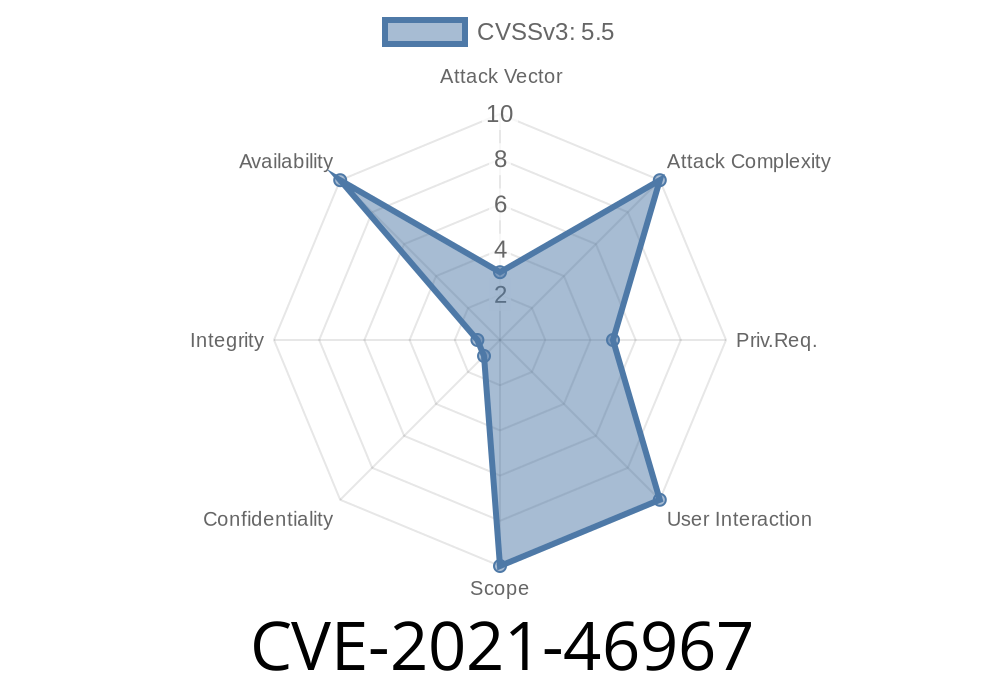
In early 2021, security researchers uncovered a critical bug affecting the Linux kernel’s virtualization subsystem, specifically the vhost-vdpa driver. The vulnerability, tracked as CVE-2021-46967, had the potential to crash the kernel and destabilize virtualized environments by mishandling memory mapping for the virtqueue "doorbell." Let's break down what this means, how it happens, and how it was fixed, using simple terms.
What is vhost-vdpa and the Virtqueue Doorbell?
vhost-vdpa is a kernel module used in virtualization setups on Linux with technologies such as *VirtIO* and *DPA (Data Path Acceleration)*. Part of its job is to accelerate the movement of data between guest virtual machines and the host system.
A doorbell in this context is a memory-mapped register -- a special location in memory that userspace programs and virtual machines can "ring" (i.e., write to) to notify the kernel that there's work to do on a queue (the virtqueue).
Root Cause
Normally, memory-mapped registers like the doorbell must be mapped with certain flags indicating "this isn't normal RAM" and shouldn't have a standard page structure (no struct page backing). These flags guide the kernel’s memory management system in handling them safely.
In the vulnerable code, vhost-vdpa’s doorbell mapping was missing the VM_PFNMAP flag. Without this flag:
The kernel might treat these memory regions as normal RAM.
- Mapping them incorrectly could lead to kernel panics: a complete crash of the operating system, which is bad for your hosts and your virtual machines.
How to Trigger
1. Userspace (or an attacker, if they had the right permissions) requests a mapping of the doorbell area via the vhost’s IOTLB (Input/Output Translation Lookaside Buffer).
The kernel tries to back that virtual address with a regular struct page.
3. Since there’s *no* actual RAM there, the result is undefined behavior. Often, that means a panic or crash.
(Simplified Visual)
// Old, vulnerable code (missing important flag)
vma->vm_flags = vma->vm_flags | VM_IO;

// Should have:
vma->vm_flags |= VM_IO | VM_DONTEXPAND | VM_DONTDUMP | VM_PFNMAP;
Proof of Concept Exploit
> Note: This issue requires admin/root privileges or access to a VM manager. It is primarily a denial-of-service (DoS) risk to host stability.
Here’s a simplified pseudo-shell that demonstrates requesting a mapping from userspace that could trigger the bug before the fix:
// Example: Try to mmap a vhost-vdpa doorbell (vulnerable scenario)
int fd = open("/dev/vhost-vdpa-ctl", O_RDWR);
if (fd < ) { perror("open"); exit(1); }

void *doorbell = mmap(NULL, x100, PROT_READ|PROT_WRITE,
                      MAP_SHARED, fd, DOORBELL_OFFSET);
if (doorbell == MAP_FAILED) {
    perror("mmap failed");
} else {
    printf("Successfully mapped doorbell! (should not work if patched)\n");
}
> *On the patched kernel, this mmap will fail with EFAULT (bad address), preventing the crash.*
Impact
- Denial of Service: Mapping the doorbell incorrectly could immediately panic the kernel, crashing the host and all its VMs.
- Potential privilege escalation: While not directly shown, bugs in mmapping hardware registers sometimes lead to code execution (though that was not the primary issue here).
The Fix
Kernel maintainers fixed the bug by adding the correct VM flags when mapping the virtqueue doorbell. The critical piece is VM_PFNMAP, telling the kernel not to expect RAM pages there.
Commit Link:
- vhost-vdpa: fix vm_flags for virtqueue doorbell mapping
Relevant Patch Snippet
// Patch: add VM_PFNMAP, VM_DONTEXPAND, VM_DONTDUMP to doorbell mappings
vma->vm_flags |= VM_IO | VM_PFNMAP | VM_DONTEXPAND | VM_DONTDUMP;
With this change, the kernel refuses “bad” mappings and fails gracefully, rather than risking a crash.
Original Commit and Discussion:
Linux Kernel Security Tracker:
CVE-2021-46967 at cve.mitre.org
VDPA and vhost kernel documentation:
VDPA Documentation (kernel.org)
Conclusion
*CVE-2021-46967 is a subtle, but potentially severe, flaw in Linux’s virtualization stack that could let a user or attacker crash the host kernel simply by mapping a doorbell register the wrong way. The fix is now incorporated in all modern kernels. Keeping your systems updated is your best defense!*
Timeline
Published on: 02/27/2024 19:04:07 UTC
Last modified on: 12/06/2024 17:55:35 UTC