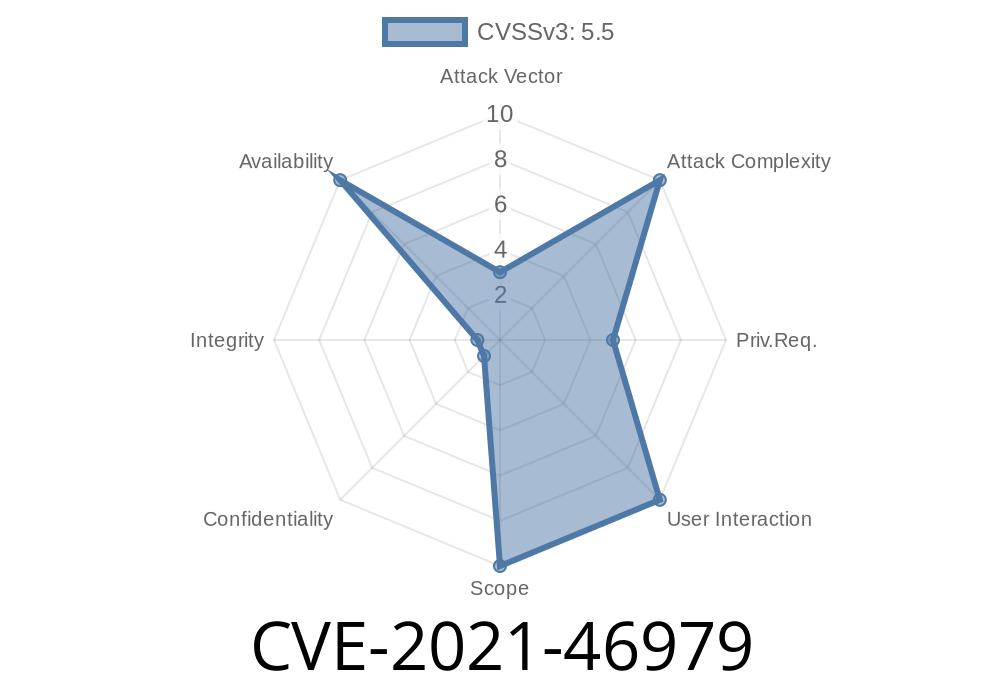
In early 2021, a serious vulnerability was identified and fixed in the Linux kernel’s Industrial I/O (IIO) core subsystem. The flaw, tracked as CVE-2021-46979, could lead to a kernel panic via a double free error. Double frees are notorious: the consequences can range from kernel crashes (DoS) to local privilege escalation, depending on the execution context.
In this article, we’ll break down CVE-2021-46979 in simple language, look at the patched code, refer to official kernel commits, and show how a theoretical exploit might work. You’ll get a clear view into how tiny mistakes in kernel resource management can spiral into security-critical bugs.
Understanding the Bug
The IIO core is a part of the Linux kernel that deals with sensors and industrial devices. The bug was in how the kernel handled the removal of _ioctl handlers_ — code used for controlling devices beyond simple read and write.
Here’s what happened
1. Device Unregister: When an IIO device was being removed (unregistered from the kernel), its ioctl handlers were freed.
2. Second Removal: Later, during other cleanup routines (iio_device_unregister_eventset() and iio_buffers_free_sysfs_and_mask()), there was another attempt to remove (and free) the same ioctl handlers.
Result: Double free! When memory is freed twice, the kernel’s memory management gets corrupted. At best, this causes a kernel panic (crash). At worst, it could be _very_ dangerous, leading to arbitrary code running in kernel mode.
Code Snippet Demonstrating the Fix
Below are snippets that capture the essence of the buggy code and its fix.
(A) Vulnerable code
// During device unregister
kfree(iio_dev->ioctl_handlers); // <-- First free

// Later, inside another cleanup function
kfree(iio_dev->ioctl_handlers); // <-- Second free! Dang!
(B) Patched code
// Only the code responsible for registration
// calls the correct cleanup function
void iio_device_unregister(struct iio_dev *indio_dev) {
    // ... other cleanup
    iio_cleanup_ioctl_handlers(indio_dev); // Safe cleanup, only once
}
The patch sets things up so that the resource is only released once, and only by the code that handled its registration.
The fix was merged in this upstream patch
- Linux Kernel Commit 5f32dd836b2c - iio: core: fix ioctl handlers removal
> _> iio: core: fix ioctl handlers removal ..._
You can see the changes made to prevent double free by making only the registration code responsible for cleanup.
Further kernel reference:
- Mainline Linux CVE records
How an Attacker Might Exploit This
Technically, exploiting a _double free_ in the kernel is non-trivial, but here’s a potential attack scenario:
1. Local User Control: The attacker creates a process that registers and unregisters an IIO device (frequently possible in embedded or IoT environments or with buggy device drivers).
2. Trigger Unregister: By rapidly registering/unregistering IIO devices, or passing unexpected input to the IIO ioctl interface, the attacker triggers both the normal cleanup and the extra cleanup function.
3. Heap Corruption: The kernel’s memory allocator (kmalloc/kfree) sees a double free. This may corrupt internal structures (like freelist or object metadata).
4. Privilege Escalation or Panic: With clever heap spraying, it could be possible for an attacker to overwrite kernel pointers or escalate privileges. Most commonly, though, the system will crash (“kernel panic”), causing a denial of service.
Minimal Proof-of-Concept
A full exploit is complex (and dangerous to test). Here's a theoretical way this bug might be triggered:
#include <linux/iio/iio.h>
#include <fcntl.h>
#include <unistd.h>
#include <sys/ioctl.h>

// Pseudocode only! Needs a proper kernel module.

int main() {
    int fd = open("/dev/iio:deviceX", O_RDWR);
    // Suppose the device allows user to trigger register/unregister
    ioctl(fd, IIO_REGISTER_IOCTL, NULL);
    ioctl(fd, IIO_UNREGISTER_IOCTL, NULL);
    // The bug could be triggered here, causing double free
    close(fd);
    return ;
}
*(Note: Actual exploitability depends on the kernel build and existing drivers.)*
Mitigation
- Upgrade Kernel: All users of affected kernels should upgrade to a version including the fix (5f32dd836b2cf856c5f437883b7fadecaecbfd, or later).
- Restrict Access: Restrict access to IIO devices to trusted users only (often only required on embedded systems).
- Kernel Hardening: Enable kernel hardening features such as _SLUB debugging_, _KASan_, or _SELinux_ to catch memory corruption early.
Conclusion
*CVE-2021-46979* highlights a classic case: even in mature areas like the Linux kernel, tiny bookkeeping mistakes (like freeing memory twice) can have outsized impacts on security. Although most users aren’t directly interacting with IIO devices, this serves as a powerful reminder to audit code paths for repeated resource release.
References
- Upstream Kernel Commit: fix ioctl handlers removal
- CVE-2021-46979 at MITRE
- Linux IIO Subsystem Documentation
Timeline
Published on: 02/28/2024 09:15:37 UTC
Last modified on: 12/31/2024 16:02:49 UTC