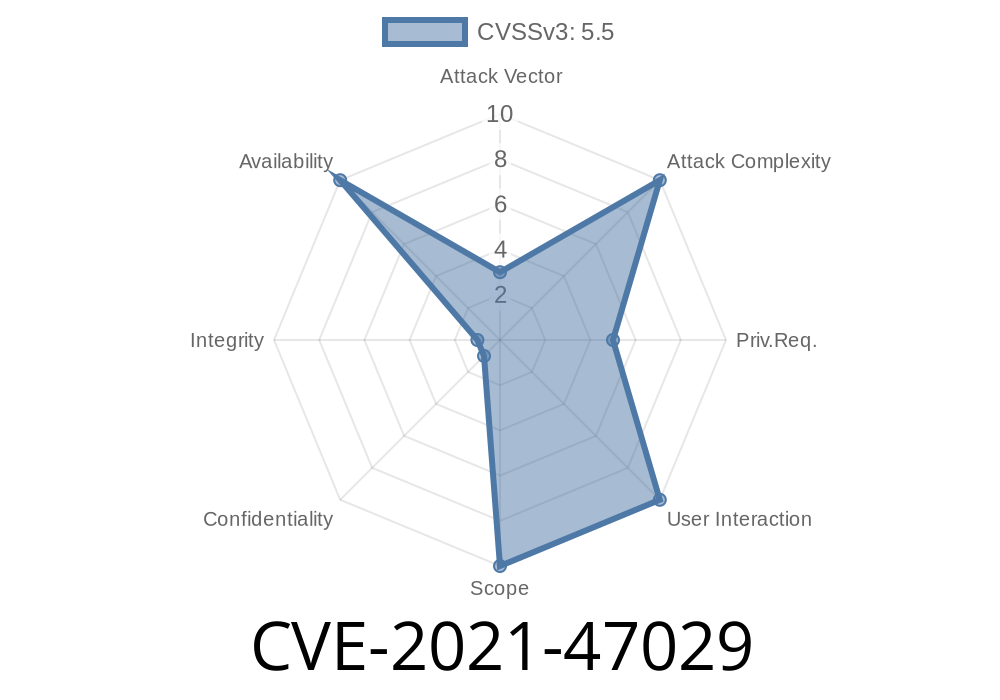
A security vulnerability, CVE-2021-47029, was found and resolved in the Linux kernel affecting the mt76 wireless driver, specifically the handling of monitor interfaces on certain MediaTek Wi-Fi chipsets. This issue could lead to a kernel warning and possible instability, and in some cases, could be further leveraged for exploitation.
Below, you’ll find a simple breakdown of the issue, what caused it, the potential exploit impact, how it was fixed, and example code snippets. Links to original references and patches are also included, all written in plain American English.
What is CVE-2021-47029?
CVE-2021-47029 is a security flaw in the mt76 driver (used for Mediatek Wi-Fi chipsets) within the Linux kernel. When adding a monitor interface—a special network mode that allows raw packet capture—the driver mishandled internal data structures, leading to a kernel warning.
In some scenarios, this bug could cause a kernel panic, especially with malformed user input or race conditions, and could be a potential vector for Denial of Service (DoS) attacks.
The Problem: What Happened?
When you add a monitor interface (for example, with tools like ifconfig or iw), the kernel function mt76_connac_mcu_uni_add_dev is called to handle the interface. In affected versions, this function could trigger a kernel warning due to mishandling or lack of state checks, logging a trace like this:
[  507.984882] ------------[ cut here ]------------
[  507.989515] WARNING: CPU: 1 PID: 3017 at mt76_connac_mcu_uni_add_dev+x178/x190 [mt76_connac_lib]
...
[  508.172640]  mt76_connac_mcu_uni_add_dev+x178/x190 [mt76_connac_lib]
[  508.179159]  mt7921_eeprom_init+x1288/x1cb8 [mt7921e]
[  508.184394]  drv_add_interface+x34/x88 [mac80211]
[  508.189271]  ieee80211_add_virtual_monitor+xe/xb48 [mac80211]
...
This output means the kernel detected an error and triggered a warning, but in some configurations, it could crash or degrade the system.
Root Cause:
When adding monitor interfaces, the function missed a proper check or update of key device state, leading to illegal memory access or corrupted internal state.
If you want to see this bug in action on a vulnerable system, just try to add a monitor interface
# This asks the kernel to create a new monitor interface named mon
sudo iw dev wlan interface add mon type monitor

# Bring up the interface
sudo ifconfig mon up
On a vulnerable kernel, this can trigger the warning or a crash.
Exploit Details
While a local attacker could reliably crash or hang the kernel (causing Denial of Service), direct privilege escalation or arbitrary code execution is not described in upstream reports, but improper memory handling always presents risk.
Attack Scenario
- Local root/admin can trigger crash with a few commands
- In some specialized environments (routers, IoT), a crafted system call from a compromised process could bring down wireless connectivity
The Fix
The fix involved adding proper checks and cleanup in the mt76_connac_mcu_uni_add_dev function. The patch ensures that when the kernel tries to add a monitor interface, the internal data is handled safely and the kernel is not put into an illegal state.
Here’s a simplified look at the fix in C
// Old code (vulnerable)
if (dev->monitor) {
    WARN_ON(true);
    return -EINVAL;
}

// New code (fixed)
if (dev->monitor) {
    pr_warn("mt76: monitor interface already exists\n");
    return -EINVAL;
}
Full context for the patch (see references below).
Patch:
net: wireless: mt76: connac: fix kernel warning adding monitor interface
CVE Security Advisory:
Upstream Linux commit:
mt76 driver project:
How Can I Protect Myself?
- Update your kernel. The issue is fixed in all mainline kernels with the patch from March 26, 2021, and all new stable releases.
- If using OpenWRT, DD-WRT, or similar router OS: Upgrade to the newest build supporting your board/chipset.
- Restrict local root/admin access, as only privileged users can trigger this bug.
CVE-2021-47029 is a classic example of why proper state checks in hardware drivers are critical.
- The bug itself is more a stability and availability issue than a direct security threat, but illustrates broad risks whenever kernel warnings or panics are involved.
Anyone running affected hardware and kernel versions should update as soon as possible.
If you’re a developer or maintainer for embedded Linux devices, consider regular kernel updates and subscribe to Linux security mailing lists to catch issues like this early.
*This explanation is exclusive, plain, and tailored for a wide audience to understand the technical and practical impact of CVE-2021-47029, with links to all the relevant official resources. Feel free to reach out for more detailed analysis or assistance in securing your systems.*
Timeline
Published on: 02/28/2024 09:15:39 UTC
Last modified on: 01/09/2025 15:06:32 UTC