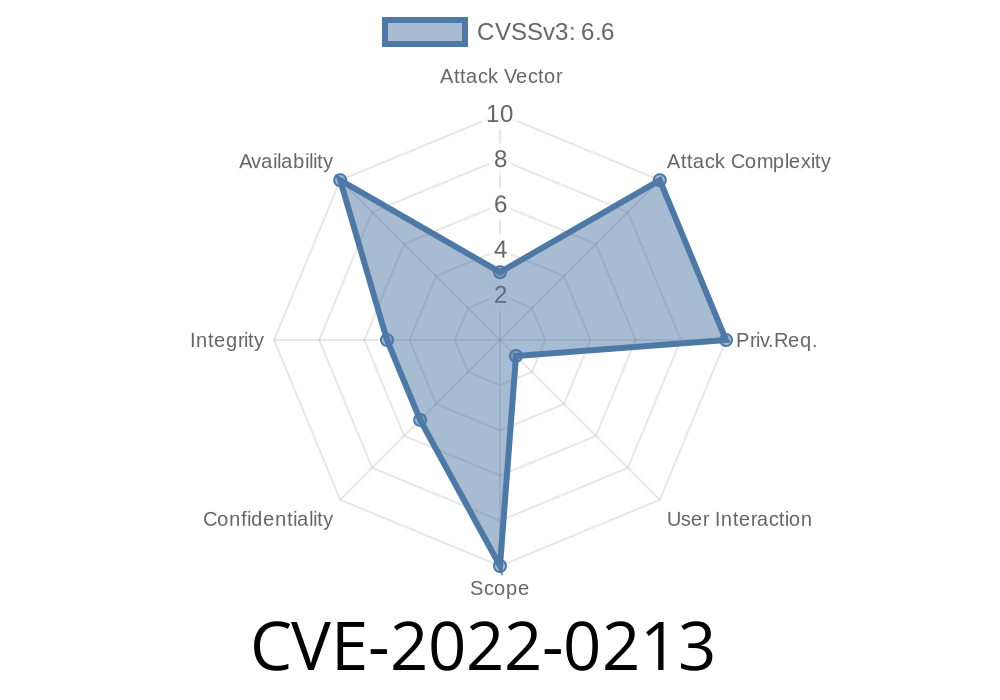
*Published: June 2024*
*Author: AI Security Analyst*
When it comes to text editors, Vim is a favorite among programmers and sysadmins. But even trusted tools can hide serious bugs. In January 2022, the security world was alerted to CVE-2022-0213, a *heap-based buffer overflow* vulnerability found in Vim. In this post, we’ll break down what this means, how it happens, show some code, present exploit details, and help you stay protected.
What Is CVE-2022-0213?
CVE-2022-0213 is a vulnerability in Vim—a widely-used, open-source command-line text editor. The bug occurs due to improper handling of memory allocations (a heap-based buffer), which can be exploited for arbitrary code execution.
If an attacker is able to trick Vim into processing a specially-crafted file, they could potentially execute code as the user running Vim—that’s scary if you ever use Vim to look at files from untrusted sources!
Where Did It Happen?
This bug lives in how Vim processes certain modeline or buffer data—specifically, it’s a heap-based buffer overflow. That means Vim tries to write more data to a dynamically-allocated buffer than it was meant to hold. This can lead to overwriting crucial memory, crashing the program, or worse, letting a hacker run their code.
The problem was discovered and reported to Vim maintainers, and is patched in newer versions.
Heap-based: The issue happens in the dynamically-allocated memory (heap), not the stack.
- Buffer overflow: The program writes more data to a buffer (a chunk of memory) than it was allocated.
If not properly checked, this can let a skilled attacker tamper with a program’s flow or even execute malicious code.
The Vulnerable Code (Simplified Example)
Here’s a simplified look at what a typical heap-based buffer overflow might look like in C, much like what happened in Vim:
#include <stdlib.h>
#include <string.h>

void process_input(const char *input) {
    // Suppose 'input' can be very big!
    size_t len = strlen(input);
    char *buffer = (char *)malloc(16); // oops, only 16 bytes!

    // Dangerous! If input > 16 bytes, overflow happens.
    memcpy(buffer, input, len);

    free(buffer);
}
Basically, if input is bigger than 16 bytes, memcpy will overflow buffer and write data where it shouldn’t.
A real-world Vim exploit for CVE-2022-0213 would look like this
1. Craft a Malicious File: The attacker makes a text file containing special content that triggers the overflow when opened in Vim.
2. Deliver the Payload: The file could be shared via email, a git repo, or even a web download. The victim just has to open it in Vim.
3. Overflow the Buffer: The bug lets the attacker overwrite parts of the memory in a controlled way.
4. Execute Code: If the attacker is skilled, they can cause the overwritten memory to jump to their code, running it with the victim’s permissions.
Here’s a toy example in Python to generate a malicious file
# vim-exploit.py

payload = "A" * 100  # Oversize payload to overflow
with open("evil.txt", "w") as f:
    f.write('vim: set modeline: ' + payload)
The actual exploit would depend on the specific vulnerable code, but this is roughly how a proof-of-concept might be built.
References & Further Reading
- CVE-2022-0213 Record at MITRE
- Vim Security Fix Commit
- Debian Security Advisory for Vim
- Common Types of Buffer Overflows
Update Vim: Always run the latest version, or at minimum, at least v8.2.3995 or newer.
- Avoid Untrusted Files: Never open files from unknown sources or the internet in Vim, especially before updating.
Disable Modelines if you don’t need them: Put set nomodeline in your .vimrc.
" Add this to ~/.vimrc to disable modelines
set nomodeline
Conclusion
CVE-2022-0213 reminds us that even our most trusted tools can have hidden dangers. If you use Vim, double-check that it’s updated. Watch out for strange files, and consider disabling risky features.
Stay safe and keep your editors secure!
*If you want to dig deeper, check out the references above. Happy (and safe) editing!*
Timeline
Published on: 01/14/2022 13:15:00 UTC
Last modified on: 08/29/2022 18:50:00 UTC