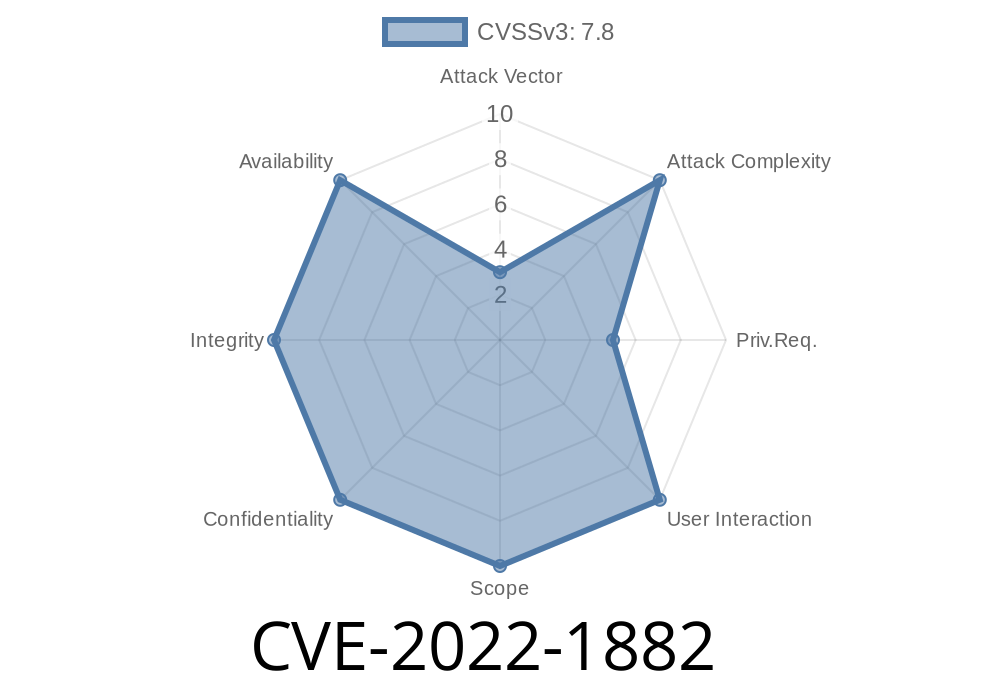
The Linux kernel is the heartbeat of millions of servers and personal computers. If a bug slips through in its inner workings, it can spell trouble for everyone. One such flaw is CVE-2022-1882, affecting the Linux kernel's pipe handling, specifically involving a use-after-free (UAF) vulnerability triggered by unsafe interaction between post_one_notification() and free_pipe_info(). This tricky bug opens the door for local attackers to crash the system or even get higher (root) privileges.
In this deep dive, we’ll explain what happened, why it’s dangerous, and how attackers could exploit it—with easy-to-read examples for curious minds.
What Is CVE-2022-1882?
CVE-2022-1882 describes a flaw in the Linux kernel’s *pipe* management code. Pipes are a core mechanism in UNIX systems for passing data between processes.
Where’s the Bug? (With Code!)
The vulnerable code lives in the kernel’s fs/pipe.c file, managing pipe notifications. Here’s a simplified snippet for understanding:
// Simplified for clarity! Not real code!
void free_pipe_info(struct pipe_inode_info *pipe) {
    ...
    kfree(pipe); // Free the pipe's memory
}

void post_one_notification(struct pipe_inode_info *pipe, ...) {
    ...
    // Use 'pipe' here AFTER it might have been freed above!
}
In certain situations, post_one_notification() can be called after free_pipe_info() already released the memory for pipe. That means the kernel could read or write junk memory, possibly controlled by an attacker.
Original references
- CVE Record at MITRE
- Red Hat CVE tracker
- Kernel patch discussion (lkml.org)
A fix landed in Linux with this patch, which updates the notification routine to ensure it can't use a pointer after it’s freed.
Who Can Exploit This, and How Bad Is It?
Attack surface:
Only local users can exploit this bug, so it can’t be triggered remotely (for example, over the network).
Impact:
Crash the system (easy)
- Try to run specially crafted code to get root privileges (harder, but possible with kernel knowledge)
The attacker then triggers post_one_notification() with the pointer to freed memory.
3. By carefully timing actions and (possibly) arranging for controlled data at the location previously used by the pipe, the attacker might:
Cause a kernel panic, OR
- Coax the kernel into performing dangerous operations, like writing to attacker-controlled memory, leading to privilege escalation.
Here’s a conceptual exploit snippet (real-world exploitation is *much* more complex, but for learning, here’s the skeleton):
// Not a working exploit, shown for educational purposes only!
int pipefds[2];
pipe(pipefds);

// Setup pipe, trigger notification routines...
// Do sequence of close(), fcntl(), or ioctl() calls to "race" the UAF
// Try to allocate data to replace the freed pipe structure ("heap spraying")

// If successful, escalate privileges!
if (getuid() == ) {
    printf("We are root!\n");
    system("/bin/sh");
}
Note: Real exploits will rely on understanding kernel memory management and races—definitely not trivial. But the existence of the bug is already a risk.
Final Thoughts
*CVE-2022-1882* serves as another reminder that even “simple” code mistakes in core kernel features can be devastating. While this bug was patched quickly, keeping systems updated and informed is your best defense.
References
- MITRE CVE-2022-1882
- Red Hat Alert
- Upstream Kernel Patch
Timeline
Published on: 05/26/2022 17:15:00 UTC
Last modified on: 07/15/2022 16:15:00 UTC