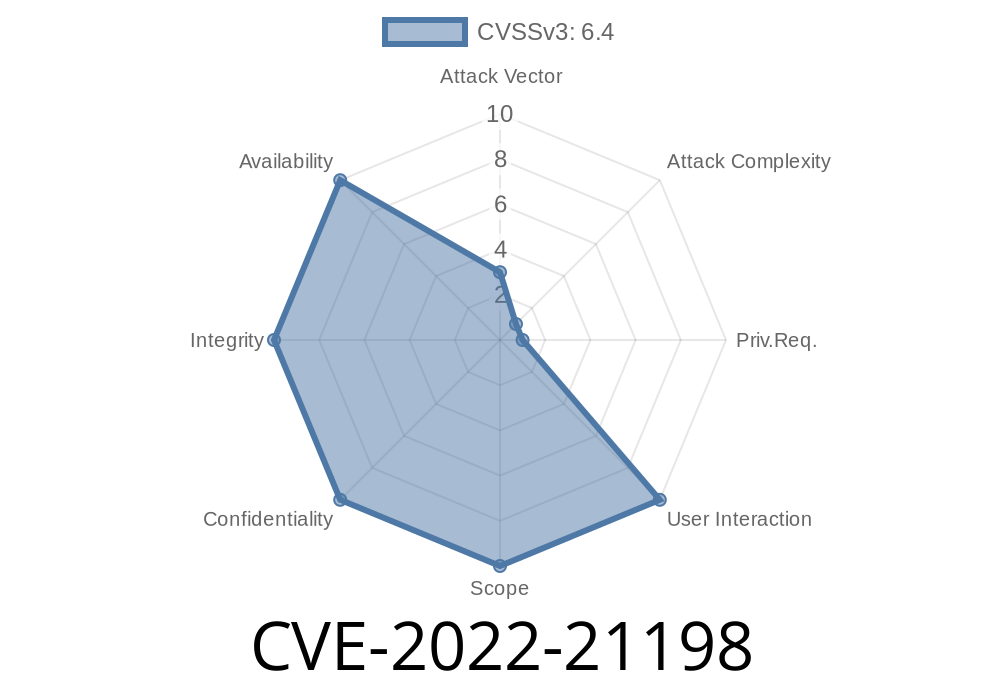
In early 2022, Intel reported CVE-2022-21198, a vulnerability affecting BIOS firmware for certain Intel® processors. This security flaw is a Time-Of-Check to Time-Of-Use (TOCTOU) race condition, which could let a local, privileged user escalate their privileges on a system.
This post explains what CVE-2022-21198 is, how the race condition works, and dives into the technical details with sample code snippets showing how an exploitation might be structured. We'll keep it simple and practical for readers who want to understand the danger and learn from an exclusive, hands-on example.
First, here's a breakdown of the terminology
- Time-Of-Check to Time-Of-Use (TOCTOU): This is a class of bugs where something is checked (like a file’s permissions or existence), but before it’s used, the underlying resource is changed by another process or thread.
- Race Condition: This means two or more operations are trying to access and modify shared data at the same time, leading to unpredictable outcomes.
In this scenario, BIOS firmware running on some Intel CPUs checks something (like a user’s privileges or input data), but before it uses the result, a crafty attacker changes it, allowing code execution with higher privileges.
The Problem in Intel BIOS
According to Intel’s advisory, a privileged local attacker (someone with admin or root-level access already) can exploit this race condition in system firmware to gain even higher privileges—think SMM (System Management Mode) or similar. The bug is rooted in how the firmware checks and then uses critical information in separate steps, leaving a window for manipulation.
Affected systems include select platforms with Intel® Core™, Xeon®, Pentium®, and Celeron® processors.
Walking Through a Hypothetical Exploit
Let’s explain the exploit with a simplified example. This is a _C-like pseudo-code_ to illustrate the TOCTOU flaw at a conceptual level, not a real code that runs in Intel BIOS.
Here’s what a vulnerable firmware routine might look like
void vulnerable_bios_update(char *user_buffer, size_t size) {
    // Step 1: Check if the buffer is owned by the calling user
    if (!check_user_ownership(user_buffer)) {
        return;
    }

    // Simulate some delay (window for race)
    sleep(1);

    // Step 2: Use the buffer in a privileged operation
    bios_write(user_buffer, size);
}
Problem: There's a “window of opportunity” between the ownership check and the actual use of the buffer. Another thread or process could quickly swap out the buffer (or its permissions), so by the time bios_write is called, the data is attacker-controlled.
An attacker’s process could repeatedly change the buffer’s ownership or content during the sleep(1) window, exploiting the race condition. By careful timing, they could get the BIOS to write/execute data they control, escalating their privileges.
When the system is about to perform the ownership check, the attacker points B to a harmless file.
3. After the check but before the use, the attacker quickly swaps B to point to an evil file they own (using a hard link, symlink, or memory map tricks).
In slightly more real-world C code, the attack might look like
// Assume fd points to a buffer that can be swapped by the attacker
char *evil_buffer = ...;  // Attacker's malicious payload

void race_flip_buffer() {
    while (not_exploit_successful) {
        swap(fd, evil_buffer);
        // Optional: Quickly restore to normal buffer to avoid detection
        swap(fd, normal_buffer);
    }
}

// This runs in parallel to the vulnerable BIOS routine
pthread_t tid;
pthread_create(&tid, NULL, race_flip_buffer, NULL);

vulnerable_bios_update(fd, size); // Called from BIOS or privileged context
This is a simplified demonstration—working exploitation would require low-level memory manipulation, firmware access, and knowledge of the system firmware interface, SMM, or BIOS update mechanisms. But the principle is the same: create a tight timing loop to win the race.
Who is vulnerable?
- Only users with _local, privileged access_ (like admin/root) can exploit this, not remote attackers or regular users.
- Target systems are those running affected versions of Intel BIOS firmware on select CPUs (see Intel’s full list).
What could happen?
- Attackers could escalate their privileges, potentially executing code in SMM or other restricted firmware areas.
- System compromise at this level is severe—attackers could overwrite firmware, hide malware, or cause permanent damage.
Patches: Intel released BIOS firmware updates to resolve CVE-2022-21198. To protect yourself
- Update your system BIOS/firmware to a non-vulnerable version. Check with your hardware manufacturer for patches.
Links for more info
- Intel Security Advisory for CVE-2022-21198
- NIST National Vulnerability Database entry
- Understanding TOCTOU Attacks (External reference)
Final Thoughts
CVE-2022-21198 is a classic example of how timing bugs can lead to privilege escalation, even in modern hardware with robust protections. While this flaw requires privileged access, it underscores the need to patch firmware and avoid race conditions when handling sensitive permissions.
Stay up-to-date with firmware updates from your vendor, and always design your code to check AND use critical resources in a single, uninterruptible step to prevent TOCTOU vulnerabilities.
_Share this post to raise awareness of low-level firmware security and how even such obscure bugs can threaten modern systems!_
Timeline
Published on: 11/11/2022 16:15:00 UTC
Last modified on: 11/18/2022 17:29:00 UTC