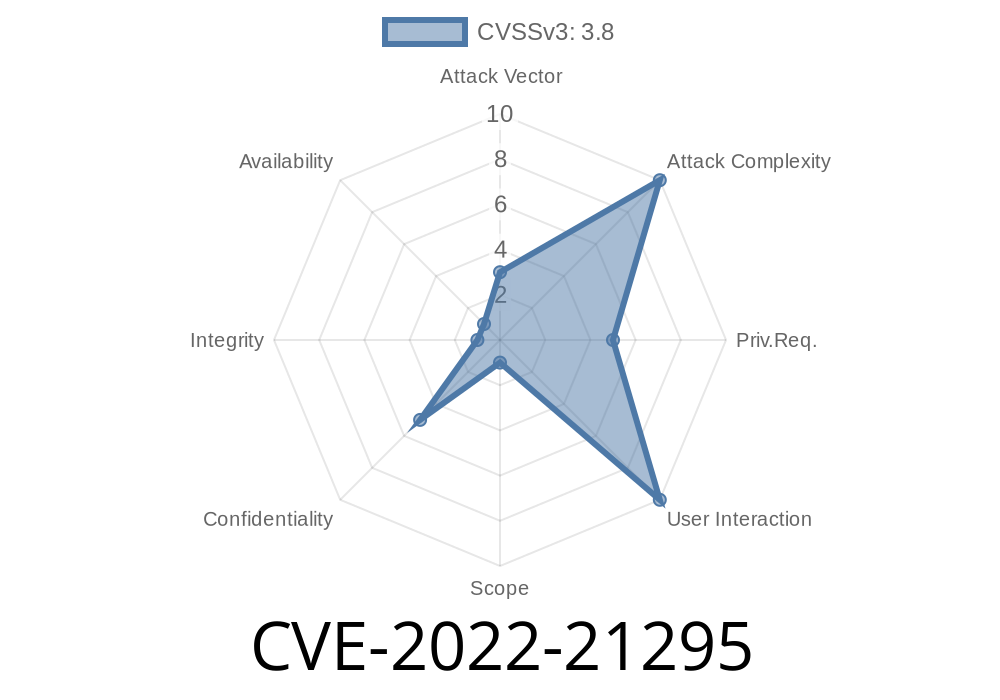
CVE-2022-21295 is a privacy-impacting vulnerability found in Oracle VM VirtualBox, specifically in versions prior to 6.1.32 running on Windows systems. Although it does not allow attackers to fully compromise a system, it does let low-privileged users read data that should be protected. This post takes a close look in plain language, breaks down how the bug works, presents code snippets to help understand the flow, and links to original sources for deep dives.
What is Oracle VM VirtualBox?
Oracle VM VirtualBox is a popular free virtualization tool that lets you run multiple operating systems on a single physical machine. Think of it as software that “pretends” to be a real computer for guest operating systems, making it a big target: a bug in VirtualBox can cross boundaries between host and guest systems.
What's the Vulnerability? (CVE-2022-21295)
CVE-2022-21295 describes a weakness in VirtualBox’s Core component on Windows. In plain terms:
> A “regular user” who can log in to a Windows system can trick VirtualBox into giving them read access to data they should not have. They can't write anything or crash VirtualBox, but they can view snippets of sensitive information.
Why Does It Matter?
On infrastructure hosting multiple sensitive VMs, this bug could let a rogue or compromised user peek at data belonging to other VMs or the host itself—like configuration files, disk contents, or credentials loaded in VM memory. Although it can’t lead to direct code execution or system compromise, leaking this information may help an attacker plan more targeted attacks.
How Does It Work? (Technical Summary)
Oracle’s advisory is sparse on detail, but here’s the typical pattern with this type of leak:
- A low-privilege user finds a way to exploit a programming mistake in VirtualBox’s file, memory, or device management.
- They are able to trick a VirtualBox process running at higher privilege into returning more data than intended.
- This can happen via abuses of inter-process communication (IPC), device emulation, or mishandling of file read operations in the VirtualBox core service.
Example scenario:
A flawed system call or device emulation code lets the user request a buffer with an incorrect size. Instead of only reading their own permitted data, the buffer is incorrectly filled with extra data from VirtualBox's memory, possibly including other users' information or guest VM data.
Example Code Snippet (Illustrative)
Let’s imagine a device interface in VirtualBox that handles reading data from a virtual disk. A bug could look something like this (simplified for demo):
// Hypothetical vulnerable code in VirtualBox
int handle_ioctl_read(int fd, void* user_buffer, size_t size) {
    char kernel_buffer[256]; // Fixed-size buffer

    // Vulnerability: copies 'size' bytes, but kernel_buffer is only 256 bytes
    memcpy(user_buffer, kernel_buffer, size);
    return ;
}
If the attacker passes a size larger than 256, the memcpy could copy data beyond kernel_buffer—potentially leaking whatever is next in memory.
Note: This is a _illustrative_ example – The real bug in CVE-2022-21295 might differ in implementation, but the leak pattern is often similar.
To exploit CVE-2022-21295, an attacker
1. Logs into a system where VirtualBox is installed (physical access, RDP, or Remote Desktop is enough).
2. Crafts a program or script that interacts with the vulnerable interface, likely by making a Windows API or system call to VirtualBox.
3. Reads out “extra” data from the response – this data may be arbitrary or include sensitive memory/data from running VMs.
No admin rights or special exploits are needed, *just logon access* and ability to run the exploit.
Here’s a minimal Python/ctypes fragment that shows the skeleton of how someone might interact with a Windows device driver, for educational purposes:
import ctypes
from ctypes import wintypes

# Simulated handle to VirtualBox driver (won't work without the real driver)
DEVICE_PATH = r'\\.\VBoxDrv'
GENERIC_READ = x80000000
OPEN_EXISTING = 3

CreateFile = ctypes.windll.kernel32.CreateFileW
ReadFile = ctypes.windll.kernel32.ReadFile

handle = CreateFile(DEVICE_PATH, GENERIC_READ, , None, OPEN_EXISTING, , None)

buffer = ctypes.create_string_buffer(1024)  # Request more data than intended
bytesRead = wintypes.DWORD()

ret = ReadFile(handle, buffer, 1024, ctypes.byref(bytesRead), None)
if ret:
    print("Leaked data:", buffer.raw[:bytesRead.value])
Mitigation & Patch
Upgrade VirtualBox to at least 6.1.32.
Oracle’s January 2022 CPU patched this issue. No legitimate workarounds exist apart from upgrading.
Official Patch Notes:
Oracle Security Advisory - CVE-2022-21295
Oracle CPU Jan 2022
References & Further Reading
- CVE-2022-21295 at NVD
- Oracle January 2022 Security Update
- VirtualBox Downloads
- Exploring Windows Kernel Device Driver Security
Exclusive summary:
CVE-2022-21295 is a leak bug in VirtualBox (Windows only, before v6.1.32) that lets low-level users snoop on data inside the VirtualBox process. It won’t crash your box or give full system control, but for companies running sensitive workloads on shared Windows hosts, patch it fast to stay secure.
Timeline
Published on: 01/19/2022 12:15:00 UTC
Last modified on: 01/22/2022 03:25:00 UTC