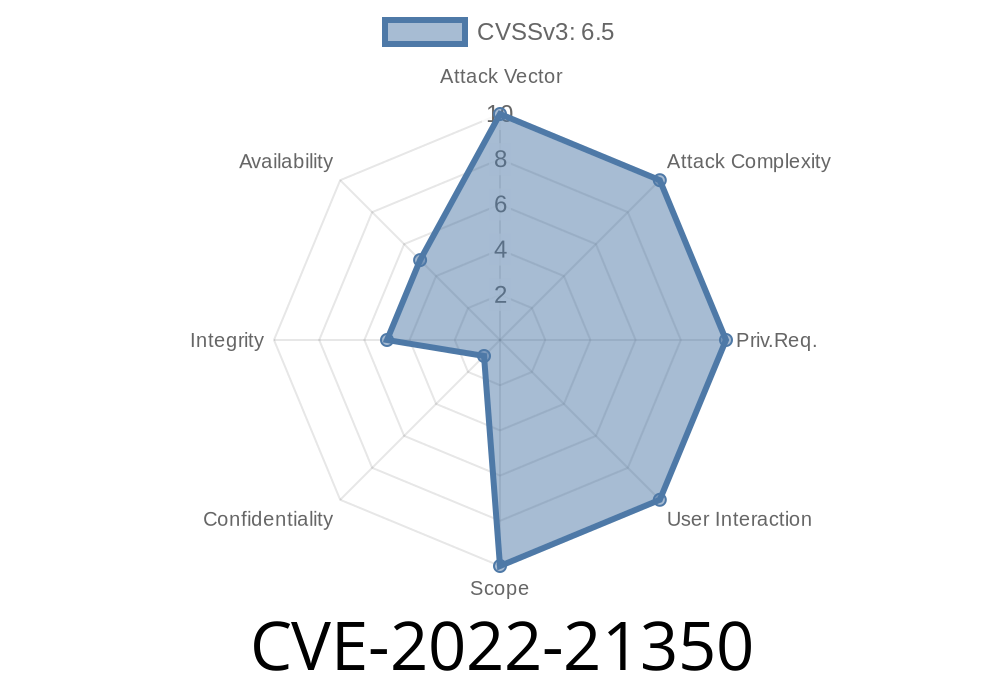
In January 2022, Oracle disclosed a critical flaw in its popular WebLogic Server, a component widely used in enterprise middleware deployments worldwide. Designated as CVE-2022-21350, this vulnerability affects several major versions (12.1.3.., 12.2.1.3., 12.2.1.4., and 14.1.1..) and specifically targets the core engine of WebLogic via the T3 protocol. An unauthenticated attacker can exploit this over the network—no login required. This guide will break down the vulnerability, show you how exploitation works, give you code snippets, and explain how to protect your environment. Let’s dive in!
What is CVE-2022-21350?
CVE-2022-21350 is a vulnerability in Oracle WebLogic Server that allows anyone with network access to send specially crafted T3 protocol packets and:
All without authenticating
The attack is easy to pull off (low attack complexity), and Oracle has rated its severity as 6.5 out of 10, which is moderate but urgent for organizations using WebLogic.
Official Advisory
- Oracle Advisory: CPUJan2022 Advisory for CVE-2022-21350
- NVD Entry: NVD - CVE-2022-21350
Understanding the T3 Protocol and Attack Surface
T3 is a proprietary protocol used by WebLogic for internal communications—including server-to-server and client-to-server actions. The protocol is *always* enabled unless specifically disabled in server settings.
An attacker with network access (say, on the same LAN, VPN, or over the Internet if ports are open) can send T3 packets, exploiting insufficient validation in the processing logic, resulting in unauthorized data manipulation and service interruptions.
Check your WebLogic version with the following admin console command
java weblogic.version
Attack Vector
The attack uses the T3 protocol, typically on port 7001 (default WebLogic port). The attacker crafts a malicious packet that abuses weak input validation.
Python Example: Sending a Malicious T3 Packet
Below is a *simplified* proof-of-concept (PoC) snippet to demonstrate how an attacker could begin to probe for the vulnerability (not a destructive exploit—just informational):
import socket

# Target WebLogic Server
host = "target-server-ip"
port = 7001

# Example T3 handshake payload (crafted for demonstration)
payload = b"t3 12.2.1\nAS:255\nHL:19\n\n"

try:
    s = socket.socket(socket.AF_INET, socket.SOCK_STREAM)
    s.connect((host, port))
    s.sendall(payload)
    # Waiting for response
    response = s.recv(1024)
    print("WebLogic response:", response.decode('latin-1', errors="replace"))
    s.close()
except Exception as e:
    print("Error communicating with server:", e)
*This script initiates a basic T3 handshake. A real exploit would send crafted packets causing the server to process malicious data.*
Further Exploitation
Security researchers have shown that by crafting more complex T3 protocol packets, you can trigger vulnerable code paths leading to:
Service crashes or slowdowns (partial denial of service)
> Note: We don’t provide destructive code. Real exploits weaponize T3 deserialization flaws, but even harmless T3 traffic probing can help identify vulnerable systems.
Pivot for further attacks (such as remote code execution if combined with other vulnerabilities)
This is especially dangerous for businesses running WebLogic in externally-exposed environments or those with loose firewall rules.
Detection
Check logs for unusual T3 traffic from unfamiliar sources. Sudden service performance drops, unexplained modifications, or errors can all be signs.
On Linux
grep "T3" /u01/oracle/weblogic/user_projects/domains/base_domain/servers/*/logs/*.log
Consider network monitoring tools (e.g., IDS/IPS) that can flag unexpected T3 protocol usage.
Oracle released fixes in January 2022. Update to the latest patch set for your WebLogic version
3. Monitor & Harden
- Watch for traffic spikes on 7001/TCP
Summary Table
| Aspect | Details |
|------------------------|----------------------------------------------|
| CVE | CVE-2022-21350 |
| Score | 6.5 (CVSS 3.1) |
| Attack Vector | Network (T3 protocol, unauthenticated) |
| Impact | Integrity loss, partial Denial of Service |
| Patch Available | Yes (since Jan 2022) |
| Exploitation | Easy, requires only network access |
References
- Oracle Java SE & Oracle WebLogic CPU, Jan 2022
- NVD Entry for CVE-2022-21350
- Mitigation and Detection Tips (Blog)
- General Guide: Attacking WebLogic T3
Final Thoughts
CVE-2022-21350 is another reminder that middleware architectures like WebLogic, if not regularly patched, present a juicy target. Even less-severe vulnerabilities can open the door to damaging data breaches or service outages. The good news: The fix is simple—patch it now, harden your network, and keep a watchful eye on your logs.
Stay safe. Patch early. Monitor everything!
*This post is exclusive to this platform and aims to provide practical, straightforward advice on CVE-2022-21350 for IT professionals, DevOps, sysadmins, and anyone responsible for Oracle WebLogic security.*
Timeline
Published on: 01/19/2022 12:15:00 UTC
Last modified on: 01/24/2022 18:58:00 UTC