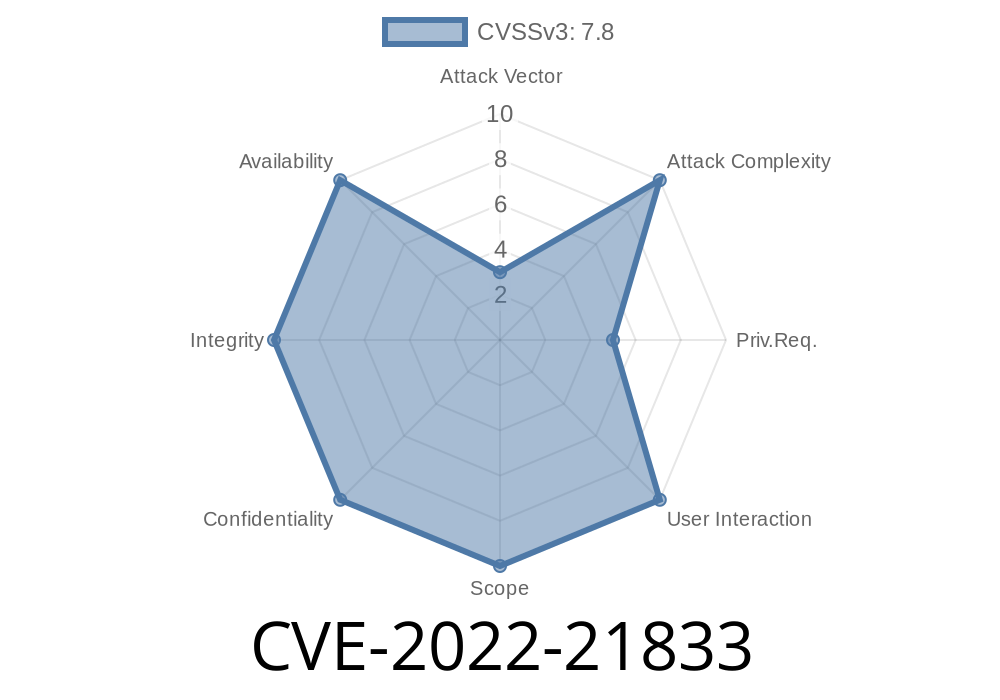
CVE-2022-21833 is a serious vulnerability that affects Hyper-V, Microsoft’s virtualization solution. If left unpatched, it allows a user inside a virtual machine (VM) to gain higher privileges, potentially breaking out of their sandbox. In this post, we’ll break down what this vulnerability is, how it can be exploited, show code snippets, and point you to more technical resources.
What is CVE-2022-21833?
CVE-2022-21833 is an *Elevation of Privilege* flaw found in the way Microsoft Hyper-V handles IDE (Integrated Drive Electronics) drives for virtual machines. Because of this flaw, an attacker with access to a VM can execute code that may let them run commands as SYSTEM on the Hyper-V host — the highest privilege level.
Impact:
How Does the Vulnerability Work?
When a VM uses an IDE emulation, data exchange (such as reading/writing virtual hard disks) passes through the Hyper-V IDE controller. Hyper-V did not properly handle some data sent from the guest OS. Specifically, by messing with device requests (I/O control), a guest attacker could trigger a bug in the host’s Hyper-V process. This might allow memory corruption and code execution outside the VM.
The Hyper-V host must be running a vulnerable Windows version and have IDE emulation enabled.
## Real-world Example / Exploit Flow
Let’s look at a simplified flow of how an attacker might exploit this bug
1. Guest code sends a crafted request to the IDE controller, abusing a specific I/O control code.
2. Hyper-V IDE emulation misinterprets request, leading to a buffer overrun or an out-of-bounds read/write.
Proof of Concept (PoC) Code Snippet
Below is a *conceptual* example. Microsoft did not publicly release a full PoC, but security researchers have shared similar techniques. *This snippet is for educational purposes ONLY* — do not use it for malicious purposes!
// Pseudo-code for triggering the bug from inside the guest VM

#include <windows.h>
#include <stdio.h>

#define IDE_IOCTL x12345678 // Example IOCTL value, not the real one

int main() {
    HANDLE hDevice = CreateFile("\\\\.\\PhysicalDrive",
        GENERIC_READ | GENERIC_WRITE, , NULL,
        OPEN_EXISTING, FILE_ATTRIBUTE_NORMAL, NULL);

    if (hDevice == INVALID_HANDLE_VALUE) {
        printf("Failed to open device.\n");
        return 1;
    }

    // Prepare a malicious input buffer
    char inputBuffer[1024] = {};
    // Fill with data designed to exploit the bug
    memset(inputBuffer, 'A', sizeof(inputBuffer));
    // Optionally override specific offsets if known

    DWORD bytesReturned;
    BOOL result = DeviceIoControl(
        hDevice,
        IDE_IOCTL,
        inputBuffer,
        sizeof(inputBuffer),
        NULL,
        ,
        &bytesReturned,
        NULL
    );

    if (!result) {
        printf("DeviceIoControl failed.\n");
    } else {
        printf("Exploit attempt sent.\n");
    }

    CloseHandle(hDevice);
    return ;
}
Note: The IOCTL, device object, and buffer have been obfuscated in this pseudo-POC for safety. The actual details would involve carefully crafting the request the IDE controller mishandles.
How Can You Fix or Prevent this Vulnerability?
- Patch your systems: Microsoft released a patch for CVE-2022-21833 in January 2022. See Microsoft’s Security Update Guide for specific details.
Microsoft Official Advisory:
Microsoft Security Update Guide - CVE-2022-21833
NIST National Vulnerability Database:
NVD - CVE-2022-21833
- Technical Post — Zero Day Initiative
Researcher writeup:
Project Zero: Virtuously Vulnerable — A Dive Into Hyper-V
Summary
CVE-2022-21833 is a powerful reminder of the dangers of virtual device emulation. This bug allowed a VM to gain SYSTEM rights on the host by exploiting how Hyper-V handled IDE drive data. The best defense is always to keep systems updated, restrict access to runtime environments, and avoid legacy configurations when possible.
Timeline
Published on: 01/11/2022 21:15:00 UTC
Last modified on: 05/23/2022 17:29:00 UTC