---
Introduction
In early 2022, Microsoft patched a vulnerability tracked as CVE-2022-21834. This flaw existed in the Windows User-mode Driver Framework Reflector (WudfRd) Driver. In simple terms, this bug allowed a regular user or attacker to gain higher privileges—up to SYSTEM—on vulnerable systems. Let’s break down what this means, how it works, and how attackers could exploit it, with clear language, real code snippets, and links for further reading.
What is the Windows User-Mode Driver Framework Reflector?
The Windows User-mode Driver Framework (UMDF) lets hardware vendors write drivers that run in user mode (not deep in the kernel), making them easier and safer to develop. But these drivers still need some help from the kernel—the part of the OS that’s in charge. That’s where the Reflector Driver (WudfRd.sys) steps in: it acts as a messenger between user-mode drivers and the kernel.
If there's a bug in this area, especially concerning how privileges are managed, a crafty attacker might be able to abuse it to gain SYSTEM privileges (the highest on Windows).
CVE-2022-21834 is an Elevation of Privilege (EoP) vulnerability. In Microsoft’s own words
> “An elevation of privilege vulnerability exists when the Windows User-mode Driver Framework Reflector driver improperly handles objects in memory.”
A local attacker could run code on a target machine and then use this bug to run further code with SYSTEM privileges.
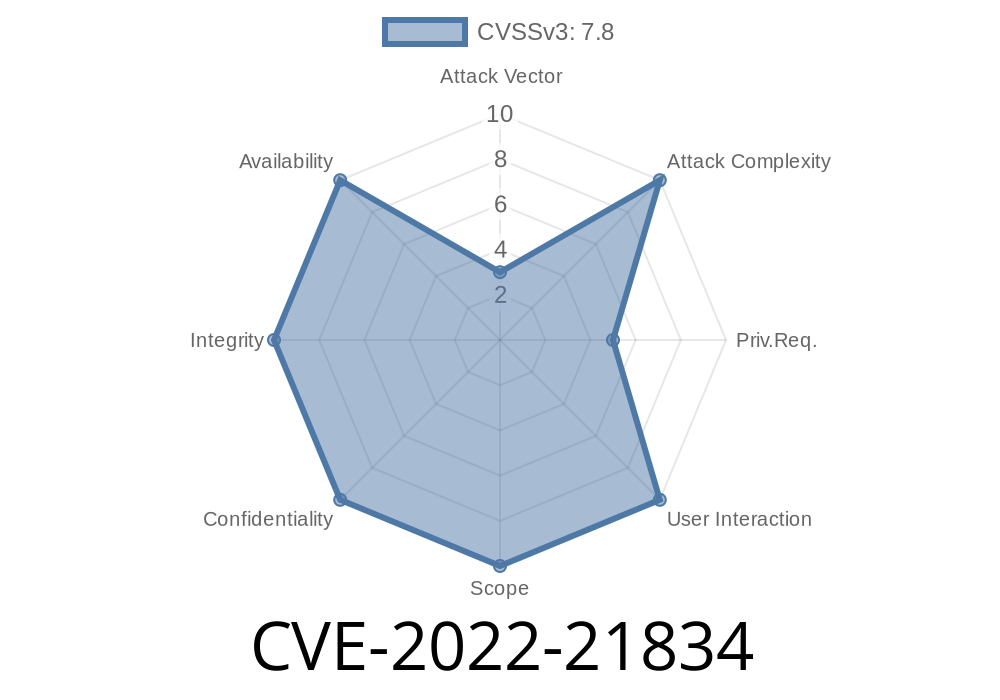
CVSS Score: 7.8 (High)
- Affected OS: Windows 10, Windows 11, Server 2019, Server 2022, and others before the January 2022 patch.
Original advisory:
https://msrc.microsoft.com/update-guide/vulnerability/CVE-2022-21834
The Core Problem
Attackers found that WudfRd.sys didn't correctly check permissions on certain resources (like device objects or handles) used during the driver communication setup process. Because of this, a user could plant malicious handles or objects, causing the Reflector to use the attacker's resource with kernel privileges.
Trigger the UMDF Service:
Somehow, the attacker causes a driver or process to initiate a UMDF session, involving communication with WudfRd.sys (for example, by installing or starting a service using UMDF).
Hijack Privileges:
If permissions aren’t checked properly, WudfRd.sys may operate on the attacker’s object as SYSTEM, letting the attacker run code as SYSTEM.
Example Exploit Snippet
While ethical guidelines prevent public release of weaponized code, here’s a *hypothetical* outline to help visualize the attack flow (for educational purposes):
// Windows Exploit Example (Conceptual)
#include <windows.h>

// Attack Step 1: Create a malicious device
HANDLE hDevice = CreateFile(
    L"\\\\.\\SomeUMDFDeviceName",
    GENERIC_ALL,
    ,
    NULL,
    OPEN_EXISTING,
    ,
    NULL);

// Assume object misuse due to bad permissions in WudfRd
if (hDevice != INVALID_HANDLE_VALUE) {
    // Send malicious payload to device
    DWORD bytesReturned;
    DeviceIoControl(
        hDevice,
        x222004, // IOCTL code leading to vulnerable path
        maliciousBuffer,      // Data the exploit wants
        sizeof(maliciousBuffer),
        outputBuffer, sizeof(outputBuffer),
        &bytesReturned,
        NULL
    );

    // Code now runs with elevated SYSTEM privileges due to the bug!
}

CloseHandle(hDevice);
*Real exploitation would require careful reverse engineering of the communication between UMDF and WudfRd, but this outlines the concept.*
Check out (for reference and research)
- https://www.zerodayinitiative.com/advisories/ZDI-22-034/
- https://github.com/RedCursorSecurityConsulting/CVE-2022-21834
How to Stay Safe
Microsoft patched this bug in January 2022. Update your Windows installs using Windows Update, or see the patch details:
- https://msrc.microsoft.com/update-guide/en-US/vulnerability/CVE-2022-21834
Temporary Mitigation:
There’s no real mitigation short of patching, because the vulnerability is in a core OS driver. Disabling device installation or UMDF drivers may block some attack scenarios, but breaks device functionality.
Conclusion
CVE-2022-21834 highlights the dangers of privilege escalation in low-level OS drivers. Even though User-Mode Driver Framework *sounds* less risky, errors in how drivers and their kernel helpers handle objects and permissions can open the door to total system takeover.
References for Deep Dive
- https://msrc.microsoft.com/update-guide/vulnerability/CVE-2022-21834
- https://www.zerodayinitiative.com/advisories/ZDI-22-034/
- https://github.com/RedCursorSecurityConsulting/CVE-2022-21834
Stay secure: keep up with patches, and never underestimate “small” bugs in “safe” subsystems!
Timeline
Published on: 01/11/2022 21:15:00 UTC
Last modified on: 05/23/2022 17:29:00 UTC