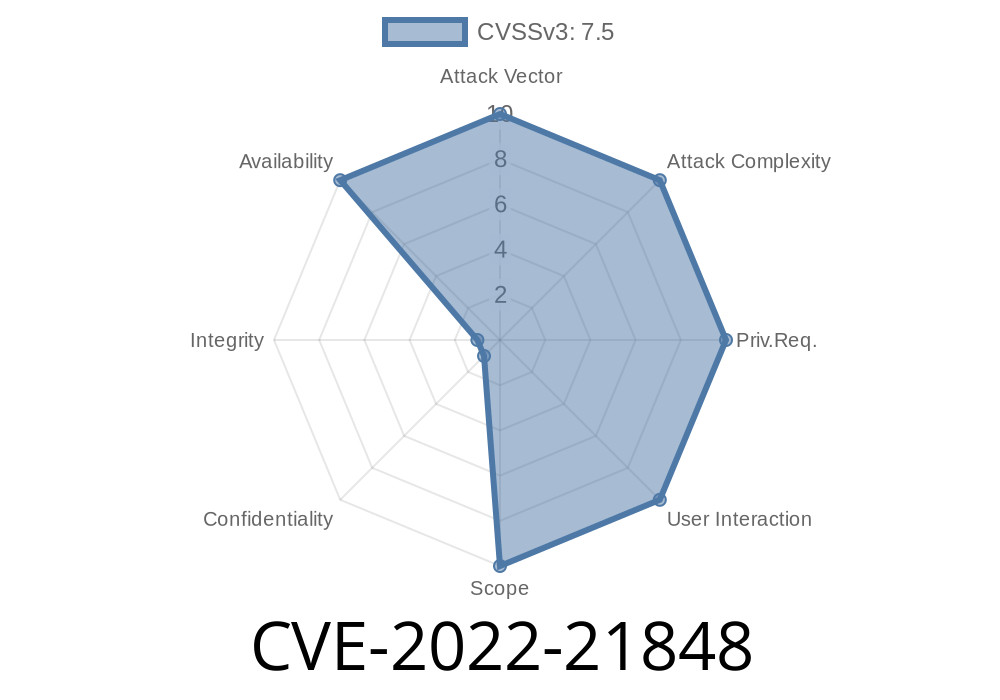
In January 2022, Microsoft patched a crucial vulnerability in the Windows Internet Key Exchange (IKE) Extension. Tracked as CVE-2022-21848, this security flaw attracted attention because it could allow remote attackers to crash affected Windows devices. In this article, we'll break down how CVE-2022-21848 works, show you basic proof-of-concept code to help understand the exploit, and guide you to original references and Microsoft advisories. Let's dive in.
What is CVE-2022-21848?
CVE-2022-21848 is a Denial of Service (DoS) vulnerability in the IKE Extension component on Windows. The Internet Key Exchange protocol is typically used to set up security associations in the IPsec protocol suite, allowing devices to communicate securely over a network.
This CVE is not the same as CVE-2022-21843, CVE-2022-21883, CVE-2022-21889, or CVE-2022-21890. Each one deals with a different flaw in Windows networking components.
How Does the Vulnerability Work?
The core issue lies in how the IKE Extension driver handles specially crafted IKE packets. By sending a malformed packet to an exposed service, an unauthenticated, remote attacker can cause the Windows networking service to crash or stop responding, effectively causing a Denial of Service (DoS).
This could be catastrophic for servers providing VPN services or essential network communication.
Here’s how an attack could go down
1. Attacker finds an exposed, vulnerable Windows system with IKEv2/IPsec enabled.
The system crashes (Blue Screen of Death) or networking subsystem becomes unresponsive.
No authentication or prior access is required—just raw access to the target's IKE service.
Microsoft’s Security Advisory
> Original Microsoft Advisory for CVE-2022-21848:
> Microsoft Security Update Guide - CVE-2022-21848
> January 2022 Windows Updates Details
Proof-of-Concept: Simulating the Attack
For educational purposes, here's a simple Python snippet that demonstrates sending an empty IKE packet. (This doesn’t guarantee a crash but shows the basic concept.)
import socket

target_ip = "192..2.123"  # Replace with your target IP
ike_port = 500

# Craft a dummy IKE packet (in real exploits, specific malformed payload causes DoS)
ike_payload = b'\x00' * 28  # 28 bytes dummy, IKE packets usually have minimum size

sock = socket.socket(socket.AF_INET, socket.SOCK_DGRAM)
sock.sendto(ike_payload, (target_ip, ike_port))
sock.close()

print(f"Sent dummy IKE packet to {target_ip}:{ike_port}")
Remember: Don’t run this code against any system you don't own or have permission to test. Unauthorized testing is illegal.
Real-World Exploit Notes
Security researchers provided information that sending an IKE_INIT packet with malformed headers could crash Windows 'IKEEXT' service. The actual malicious packets used in exploits may look very different and crafted with specialized tools (like Scapy or Metasploit), but the principle remains the same.
How Was it Discovered?
Security researchers, including the ZDI team (Zero Day Initiative), often fuzz network services to find vulnerabilities. For IKEEXT, fuzzing with malformed or truncated packets exposed handling errors leading to system crashes.
> ZDI Advisory:
> ZDI-22-102: Microsoft Windows IKEEXT Remote Denial-of-Service Vulnerability
Apply Microsoft Windows Updates:
The best protection is to patch your Windows systems. Microsoft released fixes as part of the January 2022 Patch Tuesday updates.
MSRC Update Guide - January 2022
Limit Exposure:
If you don’t use VPN or IPsec, consider disabling related services or filtering UDP port 500 traffic at your network edge.
Conclusion
CVE-2022-21848 shows how a single packet can bring down a Windows server if not properly patched. While this vulnerability has been fixed, it highlights the importance of timely updates and securing exposed network services.
Always monitor security advisories, keep your systems up to date, and control access to sensitive ports!
References
- Microsoft Security Advisory: CVE-2022-21848
- ZDI Security Advisory: ZDI-22-102
- NIST NVD Entry for CVE-2022-21848
- Intro to IKE/IPsec
If you're running critical Windows servers, make sure they are patched and your IKE/IPsec ports are not exposed to the public internet unless necessary!
Timeline
Published on: 01/11/2022 21:15:00 UTC
Last modified on: 05/23/2022 17:29:00 UTC