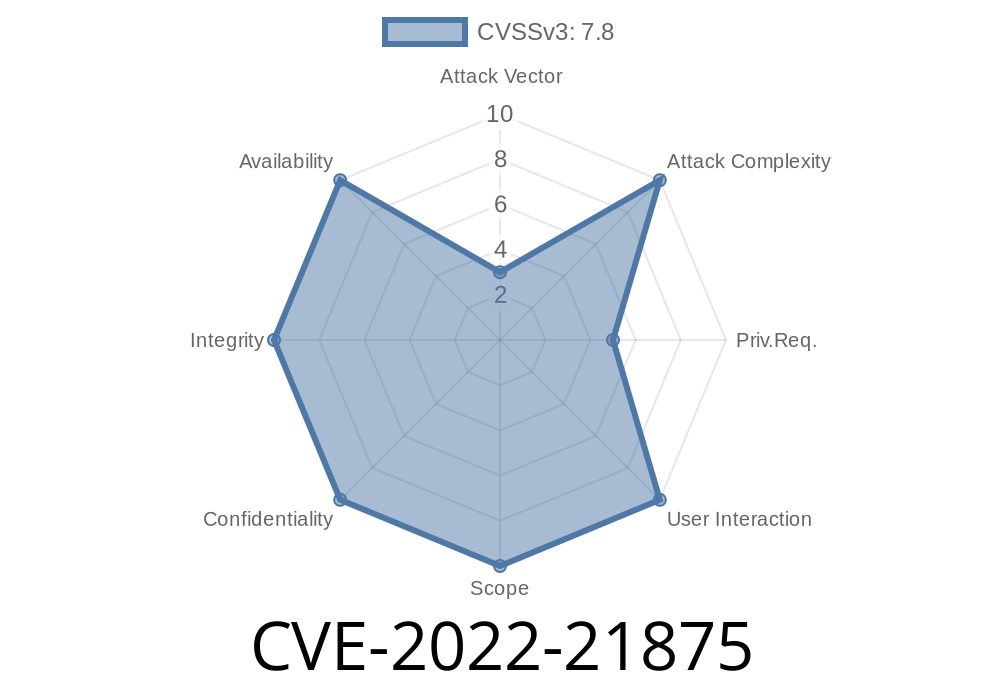
In the world of cybersecurity, new threats are always around the corner. One such threat is CVE-2022-21875, a notable vulnerability that affected Windows Storage services and allowed malicious users to escalate their privileges. This post gives you an exclusive, easy-to-digest walk-through of the vulnerability, how it works, and what you can do to stay safe. We’ll also peek at code that illustrates the core problem and touch on manual exploitation concepts — all while linking to authoritative sources for those who want a deep dive.
What is CVE-2022-21875?
CVE-2022-21875 is a security flaw in Windows related to the Windows Storage Services. Specifically, it is an *Elevation of Privilege* (EoP) vulnerability. This type of vulnerability allows an attacker with limited access to jerk themselves up to a more powerful user — often with full system control.
Affected Platforms:
Windows Server (various versions)
Link to Microsoft Advisory:
Microsoft Security Response Center: CVE-2022-21875
Local Exploitation: Any local user, even with low privileges, can use it to gain higher access.
- System Impact: Successful exploitation means the attacker can potentially install programs, view/change/delete data, and even create new accounts with full access.
- Common Service: Many enterprise setups use Windows Storage, so a huge number of business environments were at risk.
Technical Details — How Does the Attack Work?
At its core, the vulnerability resides in how certain storage service components handle parameters passed from non-admin users. An attacker can craft special input to the service — by using a custom API call or manipulating environment variables — to trigger inappropriate rights escalation.
Let’s see a *simplified* snippet in C that illustrates the flavor of the bug (note: not actual source, but demonstrates the typical flaw):
// Pseudocode: A simplified privilege escalation pattern
DWORD WINAPI VulnerableStorageServiceFunction(LPVOID lpParam) {
    // ... other code ...
    UserInput *input = (UserInput *)lpParam;

    if (input->IsValid()) {
        // Missing: Check if the current user actually has the right to escalate!
        RunAsSystemPrivileges(input->RequestedOperation); // <-- Vulnerable call
    }
    // ... other code ...
}
The key issue: The service lacks proper authorization checks before running privileged operations. Therefore, a malicious user can ask it to perform actions as SYSTEM (the highest-level user in Windows).
Attackers typically exploit this by
1. Identifying the Vulnerable Service: Find the Windows process that exposes the storage management function.
2. Crafting a Malicious Input: Create a custom API call, or abuse existing tools to pass malicious parameters.
3. Triggering the Vulnerability: The system processes the request with excessive trust, granting the attacker system-level privileges.
Receive a SYSTEM-level shell if the attack succeeds. You might use PowerShell for this
# PowerShell: Try to interact with a vulnerable service (conceptual)
$payload = @{ "operation" = "CreateAdminUser"; "username" = "eviladmin"; "password" = "P@ssword123" }
Invoke-WebRequest -Uri "http://localhost:storage-api"; -Method POST -Body $payload
*(This is not a real API, just an idea of how API-abuse-based escalation works.)*
How to Protect Yourself
1. Patch Immediately:
Microsoft released fixes in the January 2022 Patch Tuesday. Make sure your system is up to date.
Get the update here (KB5009543 for Windows 10).
2. Audit User Privileges:
Regularly check who has local user accounts and revoke unnecessary ones.
3. Monitor Logs:
Look for unusual activity, especially involving storage services or privileged operations.
4. Limit Local Access:
Physical or even remote desktop user access should be tightly controlled.
Want to learn more?
- Microsoft’s Official Security Update Guide
- NIST NVD entry for CVE-2022-21875
- Technical writeup by Tenable
Final Thoughts
CVE-2022-21875 is proof that even core Windows services can have dangerous bugs. Always patch early and restrict as much access as possible. If you’re responsible for IT security, double-check your storage servers – attackers are looking for weak spots like this every day.
If you want to see more technical posts that break down high-profile CVEs in everyday language, let us know! Stay safe, patch often — and keep learning.
Original references:
- Microsoft Advisory
- NIST NVD Record
- Tenable Writeup
Timeline
Published on: 01/11/2022 21:15:00 UTC
Last modified on: 05/23/2022 17:29:00 UTC