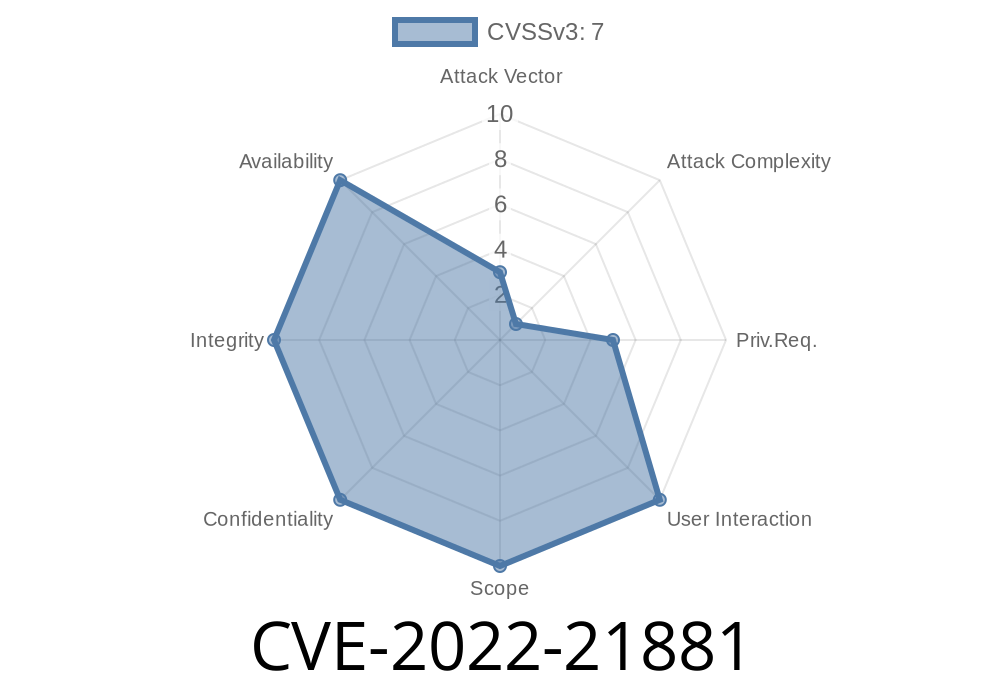
Windows is the backbone of millions of computers in businesses and homes. Should a vulnerability arise in the Windows kernel, especially one that lets attackers run code as SYSTEM, that risk spreads far and wide. CVE-2022-21881 is one such serious vulnerability that made its way into security news and Microsoft’s Patch Tuesday updates in January 2022. In this article, we will break down, in plain language, what CVE-2022-21881 is, look at a basic code example showing its possible exploitation, and provide resources for reading more and defending your systems.
What is CVE-2022-21881?
CVE-2022-21881 is an Elevation of Privilege (EoP) vulnerability in the Windows kernel. Specifically, it relates to how the Win32k kernel-mode driver handles objects in memory. If exploited successfully, an attacker could execute code as SYSTEM—basically obtaining the highest possible privilege on a Windows machine.
How Does the Vulnerability Work?
The flaw lies in how win32k.sys manages memory for certain kernel objects. Through an application running on a target system, an attacker can trigger an improper handling/validation of objects—leading to a corruption in kernel memory. This can then be leveraged to escalate privileges from a regular user to SYSTEM.
In straightforward terms: if malware or a malicious user manages to run code on your PC, they could completely take over the PC—installing other malware, exfiltrating data, or disabling security tools.
A Simple Exploit Overview
The real-world exploits for this CVE are non-trivial, but security researchers have documented proof of concept code showing the flaw. Here’s a simplified, illustrative example (not a working exploit!) that demonstrates the general idea of how attackers abuse such vulnerabilities in Win32k:
// Pseudo C code for abuse
#include <windows.h>
#include <stdio.h>

// Assume we have user-level code on the target machine
int main() {
    // An attacker would try to create/use certain Windows objects
    HWND hwnd = CreateWindowEx(
        ,                      // Window styles
        "BUTTON",               // Predefined class
        "Exploit",              // Window name
        WS_OVERLAPPEDWINDOW,    // Style
        , , 100, 100,         // Position and size
        NULL, NULL, NULL, NULL
    );

    if (hwnd == NULL) {
        printf("Failed to create window.\n");
        return 1;
    }

    // Exploit logic would follow:
    // - Allocate and free Windows objects (like menus, windows, brushes) in very specific orders
    // - Trigger a condition where win32k mishandles an object, leading to memory corruption
    // - Use this condition to write controlled data into privileged memory areas

    // In a full exploit, attacker could overwrite process token to gain SYSTEM privileges

    printf("Exploit logic executed.\n");
    return ;
}
*Note: This code is only a conceptual illustration. It cannot be used for exploitation, but shows the general approach attackers take—interacting with Windows kernel objects from user space.*
Real Exploit Availability
By late January 2022, security researchers had published several proof of concept exploits for CVE-2022-21881.
Original Microsoft advisory:
https://msrc.microsoft.com/update-guide/vulnerability/CVE-2022-21881
ZDI advisory:
ZDI-22-043: Microsoft Windows Win32k NtGdiGetBitmapBits Integer Overflow EoP Vulnerability
Security researcher writeup:
https://notselwyn.dev/blog/2022/Windows-Kernel-LPE/ (great technical explanation)
Public exploit PoC references:
https://github.com/klinix5/Windows-Exploit-Writeups/tree/master/CVE-2022-21881
CVE-2022-21881 affects
- All supported Windows client and server versions (including Windows 7/8/10/11 and Windows Server editions up to 2022)
Both 32-bit and 64-bit versions
If you haven’t installed security updates from January 11, 2022 (or later), you are likely still vulnerable.
Restrict standard users: Where possible, use accounts with limited privileges.
- Monitor for abnormal activity: Check for suspicious processes, new users, and unusual system modifications, as these can indicate privilege escalation.
Summary
CVE-2022-21881 is a major Windows kernel bug that lets attackers elevate privileges to SYSTEM. Even though exploiting it requires local access, malware can use it to escape sandboxing or limited user access. Keeping all Windows machines updated is vital. For IT and security folks, understanding what kinds of memory corruption bugs lurk in the kernel is useful for both incident response and prevention.
If you want to dig deeper, check out the references above, and always keep software current.
Stay Safe & Patch Regularly!
_Disclaimer: This post is for educational purposes only. Do not use this information for unauthorized or unlawful activity._
Timeline
Published on: 01/11/2022 21:15:00 UTC
Last modified on: 08/19/2022 10:56:00 UTC