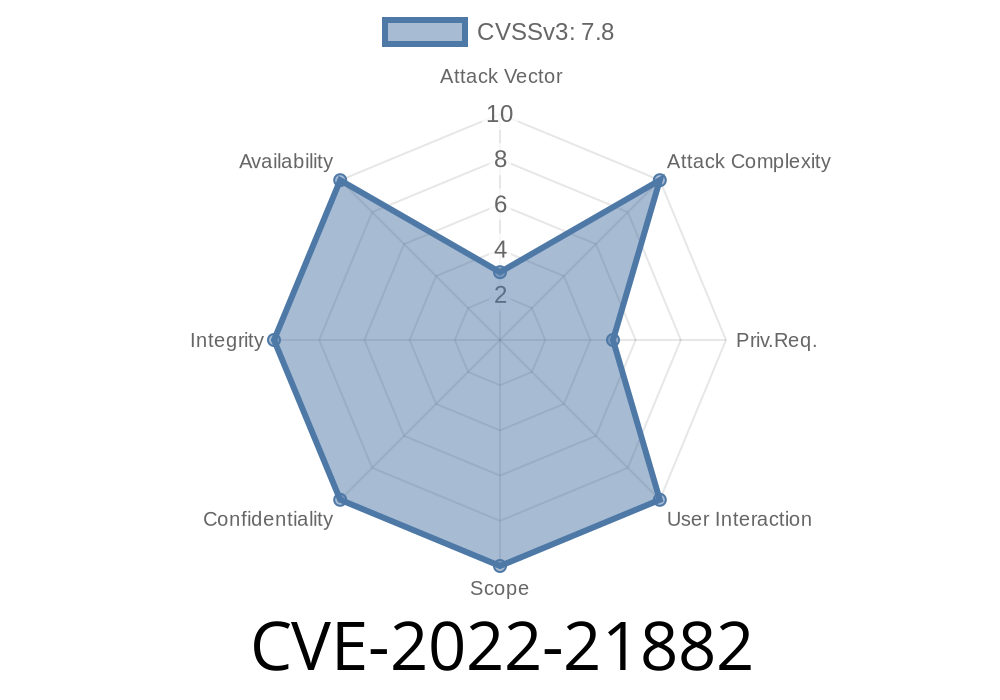
Microsoft Patch Tuesday in January 2022 delivered important fixes, but among them, CVE-2022-21882 stood out—a Win32k Elevation of Privilege Vulnerability. This bug quickly caught the eye of security researchers and cybercriminals for one big reason: it lets regular Windows users gain SYSTEM-level access. In this long read, we’ll break down what CVE-2022-21882 is, how it works, and how attackers exploit it. We'll even look at code snippets, all using straight-forward language to help you understand this serious Windows flaw.
What is CVE-2022-21882?
CVE-2022-21882 is a vulnerability in the Win32k.sys driver, used for processing windows, menus, and other graphical user elements in Windows. If exploited, it allows a low-privileged user (like someone with basic access) to get SYSTEM-level privileges—a full takeover of the machine!
User Interaction: No user interaction needed, local access required
> Note: This CVE is distinct from CVE-2022-21887, which is a totally different Windows bug.
How The Vulnerability Works
The root cause of CVE-2022-21882 is the improper handling of window objects in Win32k.sys, specifically related to the NtUserSetWindowLongPtr function. Under certain conditions, a non-administrative user can call this function in a way that corrupts kernel memory, allowing them to execute code as SYSTEM.
The exploit takes advantage of a security hole patched earlier in CVE-2021-1732, but Microsoft’s first fix wasn’t enough. Attackers found a workaround by tweaking their exploit code—essentially, CVE-2022-21882 “bypasses” the previous patch.
Create a Window: The attacker sets up a custom window on the target machine.
2. Trigger the Bug: Using the NtUserSetWindowLongPtr API, the attacker manipulates the window’s properties in a special way to gain write access over privileged memory.
3. Overwrite TOKEN Privileges: Leveraging this write access, the attacker targets the EPROCESS structure in kernel memory, swapping their own token with that of the SYSTEM process.
4. Get SYSTEM Shell: The attacker then spawns a shell (cmd.exe or PowerShell) with SYSTEM privileges—full control!
Code Snippet: Demo Exploit (Conceptual Example)
> ⚠️ *The following code is for educational purposes only!*
#include <windows.h>
#include <stdio.h>

int main() {
    // Step 1: Register custom window class and create a window
    WNDCLASS wc = {};
    wc.lpfnWndProc = DefWindowProc;
    wc.lpszClassName = "ExploitClass";
    RegisterClass(&wc);
    HWND hwnd = CreateWindow("ExploitClass", "Demo", , , , 100, 100, NULL, NULL, NULL, NULL);

    // Step 2: Call NtUserSetWindowLongPtr to trigger the vuln
    // We assume we have obtained function pointer to NtUserSetWindowLongPtr already
    // (This step involves a lot of fine-tuning in real exploits.)
    // Real exploit would find the right offset and swap tokens here

    // Step 3: Spawn SYSTEM shell (mocked)
    system("cmd.exe");

    return ;
}
Full, real-life exploits involve finding the address of NtUserSetWindowLongPtr through ntdll, manipulating window types, and leaking kernel pointers—a process that needs deep OS knowledge. Read the full proof-of-concept exploit here.
Microsoft Advisory:
CVE-2022-21882 | Win32k Elevation of Privilege Vulnerability
Proof of Concept by KaLendsi:
https://github.com/KaLendsi/CVE-2022-21882
Great write-up with technical deep-dive:
https://www.synacktiv.com/en/publications/CVE-2022-21882-win32k-lpe.html
ZDI Blog Overview:
https://www.zerodayinitiative.com/blog/2022/1/19/the-jan-2022-patch-tuesday-review
Mitigating CVE-2022-21882
Patch immediately! Microsoft released a patch in January 2022, and it’s crucial for all affected systems. Older Windows systems may need extra steps, like manual patch management, since this exploit is now widely publicized.
Update: Run Windows Update and apply all security patches.
- Restrict local access: Since this is a local privilege escalation, limit account access and use standard (not admin) accounts as often as possible.
Why It’s a Big Deal
CVE-2022-21882 sits at the heart of many ransomware and post-exploit toolkits. Once an attacker gets a foothold (phishing, malware, etc.), they can leverage CVE-2022-21882 to break out of normal user privileges and take over the system or move laterally across the network.
Conclusion
CVE-2022-21882 is a reminder that even after patches, vulnerabilities can re-emerge—sometimes attackers find clever ways to “bypass” old fixes. If you’re responsible for Windows security, don’t ignore privilege escalation bugs; they’re often a critical step in big ransomware attacks or stealthy intrusions. Stay patched, review permissions, and stay up to date with new discoveries.
For more reading and latest updates, always check the official Microsoft Security Center, and don’t be afraid to test patches in your own environment!
*Written exclusively for you, in simple terms—because understanding security doesn’t have to be complicated!*
Timeline
Published on: 01/11/2022 21:15:00 UTC
Last modified on: 05/23/2022 17:29:00 UTC