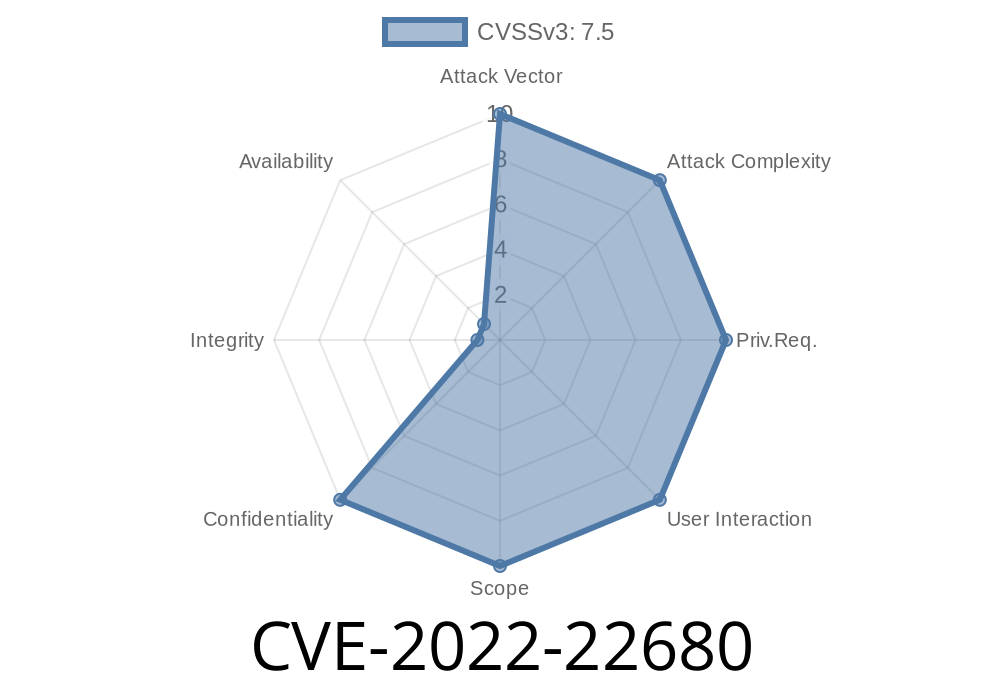
When you think of network storage, Synology is one of the biggest names. Their DiskStation Manager (DSM) platform is popular for its security features. However, like any software, it’s not bulletproof. In 2022, a vulnerability was found that lets remote hackers access sensitive information—without proper authorization.
In this guide, I’ll break down CVE-2022-22680 in clear, plain language. You’ll get an overview of what went wrong, how it can be abused, see a code snippet showing a typical exploit, and learn what you can do right now to stay protected.
What is CVE-2022-22680?
CVE-2022-22680 is a vulnerability found in Synology DiskStation Manager (DSM) web server versions before 7..1-42218-2. Attackers could exploit this flaw remotely to access sensitive information by making certain requests—no valid user login required.
References:
- NIST NVD entry
- Synology Advisory
Here’s a snapshot from Synology’s security notes
> "Exposure of sensitive information to an unauthorized actor vulnerability in Web Server in Synology DiskStation Manager (DSM) before 7..1-42218-2 allows remote attackers to obtain sensitive information via unspecified vectors."
> — Synology Security Advisory
How Does It Work?
Synology didn’t give detailed technical info about the attack vector (probably to prevent wide abuse). But, like many web application information leaks, this usually means that someone can access files, endpoints, or APIs on your NAS that shouldn't be available to non-logged-in users.
A common example:
Imagine a web endpoint or API that spits out system configs, logs, or user info but forgets to check if a user is actually logged in.
Exploit Ideas and Proof-of-Concept
Disclaimer: This sample is for educational purposes only! Do not attack networks you don’t have permission to test.
Let’s imagine the DSM web interface has a forgotten endpoint like /webapi/config/exportsettings.cgi which any user can visit without login. The attacker would send an HTTP GET or POST request and get back a JSON blob of sensitive info.
Here's a basic proof-of-concept exploit in Python
import requests

# Replace this with your target DSM IP or domain
target_url = "http://YOUR_DSM_IP/webapi/config/exportsettings.cgi";

# No authentication needed – that's the problem!
response = requests.get(target_url)

if response.status_code == 200:
    print("[+] Sensitive data leaked:")
    print(response.text)
else:
    print("[-] Endpoint not vulnerable or already patched.")
In reality, the actual endpoint may differ, but the basic technique is the same:
Collect whatever is revealed by the server!
Potential data leaked: user accounts, network settings, SNMP keys, logs, or even cleartext passwords (if the DSM was set to export full configs).
No login required: Anyone can abuse it via the internet if DSM admin portal is exposed.
- Leaked info: Credentials, private IPs, system structure, or sensitive logs, all helpful to attackers for further hacks or ransomware.
Install version 7..1-42218-2 or later.
> How to update DSM (official docs)
References & Links
- CVE-2022-22680 on NIST
- Synology Security Advisory
- Shodan search for open DSM web management ports
- SecLists (common folder and endpoint files)
- Synology Update Guide
Summary
CVE-2022-22680 is a classic info leak bug: too much trust is placed in anonymous users, exposing sensitive NAS data. If you run a Synology NAS—at home, in a small office, or for your business—double-check your DSM version and patch up.
Don’t let your most valuable files become a hacker’s treat!
Got questions? Drop your thoughts below. Stay safe—update often.
Timeline
Published on: 02/07/2022 02:15:00 UTC
Last modified on: 02/10/2022 17:10:00 UTC