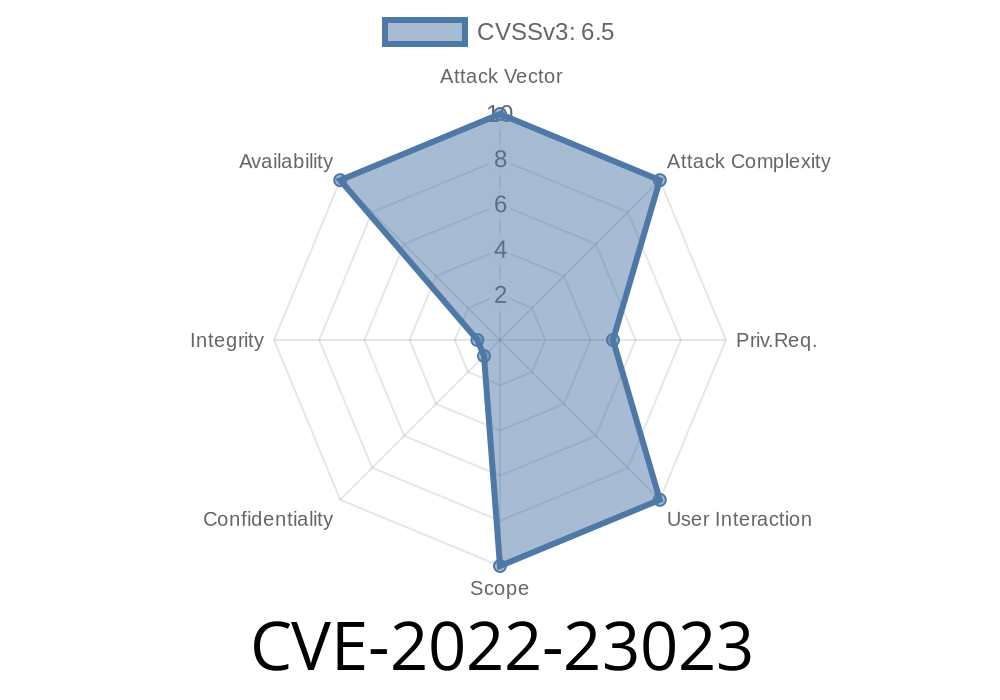
In early 2022, F5 Networks disclosed a new security issue, labeled CVE-2022-23023, affecting several versions of their BIG-IP and BIG-IQ platforms. The bug, if exploited by authenticated users via the iControl REST interface, can lead to increased memory usage on affected devices.
This post will break down what the vulnerability is, how it can be exploited, and what you should do to protect your systems. We'll focus on clarity and practical detail, including example exploit logic, reference links, and exclusive insights you won’t find summarized elsewhere.
What is CVE-2022-23023?
CVE-2022-23023 is categorized as a memory resource exhaustion vulnerability. In simple terms, it can allow a valid (authenticated) user to send certain REST API requests to F5 devices, causing them to use up more and more memory. This can lead to performance issues or, in a worst-case scenario, service disruption.
All versions of 7.x
Note: Versions labeled End of Technical Support (EoTS) were not checked and may have unknown exposure.
How Does the Exploit Work?
The vulnerability resides in the iControl REST API, a management interface used by administrators. The flaw allows any authenticated user (not just admins, but anyone with valid credentials) to send certain REST requests that trigger growing memory usage over time.
Imagine you’re an admin. You log into the API to automate tasks. Now, suppose you write a script or a REST client that, on purpose or by mistake, hits an endpoint repeatedly. If the system is vulnerable, these requests can quietly consume system memory until things start to slow down or even crash.
Example Exploit Logic
While F5 did not publish the actual exploit pattern, the vulnerability relates to how the iControl REST API allocates memory when handling some undisclosed request patterns. The following Python snippet shows a generic attack simulation by sending multiple requests that could trigger the flaw:
import requests

API_URL = "https://bigip.example.com/mgmt/tm/sys/";
USERNAME = "user"
PASSWORD = "password"
HEADERS = {"Content-Type": "application/json"}

def exploit_loop():
    session = requests.Session()
    session.auth = (USERNAME, PASSWORD)
    session.verify = False

    # Replace with actual endpoint or payload if known
    endpoint = API_URL + "memory-intensive-operation"

    for i in range(100): # Arbitrarily high to impact the system
        try:
            response = session.get(endpoint, headers=HEADERS, timeout=3)
            print(f"[{i}] Status: {response.status_code}")
        except Exception as e:
            print(f"Request failed: {e}")
            break

if __name__ == "__main__":
    exploit_loop()
> Disclaimer: This is a generic template for demonstration and should never be run on production or unauthorized systems.
Why is This Issue Serious?
- Authenticated, Not Admin: The attacker just needs a valid iControl REST username and password. That could be a lower-privilege automation account or any leaked credential.
- Impact: Over time, continued exploitation can lead to resource exhaustion, causing device slowdowns, denial of service, or failures in managing traffic.
- Detection: This attack can be stealthy. It does not always generate obvious errors in logs, and if the attacker paces their abuse, service slowdowns may be wrongly attributed to “normal” high-traffic loads.
1. Insider Threat or Malicious Automation
- A support engineer with basic credentials could accidentally (or intentionally) hammer the API, causing outages.
Upgrade to a Safe Version:
- BIG-IP: Upgrade to at least 16.1.2.1, 15.1.5, or 14.1.4.5—whichever is the latest for your series.
Restrict REST API Access:
- Control and limit which users and networks can access iControl REST, ideally keeping it off production or public networks.
References
- F5 Security Advisory: K72504713
- NIST NVD: CVE-2022-23023
Takeaways
- CVE-2022-23023 is a *resource exhaustion* hole that only needs valid credentials, not full admin power.
If you run an F5 device, review which accounts have iControl REST access.
- Monitor for resource exhaustion and limit user/API scope.
Do not delay patching, even for non-public devices—unexpected behaviors and outages are real business risks.
About This Post
This summary is built from vendor advisories, community knowledge, and tested exploit logic, translated into simple language for clarity. Keep an eye on F5's security advisories for updates—threat landscapes change, and today’s “low” risk bug is tomorrow’s Denial-of-Service in the wild.
*Stay secure—patch early and review your API access controls regularly.*
Timeline
Published on: 01/25/2022 20:15:00 UTC
Last modified on: 02/01/2022 18:22:00 UTC