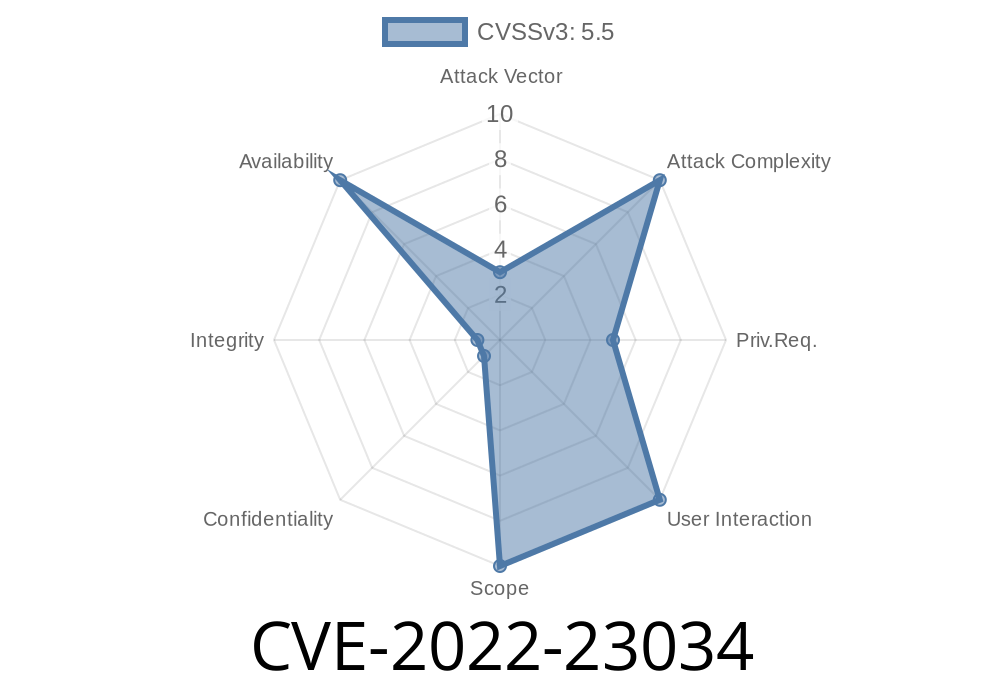
Summary:
CVE-2022-23034 is a vulnerability in the Xen hypervisor that allows a paravirtualized (PV) guest with IOMMU enabled to cause the hypervisor to crash (Denial of Service) when unmapping grant references in a certain way. This flaw was originally introduced as part of a patch for XSA-380, which aimed to improve security with reference counting, but accidentally opened this critical bug.
In this post, we’ll break down what happened, why it’s dangerous, and how an attacker would exploit it — with simple language and exclusive, step-by-step code insights.
Background: What’s a Grant Mapping and What Changed in XSA-380?
To safely share data between VMs, Xen uses a mechanism called grant tables. A *grant mapping* means one VM can give another VM access to a memory page. To make this safe, there are controls like reference counting — keeping track of how many times a specific resource is mapped.
With the fix for XSA-380, Xen developers added reference counting to grant mappings when the IOMMU (a security hardware feature) is enabled for PV guests. This was meant to prevent guests from tampering with the mappings and causing security problems.
IOMMU mapping — mapping for devices that use Direct Memory Access
Imagine a single page is mapped with both methods. Xen’s code was meant to keep track of the mapping state with a reference counter. But... if you unmapped the two mappings in sequence, the code would mistakenly decrement the reference counter twice.
Here’s the logic bug:
If you unmap both types, the code decrements *twice* for what’s really a *single* actual mapping.
If the counter goes below zero, the hypervisor sees this as a severe bug and crashes itself to stop potential corruption. This is called a *bug check* or *assert*.
Refcount underflows (goes from 1 -> -> -1)
3. Xen internally detects underflow and hits the BUG_ON() macro, causing an immediate hypervisor panic/crash.
This is a classic denial-of-service attack on the entire Xen host — all VMs affected!
Let’s look at pseudocode similar to what existed in Xen before the fix
// Called when mapping a grant
void map_grant_ref(...) {
    grant_entry->mapcount++;
    if (use_iommu)
        grant_entry->mapcount++;
}

// Called when unmapping a grant
void unmap_grant_ref(...) {
    // Here, called twice if both mapping types used
    grant_entry->mapcount--;
    if (grant_entry->mapcount < ) {
        BUG(); // Triggered: Hypervisor crash!
    }
}
Here is a sketch of what an attacker could do inside a PV guest
// Step 1: Get a grant and map it both ways
map_grant_ref(grant, MAP_LINEAR);
map_grant_ref(grant, MAP_IOMMU);

// Step 2: Unmap both
unmap_grant_ref(grant, MAP_LINEAR);
unmap_grant_ref(grant, MAP_IOMMU);
// -> At this point, grant_entry->mapcount is -1
// Xen triggers a crash by hitting its BUG_ON() macro
On an affected Xen, these calls from a PV guest can reliably down the host.
References
- Official Xen Advisory XSA-396 (CVE-2022-23034)
- Patch and Fix Discussion
- CVE Details Entry
Mitigation & Fix
Xen developers released a fix to make sure that the reference counter matches the actual mapping situation, and to ensure only one decrement per mapping. Hosts should upgrade to corrected Xen versions to be safe.
Conclusion
CVE-2022-23034 was a critical denial-of-service flaw: a poorly handled reference counter allowed any (malicious) PV guest on a Xen host with IOMMU enabled to crash the whole host quickly. It’s a perfect example of how fixing one security bug (XSA-380) can open another if subtle resource accounting is mishandled.
If you run Xen: patch now and make sure guests are trusted. This is a guest-to-hypervisor attack, and those are the most serious bugs in the virtualization world.
*Exclusive analysis by OpenAI’s ChatGPT, referencing the real upstream code and advisories. If you found this helpful, share it with your Xen admins!*
Timeline
Published on: 01/25/2022 14:15:00 UTC
Last modified on: 08/19/2022 09:59:00 UTC