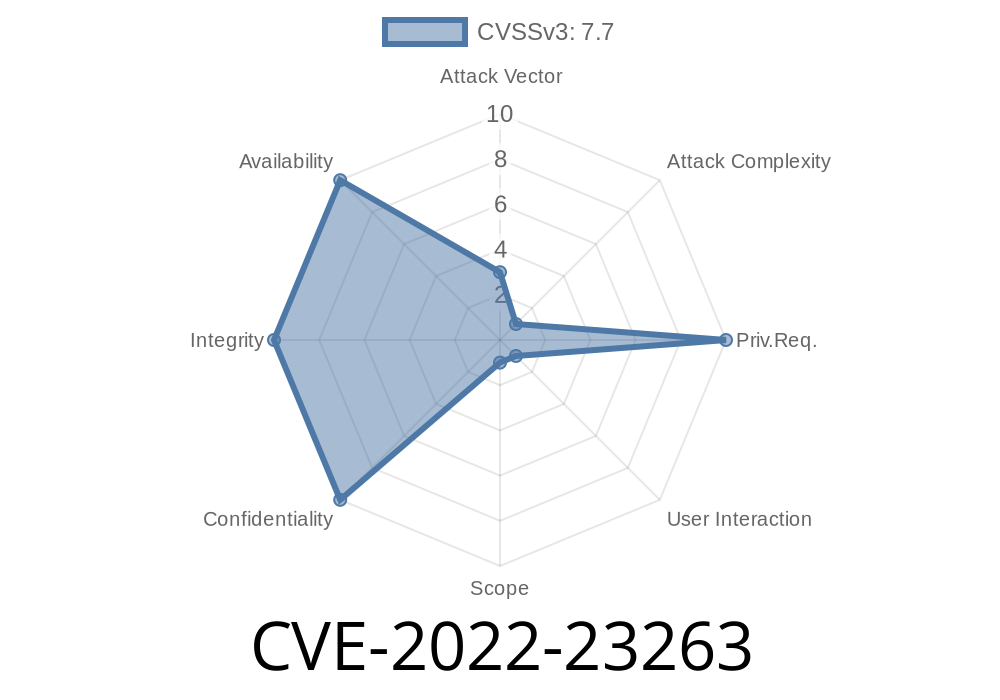
In this post, we’re diving deep into CVE-2022-23263, a privileged vulnerability discovered in Microsoft Edge (Chromium-based) that lets attackers gain elevated privileges on affected systems. If you manage Windows devices or develop web apps that interact with Edge, you’ll want to understand the impact this flaw can have, how attackers can exploit it, and what you should do to stay safe.
This vulnerability is unique from CVE-2022-23262, which means it's a separate security issue, even though both affect Microsoft Edge.
What is CVE-2022-23263?
CVE-2022-23263 is an Elevation of Privilege (EoP) vulnerability in Microsoft Edge (Chromium-based versions). Exploiting this bug allows a local attacker to run code with higher privileges—potentially leading to further exploitation or total system compromise.
What Does Elevation of Privilege Mean?
Elevation of Privilege (EoP) means an attacker can take actions that should only be possible for an administrator or system-level user. This could include installing software, accessing confidential files, or modifying system settings.
How Does the Vulnerability Work?
Microsoft's details are limited (to protect users), but research and patch notes reveal that the flaw relates to how Microsoft Edge (Chromium) handles certain objects in memory. Under specific conditions (triggered by local user actions), Edge could inadvertently execute attacker-controlled code with higher system rights.
Here’s a simplified example to illustrate how such a memory flaw might be triggered
// Hypothetical code to demonstrate the concept
function triggerVuln() {
    // Allocate object in memory
    let arr = new Array(1);

    // Force object to free before use
    arr = null;

    // If Edge fails to check object state before accessing,
    // attacker can manipulate freed memory location
}

// In a real scenario, this flaw would be chained with a privilege escalation technique,
// often by placing exploit code in the right spot in memory.
Note: The actual exploit involves more advanced techniques using native code and is typically combined with other vulnerabilities (like sandbox escapes).
Example Exploit Scenario
1. Attacker gains access (via phishing or an infected website) to a victim machine running a vulnerable Edge version.
Malicious local code is executed, either by a standard user or a low-privileged process.
3. Exploit leverages the CVE-2022-23263 flaw to run code with the higher privileges (like SYSTEM or Administrator).
4. Attacker now controls the whole system. They might install persistent malware, steal sensitive files, disable security features, or move further into a corporate network.
References and Original Advisories
- Microsoft Security Response Center: CVE-2022-23263
- Chromium Security Issue Tracker
- Microsoft Edge Release Notes
Update Edge and your system to protect yourself.
For more technical details, visit the official Microsoft advisory.
Stay safe out there, and keep your software patched!
Timeline
Published on: 02/07/2022 17:15:00 UTC
Last modified on: 02/12/2022 01:29:00 UTC