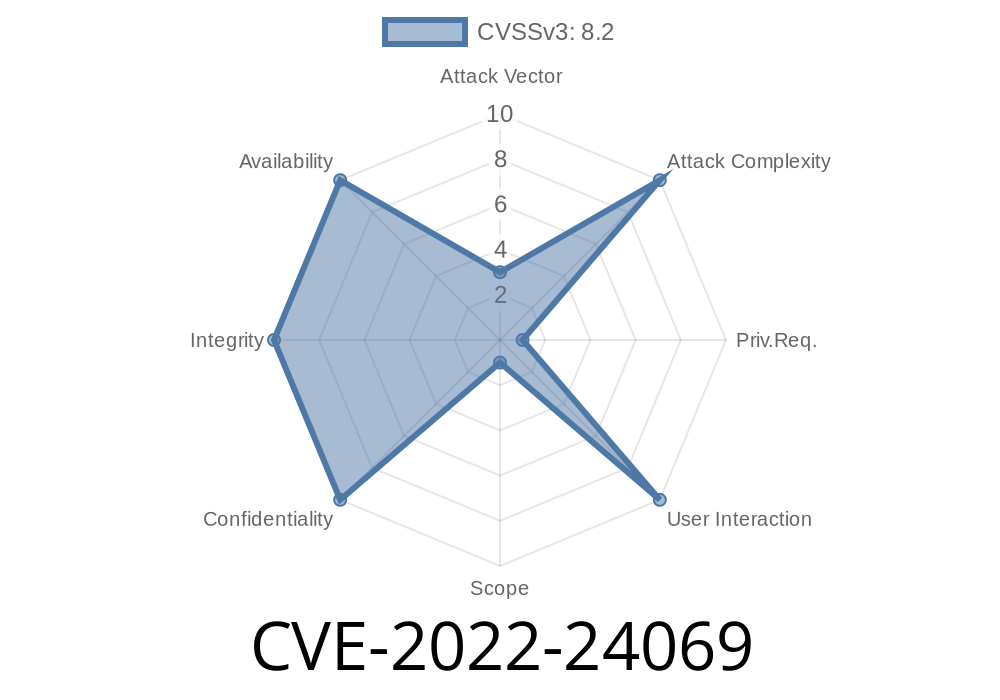
CVE-2022-24069 is a critical vulnerability in the Insyde InsydeH2O UEFI firmware, specifically in the AhciBusDxe driver. This bug exposes a weakness where an attacker can hijack the execution flow of code that runs in System Management Mode (SMM). Successfully exploiting the bug can provide the highest privilege access on the system, beyond the reach of even the operating system and hypervisors.
What’s InsydeH2O and SMM?
InsydeH2O is firmware used by many PC and laptop manufacturers to control hardware at the lowest level (think BIOS/UEFI). Kernel versions 5. through 5.5, prior to specific updates, are affected.
System Management Mode (SMM) is a special CPU mode separate from those used by the operating system. SMM code and memory are locked down and used only for functions like power management or firmware updates. If an attacker gets code running in SMM, they own the system at the deepest level.
The Bug: SMM Callout in AhciBusDxe
An "SMM callout" occurs when firmware code running at a lower privilege (like UEFI DXE drivers) inadvertently makes an unsafe call into System Management Mode code—that’s like letting a random guest into the server room.
What Goes Wrong
The vulnerable code lets an attacker with local access (say, running malware as admin/root) provide input that changes what the SMM handler does. If the SMM handler trusts that input *without* verifying it—like pointers, buffers, or function pointers—an attacker can steer SMM execution to code they control.
While the original, proprietary source isn't public, a simplification could look something like this
// Vulnerable call in AhciBusDxe:
VOID HandleSmmCall(IN EFI_SMM_COMMUNICATE_HEADER *CommBuffer) {
    // Attacker controls CommBuffer->Data
    FuncPointerType func = (FuncPointerType)CommBuffer->Data;
    func(); // Direct call, no validation!
}
Problem:CommBuffer->Data comes from untrusted input and gets executed blindly.
Safer code would *only* call known internal SMM functions, ignoring user input.
How Is This Exploited?
Detailed exploits for firmware bugs are rare in the open due to their dangerous nature, but the basic steps to abuse this flaw:
Get Privileged OS Access: The attacker (or malware) must already run as SYSTEM or root.
2. Craft Malicious Communication: Use the SMM communication mechanism (usually via /dev/mem in Linux or third-party tools in Windows) to craft a data structure or a buffer which points to code controlled by the attacker.
3. Trigger the SMM Handler: Coax the firmware (using a legitimate or spoofed call) into processing the malicious input.
4. Gain SMM Execution: If the handler executes attacker-supplied addresses/pointers, code now runs in SMM—full ring -2 privileges. Attackers can then dump/decrypt secrets, implant persistent rootkits, or bypass security features forever.
Here's how a proof-of-concept exploitation could look in a safe, controlled environment
# Pseudocode ONLY. Do not use on production.
# Assumes vuln SMM communication interface is mapped to /dev/smm

import mmap

def trigger_exploit():
    # Prepare malicious buffer
    payload = b"\x90" * 100    # Example NOP sled (real exploit inserts shellcode)
    fake_func_ptr = x12345678 # Attacker-controlled func ptr
    buffer = payload + fake_func_ptr.to_bytes(8, "little")

    with open("/dev/smm", "wb") as f:
        f.write(buffer)  # Send buffer to the SMM communications interface

trigger_exploit()
*This is a very simplified example*, but the essence is: craft a buffer with attacker-controlled code/data, send it to SMM, and trigger unsafe execution.
Who Is Affected?
Any PC, laptop, or device using Insyde InsydeH2O with the vulnerable AhciBusDxe driver and not updated to a safe kernel/firmware revision. This includes many major OEMs (Acer, HP, Dell, Lenovo, and others). Servers, industrial boxes, and embedded systems may also use this firmware.
Mitigation
- Update your firmware: Only a firmware update from your device/OEM can fix this for sure.
Check for updates at your manufacturer's support page.
- See Insyde’s advisory: Insyde Security Advisory (SA-2022047)
- Limit admin/root access: Prevent malware and attackers from getting high privileges in the first place.
Use endpoint security: Some security products can warn about suspicious SMM interaction.
- Monitor for unusual firmware activity: Sudden reboots, firmware changes, or odd hardware errors could be a sign.
References
- NVD CVE-2022-24069
- Insyde Security Advisory - SA-2022047
- Binarly Analysis (archived)
- Firmware SMM Security
Conclusion
CVE-2022-24069 is a dangerous flaw giving attackers a path straight into the heart of your computer's firmware. If left unpatched, any malware that gets admin rights could entrench itself deeper than any OS reinstall can fix. The only fix is a firmware update from your device maker.
Check your firmware version, patch ASAP, and keep a wary eye for strange activity at the firmware level!
*Stay safe, patch early, and remember: the only good SMM bug is a fixed SMM bug.*
Timeline
Published on: 02/03/2022 00:15:00 UTC
Last modified on: 03/29/2022 16:35:00 UTC