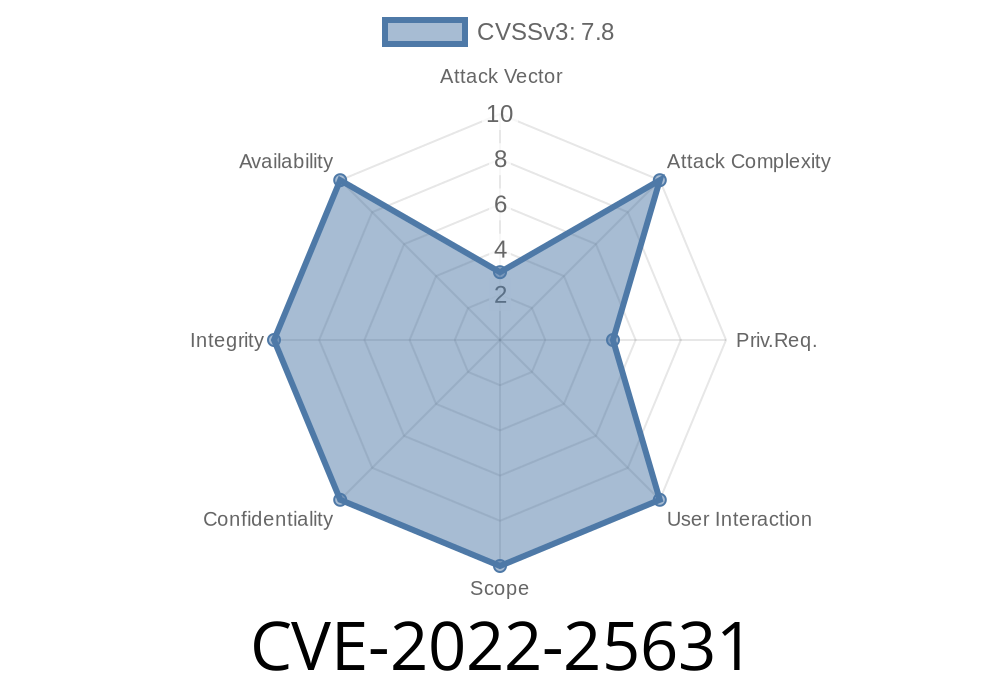
Symantec Endpoint Protection is a widely used security solution in enterprise environments. It plays a vital role in protecting business systems from malware, ransomware, and unauthorized access. Unfortunately, even trusted software like this can have vulnerabilities. CVE-2022-25631 is one such issue affecting Symantec Endpoint Protection (SEP) before version 14.3 RU6 (14.3.921.600), and it allows attackers to escalate privileges—a very dangerous scenario in any organization.
In this post, I’ll break down how CVE-2022-25631 works, show you code snippets demonstrating the problem, outline how attackers might exploit it, and provide references for deeper reading. Let’s start with the basics.
What Is CVE-2022-25631?
CVE-2022-25631 is an Elevation of Privilege (EoP) vulnerability in SEP. That means a low-privileged user could take advantage of a flaw in the software to gain higher privileges on the system—potentially even full admin rights. Once this happens, the attacker might install unauthorized software, alter critical files, disable security controls, or move laterally across the network.
According to Broadcom’s official advisory (source here), systems running SEP versions older than 14.3 RU6 are at risk. The company has addressed this in 14.3 RU6 (build 14.3.921.600) and newer.
How Does the Vulnerability Work?
The flaw exists because of improper privilege management in certain SEP components. In simple words, SEP installs and runs processes and services that, due to insecure permissions or poor separation of privileges, could be abused by a non-admin user to execute code as SYSTEM.
Attackers might exploit this in several ways. The most common pathway is abusing writable directories or improperly protected services that belong to SEP, allowing an attacker to replace legitimate files with malicious ones that run with elevated permissions.
Attacker’s code runs with SYSTEM privileges.
Below is a simplified example of a code snippet an attacker might use to drop a payload into a location owned by _Everyone_ group—illustrating the risk of improper permissions:
import os
import shutil

# Attacker-controlled payload
malicious_exe = "C:\\Users\\Attacker\\malicious.exe"

# Vulnerable SEP folder, hypothetically writable by all users
vulnerable_dir = "C:\\Program Files\\Symantec\\SEP\\bin\\"

# Name of the legitimate SEP executable
target_process = "SepService.exe"

# Replace legitimate SEP binary with malicious payload
os.remove(os.path.join(vulnerable_dir, target_process))
shutil.copy(malicious_exe, os.path.join(vulnerable_dir, target_process))
NOTE: This code is for educational demonstration only. Never use it to attack or exploit any software.
Real-World Impact
If exploited, this vulnerability lets attackers “break out” of normal restrictions. They can run code as SYSTEM, meaning:
Stealing credentials and attacking further across the network
This type of EoP bug is often a stepping stone in advanced attacks. Even if initial access is limited, leveraging this flaw can give attackers the keys to the kingdom.
How to Protect Yourself
- Update SEP: The best protection is to update Symantec Endpoint Protection to 14.3 RU6 (14.3.921.600) or later.
References
- Broadcom Security Advisory SYMSA1983 (Original)
- NIST National Vulnerability Database Entry
- Symantec Endpoint Protection - Official Download
Conclusion
CVE-2022-25631 is a prime example of why regular patching and security reviews are so important—even for software designed to protect you! By understanding how attackers exploit privilege escalation flaws, defenders can take stronger measures to lock down critical systems.
If you’re running Symantec Endpoint Protection, update right away. Stay safe!
Timeline
Published on: 01/20/2023 17:15:00 UTC
Last modified on: 02/02/2023 14:06:00 UTC