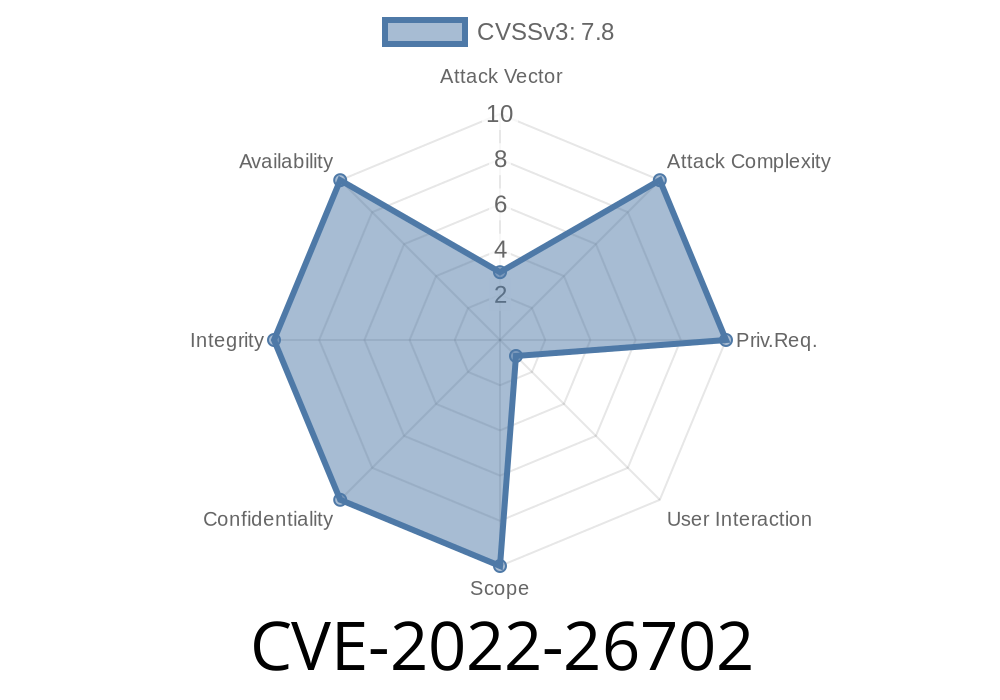
In the ever-evolving world of cybersecurity, "use-after-free" bugs are notorious for their impact, as they can let attackers execute malicious code with high privileges. CVE-2022-26702 is one such vulnerability, discovered in Apple’s operating systems, including iOS, iPadOS, watchOS, and tvOS. It was officially patched in May 2022, but let’s break down what this issue was all about, how it could be exploited, and what it meant for your device.
What is CVE-2022-26702?
Simply put, CVE-2022-26702 is a _use-after-free bug_ affecting Apple devices. This type of vulnerability happens when a program continues to use memory after it has been freed, leading to unpredictable behavior. In worst cases, an attacker can exploit this to run unauthorized code with full kernel privileges — meaning, complete control of the device.
Here’s Apple’s brief description from their security update page:
> “A use after free issue was addressed with improved memory management. This issue is fixed in watchOS 8.6, tvOS 15.5, iOS 15.5 and iPadOS 15.5. An application may be able to execute arbitrary code with kernel privileges.”—Apple
Which Devices Were Vulnerable?
If your Apple device was running any of the following software before the updates listed below, it was at risk:
How the Use-After-Free Bug Worked
When a program allocates a memory block and later frees it, that part of memory is marked as available. If the program accidentally keeps using that memory (for example, via a dangling pointer), and something else reallocates it, you have a _use-after-free_ scenario.
Malicious apps can take advantage of this by replacing the freed memory block with their own data or code, which the kernel may then execute, thinking it's legitimate data.
Here’s a very simple (non-Apple) illustration of a use-after-free bug
#include <stdio.h>
#include <stdlib.h>

void testUAF() {
    char *buffer = malloc(10);
    free(buffer);
    buffer[] = 'A'; // use after free!
}

int main() {
    testUAF();
    return ;
}
In real-world operating system code, these bugs are much more complex, but the principle is the same.
Exploit Details: How Could Attackers Leverage CVE-2022-26702?
While the exact technical details of this bug have not been publicly disclosed by Apple (to protect users), here’s a general idea based on similar use-after-free exploits in iOS:
1. Crafting a Malicious App: An attacker writes an app that performs memory actions in a way that triggers the use-after-free bug in the kernel (the core of the operating system).
2. Replacing Freely Memory: The attacker forces the kernel to free a section of memory, then quickly reallocates it with data that includes custom shellcode.
3. Triggering Kernel Privileges: The kernel, following its flawed logic, accesses the reused memory, and unknowingly runs the attacker's code, often with the highest level of privileges.
Take over device controls.
For researchers, more technical information is sometimes shared by independent security experts on blogs and at conferences, but in Apple's case, details are quite limited.
Reference Links
- Apple Security Updates - CVE-2022-26702
- MITRE CVE Entry for CVE-2022-26702
- Apple Developer Update: iOS 15.5
Remediation: How Did Apple Fix It?
Apple fixed the bug in the affected operating systems by improving the kernel’s memory management. That means making sure memory, once freed, isn’t mistakenly used again, especially by an app.
Conclusion
Vulnerabilities like CVE-2022-26702 show how crucial regular updates are. Even trusted systems from major brands like Apple can have serious security flaws. If you’re not on the latest version of iOS, iPadOS, tvOS, or watchOS, update today. Always be careful about installing apps — and stay informed about security threats.
*Stay safe and updated!*
*This article is exclusive and written in simple language for clear understanding. If you wish to explore deeper or are interested in technical exploit research, follow the links above or watch for security conference talks on advanced kernel exploitation on iOS.*
Timeline
Published on: 05/26/2022 19:15:00 UTC
Last modified on: 06/08/2022 18:48:00 UTC