---
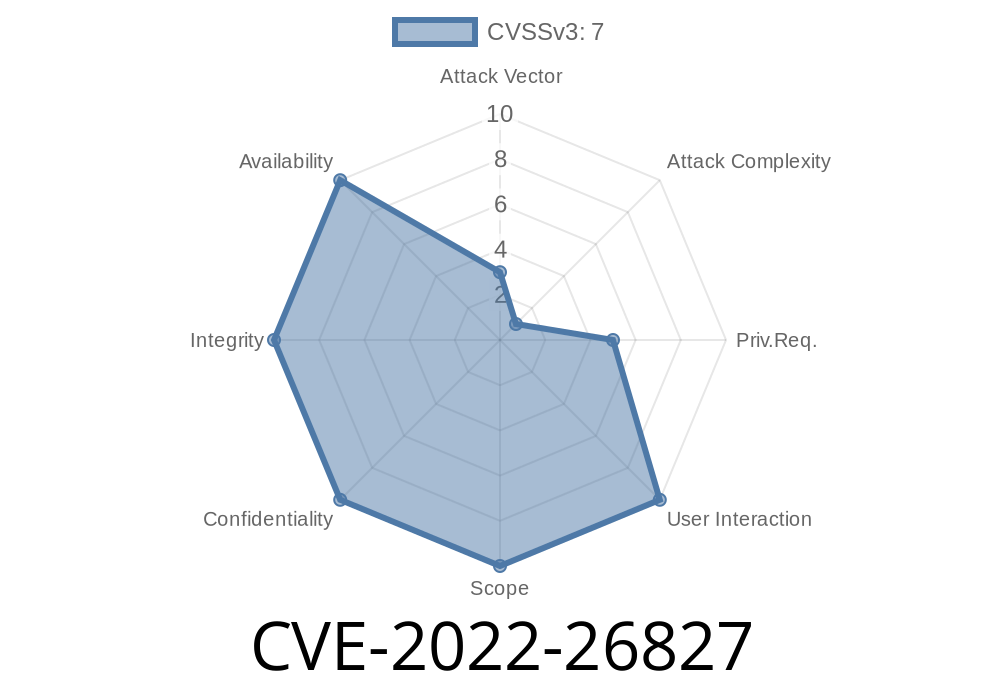
In April 2022, Microsoft addressed a critical security vulnerability—CVE-2022-26827—in the Windows File Server Resource Management (FSRM) service. This flaw allowed attackers to gain higher privileges on affected systems, posing a serious threat to enterprise environments. This article will break down the vulnerability in simple terms, discuss how it works with code snippets, and provide resources so you can protect your organization.
What is CVE-2022-26827?
CVE-2022-26827 is an "Elevation of Privilege" (EoP) vulnerability in Microsoft's Windows File Server Resource Manager (FSRM) service. The FSRM is a component used to manage and classify data stored on server file shares.
With this vulnerability, a local attacker could exploit the FSRM to execute code with SYSTEM privileges—basically the highest level of access possible in Windows, more powerful than even an Administrator.
This vulnerability does not overlap with CVE-2022-26810, which is a separate FSRM security bug.
How Does the Exploit Work?
Microsoft's own advisory was intentionally light on details, but here's a high-level breakdown of how the exploit goes:
The FSRM service runs with SYSTEM-level privileges as a Windows service (fsrmsvc).
- By sending specially crafted requests to the SRMMS (Shared Resource Management) named pipe, an attacker can trigger the service to load an arbitrary DLL (Dynamic Link Library) outside of a safe folder.
- This allows an attacker with local access to "trick" the service into running malicious code with SYSTEM permissions—which can be used to take over the machine.
Sample Proof-of-Concept (PoC)
Note: For ethical reasons, we’ll use a theoretical code snippet to demonstrate the basic attack flow, not a fully weaponized exploit.
# WARNING: DO NOT USE THIS CODE FOR ANY UNAUTHORIZED ACTIVITY
import os
import subprocess

# Suppose attacker places malicious DLL where FSRM will look
malicious_dll_path = "C:\\attack\\malicious.dll"

# Code to simulate interaction with the FSRM named pipe
SRMMS_NAMED_PIPE = "\\\\.\\pipe\\SrmPipe"

def interact_with_fsrm(pipe_name, payload):
    try:
        with open(pipe_name, 'wb+', buffering=) as pipe:
            pipe.write(payload)
    except Exception as e:
        print(f"Could not interact with FSRM pipe: {e}")

# This payload would contain the instructions to trigger the DLL load.
payload = b"\x00\x01\x02..."  # Simplified

interact_with_fsrm(SRMMS_NAMED_PIPE, payload)
In an actual attack, a user—lacking admin rights—could use something like this to instruct FSRM to load their malicious DLL, immediately running their code as *SYSTEM*.
Why is This So Dangerous?
- Privilege Escalation: Allows regular users or malware with a 'foothold' to get full system control.
- Persistence: SYSTEM access could let an attacker turn off security tools, hide processes, or plant other backdoors.
- Lateral Movement: With SYSTEM on a file server, attackers can jump to other machines more easily.
Mitigation and Detection
- Update Immediately: Microsoft fixed this issue in April 2022 Patch Tuesday updates. See the official security advisory for links to the patch for your OS version.
References and Further Reading
- Microsoft Security Advisory – CVE-2022-26827
- Windows FSRM Documentation
- Rapid7 Blog on FSRM Vulnerabilities
- exploit-db (check status for PoCs)
Summary
CVE-2022-26827 is a classic example of how critical Elevation of Privilege vulnerabilities allow attackers to 'level up' after gaining initial access. If you're running any Windows File Server infrastructure, patching is essential. Awareness and monitoring for unusual activity can also help catch abuse before it escalates.
Stay safe and make sure your systems are up to date!
Disclaimer: This article is for educational and defensive use only. Do not attempt to exploit systems without explicit authorization.
Timeline
Published on: 04/15/2022 19:15:00 UTC
Last modified on: 04/25/2022 19:24:00 UTC