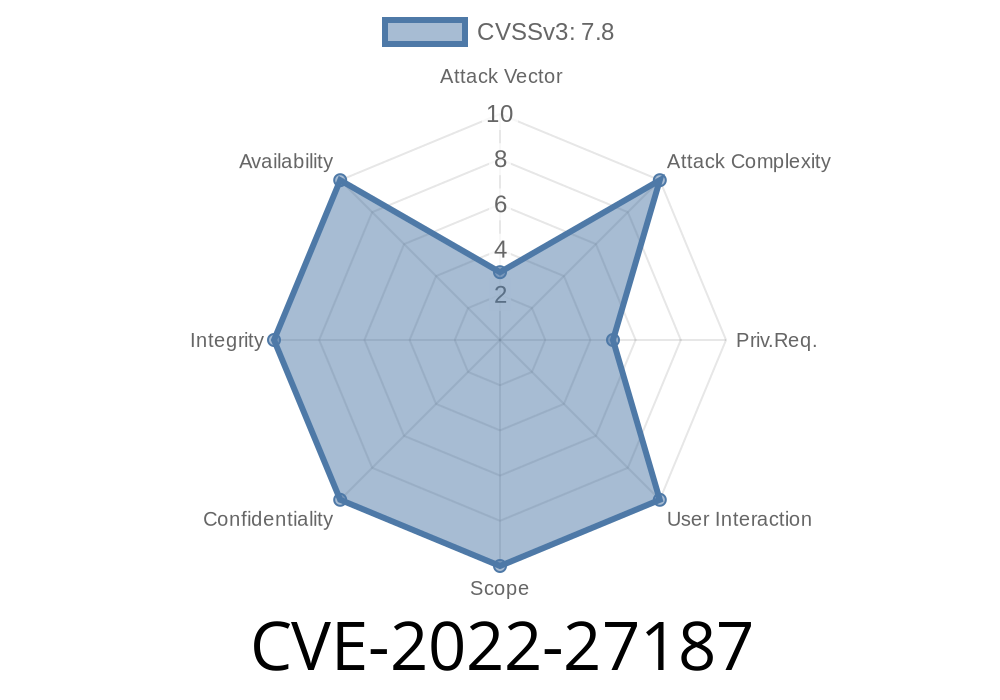
In early 2022, security researchers identified a serious vulnerability in the Intel(R) Quartus Prime Standard Edition software, tracked as CVE-2022-27187. This vulnerability pertains to an uncontrolled search path element, potentially allowing an attacker with local access to escalate privileges on the system. If you’re using Intel Quartus Prime Standard edition before version 21.1 Patch .02std, you are at risk and should patch as soon as possible.
This post breaks down what CVE-2022-27187 is, how it can be exploited, and what you need to do to stay secure.
What Is Intel Quartus Prime?
Intel Quartus Prime is a popular development environment used to design and program FPGAs (Field-Programmable Gate Arrays). Many universities and industry engineers rely on it for chip design and embedded solutions.
Vulnerability Overview
Type: Uncontrolled search path element
CVE: CVE-2022-27187
Severity: Medium (CVSS: 6.7)
Affected Software: Intel(R) Quartus Prime Standard Edition, versions before 21.1 Patch .02std
Impact: Local privilege escalation
What Is an Uncontrolled Search Path Element?
An "uncontrolled search path element" issue occurs when an application searches for resources (like libraries or executables) in insecure locations. If an attacker can place a malicious file in a directory that is searched before the correct location, the application may load the attacker’s file, resulting in unintended code execution with the application’s privileges.
How Does This Affect Quartus Prime?
Intel Quartus Prime, in vulnerable versions, calls certain executables or loads DLLs without specifying explicit and secure search paths. An attacker with access to the local system can place a malicious DLL or executable in a directory that appears in the search order before the actual system directories.
When the Quartus process launches, it may load and execute the malicious file, effectively giving the attacker the ability to run code as the user who launched Quartus—this could be an engineer, administrator, or even a system-level account.
Proof of Concept
Let’s look at a generic code example to understand how DLL hijacking via an uncontrolled search path might work. (Note: This is for educational purposes only.)
Suppose Quartus.exe loads a DLL named libfoo.dll which it expects to find in the system folder. But it does not specify the full path when loading:
// Poor DLL loading (searches through insecure directories)
HMODULE hMod = LoadLibrary("libfoo.dll");
If %PATH% contains directories writable by non-admin users (or the application runs from a directory with weak permissions), a malicious user can drop their own libfoo.dll there:
// Evil DLL (libfoo.dll)
#include <windows.h>
BOOL APIENTRY DllMain(HMODULE hModule, DWORD ul_reason_for_call, LPVOID lpReserved){
    if (ul_reason_for_call == DLL_PROCESS_ATTACH){
        system("net localgroup administrators username /add");
    }
    return TRUE;
}
This would add username to the Administrators group—clear privilege escalation.
For an attacker to exploit CVE-2022-27187, the following conditions need to be met
1. Local Access: The attacker must be authenticated and able to write files to certain directories on the system (such as temporary folders or application folders with weak permissions).
2. Execution: The attacker must know or guess which DLL or executable the application attempts to load without a full path.
3. Payload Placement: The attacker places their malicious DLL (libfoo.dll) in a directory that will be searched before the legitimate one.
4. Trigger: When Quartus Prime is launched, it unknowingly loads the malicious DLL, granting the attacker code execution in that context.
Example exploitation scenario:
If Quartus Prime is installed in C:\Program Files\Intel\Quartus and %PATH% also includes C:\Temp (which is writable by all users), an attacker can drop their malicious DLL in C:\Temp. When a privileged user launches Quartus Prime, the malicious DLL is loaded.
> For a more detailed technical explanation, check out MITRE’s advisory and the Intel Security Advisory.
Mitigation
Intel addressed this vulnerability in Quartus Prime Standard Edition 21.1 Patch .02std and later.
Update Quartus Prime:
Download the latest updates from Intel.
Original References
- CVE-2022-27187 – NIST National Vulnerability Database
- Intel Security Advisory INTEL-SA-00699
- Quartus Prime Official Website
Conclusion
CVE-2022-27187 is a classic example of how legacy software habits (like loose path handling) can lead to modern security issues, even in specialized engineering environments. If you’re running an affected version of Intel Quartus Prime, update your software now and check your installation paths for loose permissions. Don’t let a simple path search bug be your weak link!
Timeline
Published on: 11/11/2022 16:15:00 UTC
Last modified on: 11/16/2022 02:51:00 UTC