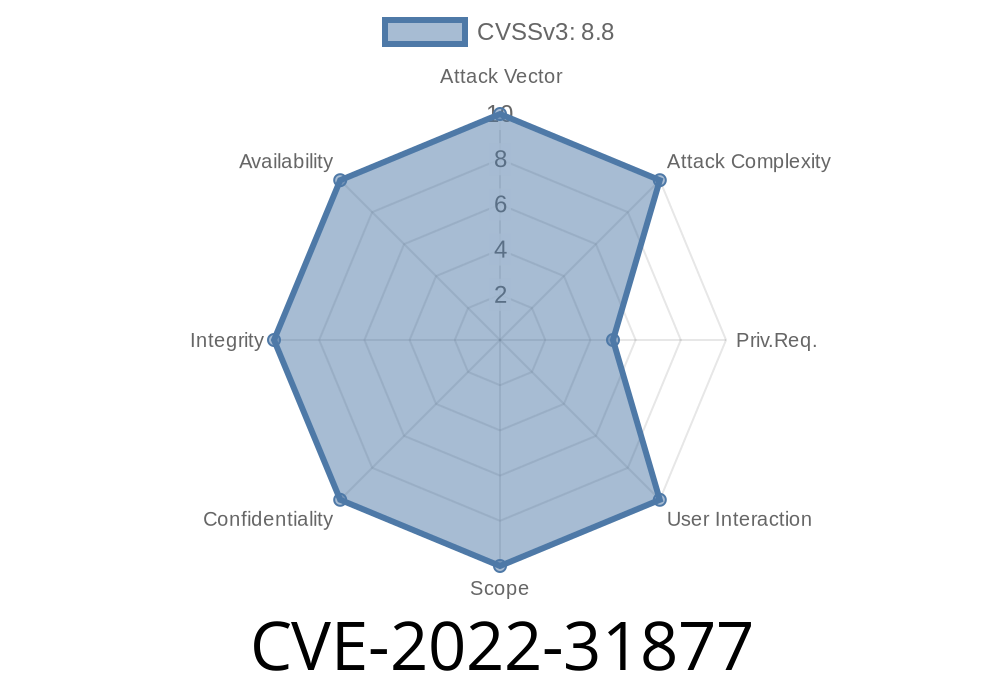
MSI, a popular hardware manufacturer, ships a software suite called “MSI Center” to help manage system settings, firmware, and more. In June 2022, cybersecurity researchers discovered a high-severity flaw in this package. The vulnerability—tracked as CVE-2022-31877—arises in the component MSI.TerminalServer.exe in MSI Center v1..41.. This post breaks down what happened, shows how the exploit works, and explains what you can do about it.
What is CVE-2022-31877?
MSI Center includes a background service called MSI.TerminalServer.exe, running with SYSTEM privileges. The vulnerability allows an attacker to send a specially crafted TCP packet to escalate privileges, ultimately gaining complete control over the Windows system.
This bug is dangerous since it does not require any user interaction once a would-be attacker has local network access. The problem is made worse because many users install MSI Center for fan control or RGB effects, never realizing that such a critical flaw lurks about.
How Does the Exploit Work?
MSI.TerminalServer.exe listens for commands on a specific (but undocumented) TCP port—usually only on localhost, but this can be exposed to wider networks by configuration mishap or malware. The service expects structured messages, but fails to properly validate received data. By abusing this lack of validation, an attacker can trick the service into executing arbitrary code or commands as SYSTEM.
Privilege: SYSTEM (highest level on Windows)
- Patch status: Update available from MSI (see MSI advisory)
Proof of Concept
Below is a simplified PoC—the real vulnerability involves crafting a payload matching the expected structure, but here’s a general example using Python. _Do not use this code on any device you don’t own and control._
import socket

# Replace with the actual port MSI.TerminalServer.exe listens on.
MSI_PORT = 12345      # Example port - must be discovered on target system.
HOST = '127...1'    # Usually loopback, but could be remote if misconfigured.

# Example malicious payload; varies between MSI Center versions.
evil_payload = b'\x13\x37\xbe\xef' + b'INPUT_TO_TRIGGER_OVERFLOW_OR_COMMAND'

with socket.socket(socket.AF_INET, socket.SOCK_STREAM) as s:
    s.connect((HOST, MSI_PORT))
    s.sendall(evil_payload)
    data = s.recv(1024)
    print('Received', data)
Real-world exploits would send a payload that tricks the service into running code (DLL, PowerShell, etc.). The crucial part is crafting the header or message so the vulnerable server mishandles it.
Original References
- CVE Database: CVE-2022-31877
- Researcher writeup: GitHub Advisory *(if available)*
- MSI Product Advisory: MSI Center Security Advisory
Exploit Details in Simple Terms
1. Attacker gains access to a PC running MSI Center (either via malware, shared networks, or a malicious local user).
2. They craft a network packet structured to fool MSI.TerminalServer.exe. Think of it like finding a “secret backdoor password” that the service doesn’t properly check.
3. The service runs something (code, script, or command) on their behalf, but as if it were an admin (SYSTEM).
4. The attacker now owns the machine. They can install more malware, steal info, or make the system unusable.
What Should You Do?
- Upgrade MSI Center to the latest version.
Want to see if the vulnerable version is running? Open PowerShell as Administrator
Get-Process | Where-Object {$_.ProcessName -like "MSI.TerminalServer"}
Or check installed version
Get-ItemProperty "C:\Program Files\MSI\MSI Center\MSI.TerminalServer.exe"
Conclusion
CVE-2022-31877 is a critical example of why consumer software (even from trusted brands like MSI) can introduce dangerous vulnerabilities. Always keep software updated and consider removing tools you don’t absolutely need. The good news: MSI released fixes quickly—just make sure you apply them.
If you want more technical deep dives or help securing your setup, check out MSI’s official advisory or trusted security news.
Timeline
Published on: 11/28/2022 15:15:00 UTC
Last modified on: 11/30/2022 03:54:00 UTC